
How AI and Automation Are Transforming Contract Lifecycle Management
The Challenges of Traditional Contract Management
Lack of Centralized Visibility
Manual and Repetitive Tasks
Manually drafting, reviewing, and approving contracts takes hours, or even days. This not only wastes precious legal time, it also increases the potential for human error.
Compliance and Risk Exposure
As regulatory requirements change, old templates or unapproved clauses may result in the organization facing fines and legal action.
Insufficient Interdepartmental Communication
Limited Use of Data
What Is AI-Powered Contract Lifecycle Management?
Automate contract creation with clause libraries and pre-approved templates
Smart analysis of clauses and risk identification
AI-driven insights for negotiations and compliance
The Role of Automation in Contract Lifecycle Management
Automated Contract Drafting
Instead of drafting agreements from scratch, contracts can be created through automation based off existing templates with pre-defined clauses common to all agreements, while also making sure nothing is left out so compliance is maintained, consistency across departments is a continued practice.
Optimized Review and Approval Workflows
Automated routing will take contracts through the proper approval process based on your contracting standards (i.e. contracted value, departments). Reminders and eSignature will assist with timeliness of approval.
Single Contract Repository
Automation will tie all of the contracts together into one single searchable repository. Users can filter based on contract type, status, or expiration dates and anyone can find any contract quickly and at any time, building visibility and collaboration.
Renewal and Obligation Alerts
Automated alerts will remind stakeholders of renewal dates, performance review deadlines, or compliance obligations, keeping you ahead of risk.
Effortless System Integrations
Modern CLM tools will help businesses put all of applications into the contracting lifecycle. CLM should easily integrate with existing applications into the process and access to your document repository from any of the workflows.
Smarter Contracts. Zero Chaos.
Understand how automation and AI simplify drafting, review, and negotiation for legal and business teams.
How AI Revolutionizes Contract Lifecycle Management
The emergence of artificial intelligence is transforming the world of contract lifecycle management (CLM) by eliminating repetitive tasks, evaluating contract-language, and generating practical advising. Contracts can migrate away from static documents to being strategic business assets to enhance efficiency, compliance and informed decision-making.
AI Contract Drafting
Drafting contracts can be burdensome, particularly verifying they conform with legal templates and corporate policies. An AI-enabled CLM platform can speed up the drafting process by:
Suggesting a variety of clauses associated with contract type
Automatically recognizing and/or detecting missing information or inconsistent drafts
Recognizing and/or providing compliant and associated language
For example, an AI-enabled CLM platform may highlight supplier agreement drafts that are inconsistent with approved clauses, enabling the parties work to negotiate the contract faster and have more confidence in compliance and liability.
Intelligent Review and Risk Rating
One of the most effective uses of AI to CLM is conducting an intelligent review of the contract. Through NLP methodology, AI can essentially:
Identify and categorize clauses automatically
Identify clauses that may pose risk or other non-conforming language or terms of art
Provide a score in a predetermined range of risk to help prioritize for review.
Automated Compliance and Obligation Tracking
Staying compliant with regulations and contracts is vital in many regulated sectors. AI enhances compliance in operations such as:
Monitoring clauses automatically for compliance against regulations
Alerting users for renewals, obligations or deadlines approaching
Flagging issues that may require attention but not an immediate action
Having a continuous monitoring approach minimizes the risk of missing obligations, avoiding fines or avoiding disputes over contractual obligations.
AI-Powered Search and Contract Summarization.
Many contracts can be long and complex, which leads to a burdensome manual process.
Artificial Intelligence improves adoption and efficiency with:
- Semantic Search: Users can utilize natural queries to search contracts like “show me all contracts that expire next quarter.
- Summarization: AI can summarize contracts into key messages, revealing contractual obligation, milestones, and risks.
These features can support faster decision making by accessing critical contract information quickly.
Collaborative Enhancements and Workflow Automation
AI technology fits well with workflow automation to aid in collaborative work across departments:
The AI will automatically route a contract to the correct approver based on rules, i.e., department or contract value
The AI will also send reminders and/or notifications to prevent delays in work processes
The integration with enterprise systems, such as CRM or ERP or other procurement platforms, supports AI and other applications for consistent management of data.
Both AI technologies help different divisions work collaboratively while avoiding bottlenecks.
Benefits of AI and Automation in Contract Management
Leveraging artificial intelligence and automation in Contract Lifecycle Management (CLM) will generate concrete benefits for your organization, in four key areas: speed, efficiency, compliance, and cost.
Increased Speed in Command Cycle Times:
Automated workflows will reduce the average time it takes to create and approve a contract, from weeks to hours – yielding organizations increased times to close and time to revenue.
Compliance and Accuracy:
AI can help ensure that all contracts are using pre-approved templates and clauses and thereby decreasing errors and legal related risks associated with local globally compliant contracts.
Increased Visibility and Control:
An intelligent centralized repository gives you real time visibility to the status of your contracts and obligations and renewals in your contract portfolio.
Cost Savings and Timeliness:
By eliminating much of the manual first generation work, organizations can reduce all administrative cost associated with management contracts allowing lawyers to spend more time on mission related and higher value law work.
Data Driven Decisions:
AI helps take contract data and translates them into actionable business insights to assist in optimal negotiations, performance and supplier risk and performance.
Increasing Collaboration:
Automating workflows with departments and using digital collaboration tools leads to a better collaboration between legal finance and procurement personnel.
Real-World Use Cases of AI in Contract Management
AI-assisted CLM (contract lifecycle management) is impacting every industry or function. Here are some examples of how organizations are putting this to use:
Procurement and Supplier Management
AI enabled CLM solutions assess suppliers, enable cost savings and renewal, using existing email methods or typically through the lifecycle management process.
Accelerate Selling Contracts
Sales teams create and approve contracts directly from their CRM positions, like a Salesforce, and on the contract can enable some level of checks on pricing or terms compliance making it easier to close.
Legal and Compliance
Through contract lifecycle management, AI creates efficiency through the analysis of clauses or even outdated and risky terms. In addition, it can monitor for regulatory changes, alerting to make any changes to ensure compliance with law.
Financial Services and Healthcare
In regulated industries, AI monitors obligations accordingly, for instance, within the legal constructs of GDPR and HIPAA, reducing the risk for penalties.
Mergers and Acquisitions (M&A)
In the due diligence period, using AI, you can review all contracts or thousands of contracts in hours, easily identifying every potential liability and contractual terms of renewal, change of control, etc. which is extremely valuable.
Key Reasons Enterprises Should Adopt AI-Powered CLM
Accelerated Contract Processes
One of the most direct benefits of an AI-powered CLM (Contract Lifecycle Management) solution is its speed. Contract drafting, review, and approval cycles that are manual processes can take weeks and sometimes months and block essential business activities. With AI-powered CLM, you can speed up such processes by:
Recommending the proper clauses and templates during contracting,
Automatically identifying missing clauses and non-standard language,
Routing contracts to the right reviewers for approval, and
Following-up with reminders on outstanding items.
AI-powered CLM reduces the time to negotiate a contract, allowing you to close deals faster, and for your business to be agile, with less involvement from people.
Enhanced Accuracy and Compliance
Errors in contracts can lead to serious consequences, from monetary loss to regulatory consequences. AI-powered CLM solutions can reduce both risks by:
Standardizing templates and clauses across the same contract, effectively reducing mistakes
Identification of potentially risky or non-compliant language, or clauses
Continuous oversight of contracts for regulatory compliance or compliance with corporate policy.
The accuracy created by AI will eliminate legal and compliance risk to your enterprise, so you can have confidence that contracts will remain within enterprise contract standards.
Enhanced Visibility and Control
Businesses often find it difficult to manage obligations, renewals, and deadlines when contracts are held in different units or storage systems. AI-powered Contract Lifecycle Management (CLM) offers:
A single repository to maintain all contracts,
Real-time dashboards to keep track of obligations, important dates, and status,
The capability to search through contracts using natural language,
With these capabilities, organizations can have full visibility and control of the contracts without ever worrying that a deadline or obligation will go unnoticed.
Actionable Insights with Analytics
Although contracts contain critical business data, getting actionable insights from that data can take a lot of time and effort. AI-powered CLM will utilize predictive analytics and machine learning to:
Identify trends with supplier performance or customer commitments,
Highlight potential risk before they become problematic,
Provide insights regarding negotiation tactics based on historical contract data,
By converting data stored in contracts to actionable intelligence, AI can create options for decision-makers to make informed decisions and adjust for performance improvement and risk.
Cost Effectiveness and Resource Utilization
Managing contracts manually take time and is expensive. Legal and procurement teams can spend multiple hours on repetitive processes such as drafting, reviewing, and tracking approvals. This resource utilization can then be tied to improved operational efficiency and savings.
Strengthened Collaboration Across Teams
Contracts typically require involvement from legal, finance, sales, and procurement. Traditional systems create silos and `communication becomes disjointed, which results in delays and inefficiencies. AI-powered CLM enables:
Automated workflows to promote quick routing and approvals
Collaborative, real-time edits and negotiations of the contract
Automated notifications and reminders to all contract stakeholders
The results are faster decisions, reduced bottlenecks and cohesive departments.
Scalability for Growing Enterprises
The scale and complexity of the contract process increase with the scale of the organization. Enterprise contract-heavy AI-enabled CLM systems are scalable and can manage thousands of contracts across business units, location, and departments. Cloud-based platforms:
Allow for easy expansion while avoiding additional infrastructure
Deliver repeatable business processes followed by the industry, in all locations
Enable organizations to balance business endeavours with compliant, regulatory business conduct
This scalability allows enterprises to continue to service contracts efficiently, whether the exponential increase in business operations becomes small or large, or simple or complex.
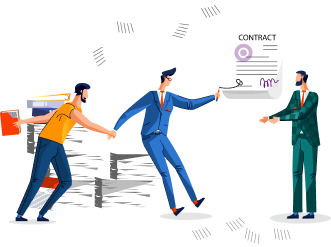
The New Era of Contract Management
See how AI streamlines your workflows, reduce manual effort, cut risk, and speed up approvals.
Future Trends: The Evolution of AI in Contract Management
Gaining insight into forthcoming developments within the contract lifecycle management (CLM) space can enable organizations to strategize a more nimble, intelligent, and risk-resistant approach to contracts.
The Growth of AI-Enabled Contract Management
Artificial intelligence is already changing the way in which contracts are created, reviewed, and analyzed. The future application of AI technology will be even more significant providing opportunities for organizations to:
- Automate Contract Drafting: AI can recommend clauses, agitate inconsistencies, and ensure compliance with corporate policies while reducing manual effort.
- Predict Risk and Performance: Machine learning models will leverage past contract data to predict future breaches, renegotiations, and supplier performance risk.
- Intelligent Summaries: AI will be able to summarize lengthy contracts into actionable items that outline obligations, timelines, and financial terms.
With AI integrated into the CLM process, organizations will make faster, data-powered decisions and minimize human error.
Smart Contracts and Blockchain Integration
Blockchain technology is changing the way that contracts execute. Smart contracts are self-executing agreements that live on a blockchain, and are likely to become a standard in the future of CLM. The advantages of blockchain-enabled contracts include:
- Automation of execution: Payment releases and service deliveries, among other activities, can happen automatically upon a contract condition being satisfied.
- Increased security: Blockchain guarantees tamperproof records, which reduces fraudulent conduct and builds trust among contract parties.
- Transparent audit trails: Each change, and execution, displays on the blockchain, which allows for easy audits and regulatory compliance.
Smart contracts will provide organizations with efficiencies and no longer depend on manual action to enforce.
End-to-End Automation and Autonomous CLM
Contract management automation is evolving beyond simply routing workflows and using templates. The future is autonomous CLM systems that can manage an entire lifecycle with high levels of minimal human engagement. Examples of autonomous CLM traits include:
Automatic drafting, review, and even approval of contracts based on pre-set business rules.
Real time notifications of obligations, renewals or changes in the regulatory environment.
Intelligent interactions with enterprise systems such as CRM, ERP or Procurement systems.
Autonomous CLM will dramatically decrease turnaround times, diminish bottlenecks, and allow legal and procurement teams to focus on more meaningful strategic activities.
Predictive Analytics and Data-Driven Decision Making
Contracts serve as important sources of business intelligence, and predictive analytics will help expand that potential in the future. CLM platforms will:
Analyze performance trends of contracts, supplier reliability, and customer behavior
Assess risk of potential breach or non-compliance before it occurs
Suggest negotiations strategies based on historical data
When contracts are transformed into insights and actions, organizations can proactively manage risk, optimize contracts, circumvent negotiations, and improve organizational performance.
Conversational and AI-assisted contracting
The next generation of CLM tools will utilize conversational AI and may even leverage the use of chatbots more frequently in the contracting experience, particularly to enhance the ease of use. Future state examples include:
- Natural Language Queries: Stakeholders could ask questions like “What contracts are expiring in the next quarter?” or “Show me all agreements that have non-standard clauses.”
- AI Tools: AI tools can provide optimal terms for contracts, recommend features that represent risk for negotiation, and provide suggestions during negotiations.
- Voice Features: Stakeholders could interact with contracts using voice commands to complete complex workflows.
All of these will enhance the user experience while reducing the time spent on training and accelerating the life cycle of the contracting process.
Integration with Enterprise Ecosystems
In the future, CLM systems will be integrated with additional enterprise systems, and this should become commonplace. Organizations will need seamless flow of key data and integrations to make better business judgements and decisions. Anticipated integrations are:
- Customer Relationship Management (CRM): Connecting customer contracts to the deal terms and customer relationships.
- Enterprise Resource Planning (ERP): Connecting contracts to purchasing, finance, and inventory.
- Compliance and Risk Management Tools: Automate reviews of the regulatory compliance check and the risk assessments taking place across the entire organization.
Organizations need to view this as: proactive contract management is not a solely legal function, but it is integrated in everything we do as a company.
Security and Enhanced Compliance with Regulations
As the enterprise is moving to a greater level of digitization with more sensitive information, security and compliance will remain at the forefront of issues.
Anticipated trends in CLM:
- More Encryption and Access Controls: Supporting contract security from unauthorized access and cyber threats.
- Regulatory Monitoring: Global and local regulatory changes, artificial intelligence systems will monitor and flag contracts for review.
- Audit-Ready Records: Inserting a degree of tracking approvals, revisions, and histories of execution will ease audits from organizations needing to fulfil compliance audit requirements.
These enhanced levels of security will provide comfort and confidence for executives and the larger organization to move forward with managing the role of many evolving regulatory standards.
User-Centric Interfaces and Mobility
The user experience will also end up being a major differentiator for CLM solutions.
The future platforms will have:
Intuitive dashboards with visual analytics and contract metrics in real-time.
Mobile capabilities so stakeholders can review, approve or reference the status of contracts from anywhere.
Customizable workflows according to differing teams and business units.
The focus on usability and mobility signifies that contract management will become efficient, accessible, and more relevant to the current work environment.
Sustainability and Ethical Governance
Sustainability and ethical governance is becoming increasingly normalized within business operations.
The CLM solutions of the near future will help with:
- Sustainable Supplier Management: Tracking and reporting on suppliers’ compliance with environmental and social standards.
- Digital Contracting: Reducing reliance on paper contracts to support environmentally sustainable practice. Sustainability is becoming another equation. When organizations introduce sustainability into contracting, they expand contract management to contribute to their overall corporate responsibility goals and commitments.
- Utilizing machine learning: The platforms will use previous contracts and inform a level of accuracy and recommendations.
Analyze patterns in negotiations, compliance, or performance to continuously improve processes.
Conclusion
The convergence of AI and automation in contract lifecycle management indicates an inflection point for organizations globally. The slow, manual process has transformed into an intelligent, agile system for driving compliance, insights, and growth.
By automating repetitive workflows and applying AI to analyze contracts in greater depth, organizations will achieve efficiencies, lower risks, and faster data-driven decision making.
Contracts are no longer static frameworks in a world that is digital-first; they are live repositories of business intelligence. An investment in AI-enabled CLM today provides the organization with the agility, the accuracy, and the intelligence to cultivate a leadership position in tomorrow’s marketplace.

Future Ready CLM Starts Here
Discover a faster, smarter, and more compliant way to manage every contract from start to finish.
Table of Contents
FAQs
How is AI changing the way contracts are drafted?
How does AI help during contract negotiation?
Can AI improve contract review accuracy?
How do AI powered clause libraries support standardization?
Is AI powered CLM secure for sensitive contract data?
How do AI powered insights help business teams?
What future advancements can we expect in AI driven CLM?
Features
Contact Us

©
SutiSoft, Inc. All Rights Reserved