The business world is constantly evolving, changing, and growing. Every year, employees are hired, promoted, and some are let go. Laws are also in a constant state of change. All these factors put increasing pressure on Human Resources teams to maintain accuracy while managing the growing complexity of the workforce. Some organizations must keep up with multi-state employment laws, while all need to understand and comply with evolving data privacy regulations. There are also often deeply integrated payroll and benefits systems that leave little margin for error. At the same time, HR leaders are expected to deliver clean reporting, audit readiness, and strategic workforce insights. All of this is often done with lean teams and limited resources.
Many organizations still rely on employee record-keeping practices that are scattered across spreadsheets, email threads, payroll platforms, benefits portals, and legacy HR tools. When employee data is stored across multiple systems, inconsistencies are often the norm. A job title updated in one system but not another can trigger payroll discrepancies. A missed termination update can lead to benefit overpayments. Outdated personal information can create compliance violations during audits. Over time, these gaps do more than slow down HR teams. They can, and often do, introduce financial risk and legal exposure, and erode employee trust.
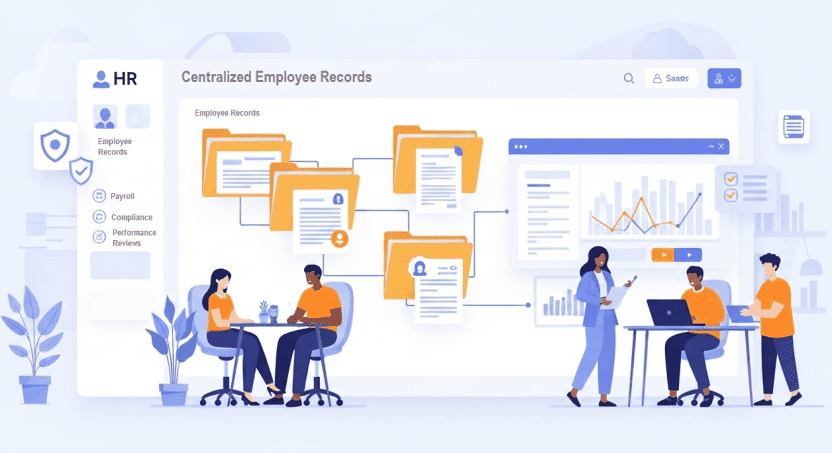
Centralized employee records address this challenge by creating a single source of truth. Core HR software creates a single authoritative system in which employee information is entered once, controlled consistently, and securely shared across connected systems.
This approach forms the foundation of modern HR operations and is a core principle explored in Core HR software and HRIS platforms designed to support compliance, accuracy, and long-term scalability.

Simplify Compliance with Centralized HR Data
Struggling with disconnected employee records and manual compliance tracking? SutiHR centralizes employee data, automates workflows, and strengthens audit readiness—all on a single platform.
Key Takeaways
- Fragmented employee records increase compliance risk and audit exposure
- A single source of truth improves payroll accuracy and benefits administration
- Centralized data strengthens security, governance, and access control
- Clean employee records enable reliable reporting and workforce analytics
- Centralization is critical for scaling HR operations without added risk
What a “Single Source of Truth” Means in Core HR
A single source of truth goes beyond simply combining employee data into a single database. In a Core HR environment, it is a reliable system for creating, updating, validating, and controlling employee information throughout the employment lifecycle.
This includes personal and demographic information, job titles and reporting relationships, compensation history, employment status, compliance documentation, certifications, and performance records. Every lifecycle event, from hire, promotion, transfer, leave, to termination or retirement, updates the same underlying employee record.
Rather than duplicating information across systems, Core HR Software platforms automatically push data to payroll, benefits, time-tracking, and analytics tools. This ensures that downstream systems are always working with the most up-to-date information. As a result, organizations reduce errors, completely remove the need to manually update multiple systems, and gain confidence that HR operations are aligned across the employee lifecycle.
The Hidden Risks of Fragmented Employee Records
Fragmented employee records create a risk that quietly builds over time. While individual discrepancies may appear manageable, the true danger lies in how inconsistencies flow across compliance, payroll, reporting, and security functions. As organizations grow and regulatory oversight increases, these gaps evolve from administrative inconveniences into real business risks.
Key Takeaways
- Fragmentation weakens compliance posture and increases audit exposure
- Inconsistent data drives payroll and benefits errors
- Disconnected systems delay audits and undermine reporting confidence
- Multiple data sources expand security and privacy risk
Compliance Exposure
When employee records are incomplete or inconsistent, compliance becomes a game of catch-up instead of control. HR teams may struggle to demonstrate compliance with wage-and-hour laws, employee classification rules, leave entitlements, or record-retention requirements.
For example, inconsistent job classifications or work-location data can result in overtime violations or errors in applying state-specific employment laws. If policy acknowledgments or eligibility documentation are missing, audit readiness is further weakened. If there isn’t a single source of truth, the HR team may have to look in multiple different systems or filing cabinets to find the necessary documents for an audit, which can lead to human error and cause them to fail the audit. During regulatory reviews or legal disputes, fragmented records make it difficult to present a clear, defensible employment history.
Payroll and Benefits Errors
Payroll and benefits systems depend on accurate employee data. When updates are delayed or incomplete, errors occur quickly. Terminations that are not time-synced can result in benefit overpayments. If an employee has a child and the dependent isn’t synced to the benefit system, it could be weeks or even months before the discrepancy is noticed. This could lead to increased expenses for the employee if the dependent were added to the insurance plan. If an employee is promoted and the compensation changes are not reflected in the payroll system, this will result in incorrect pay.
Beyond financial reconciliation, these errors damage employee trust. Repeated payroll or benefits issues increase dissatisfaction and turnover while consuming HR and finance resources to correct preventable problems.
Audit and Reporting Delays
Audits require consistency, traceability, and documentation. Fragmented records force HR teams to manually reconcile data across systems, often under tight deadlines. This manual effort increases the likelihood of errors and incomplete submissions.
Leadership reporting also suffers. When headcount, turnover, or compensation reports vary across data sources, decision-makers lose confidence in HR insights. Instead of focusing on strategy, HR teams spend time validating numbers and explaining discrepancies.
Data Security Gaps
Each additional system that stores employee data increases the security risk. Inconsistent access controls and limited visibility into data changes make it difficult to track who accessed or modified sensitive information.
Fragmentation also complicates privacy compliance. Responding to employee data access or deletion requests becomes more complex when records are spread across multiple systems, increasing the risk of incomplete or non-compliant responses.
How Centralized Employee Records Strengthen Compliance
Centralized employee records transform compliance from a reactive, documentation-heavy responsibility into a proactive, system-enforced process. Rather than relying on manual checks or institutional knowledge, core HR platforms embed compliance controls directly into the processes that create, update, and govern employee data.
This system-driven approach reduces human error, standardizes enforcement across the organization, and provides continuous visibility into compliance. This is an essential capability in modern core HR systems that support regulated and multi-jurisdictional workforces.
Built-In Validation and Approval Rules
Centralized core HR systems enforce data standards at the point of entry. Required fields, standardized formats, and rule-based validations ensure employee records meet organizational and regulatory requirements before changes are finalized.
Compensation changes may require documented approval. Job classification updates can trigger validation against overtime eligibility rules. Location changes can automatically prompt jurisdiction-specific compliance checks. All of these controls are built into the system, so no one has to remember to manually check for compliance in these areas. These controls will prevent non-compliant data from entering the system and reduce downstream risk.
Approval workflows further strengthen governance by replacing informal approvals with structured, traceable review paths that reinforce accountability.
Automated Audit Trails
Audit readiness depends on visibility and traceability. Centralized employee records maintain detailed audit trails capturing who made changes, when they occurred, and what data was modified.
These system-generated logs eliminate the need to reconstruct timelines during audits or investigations. HR teams can demonstrate compliance with employment laws, internal policies, and regulatory requirements using defensible, time-stamped records that align with best practices outlined in core HR compliance frameworks.
The auditor will be able to follow the approval workflow, and the HR team will no longer have to follow the email trail and hope to find the beginning of the chain to provide to the auditor.
Centralized Policy and Documentation Management
All compliance documentation, policy acknowledgments, certifications, and regulatory notices must be accurate, accessible, and centrally located. Centralized Core HR platforms store these materials directly within employee records, link them to lifecycle events, and maintain version history.
Expiration tracking and renewal reminders ensure documentation remains current. During audits, HR teams access complete, organized compliance records from a single system rather than searching across emails or shared drives.

Reduce Audit Stress with Built-In Controls
With SutiHR, compliance is embedded into everyday HR workflows—complete with validation rules, audit trails, and centralized documentation.
Role-Based Access and Data Governance
Centralization increases the importance of access control and governance. Modern Core HR platforms apply role-based permissions that align system access with job responsibilities. This allows HR admins to restrict sensitive employee information and ensure it is visible and accessible only to authorized users. With role-based permissions, each role can have its own access rights, ranging from limited to full, depending on job duties and necessity.
HR teams maintain broad access for administration and compliance; managers see data related to their direct reports; payroll teams access compensation information; and employees securely manage their own records. As roles change, permissions update automatically, reducing manual oversight and minimizing security gaps.
Beyond access control, centralized systems support consistent data governance practices, including retention policies, classification standards, and privacy controls. These governance frameworks strengthen compliance with data protection regulations while preserving transparency and accountability across HR operations.
Centralized Data as the Foundation for HR Analytics
Reliable analytics require consistent data. Centralized employee records provide the clean, structured foundation needed for meaningful workforce reporting and strategic decision-making.
With a single source of truth, HR teams can confidently analyze headcount, turnover, compensation trends, tenure, and compliance metrics. Reports reflect real-time workforce conditions rather than conflicting data pulled from multiple systems.
Over time, centralized data enables more advanced analytics, including workforce forecasting, equity analysis, and trend identification. These insights support proactive workforce planning and align HR strategy with broader business goals, capabilities increasingly associated with mature Core HR platforms.
Why Centralization Becomes More Critical as Organizations Scale
As organizations grow, the complexity of employee data increases exponentially. New hires, new locations, evolving job structures, and expanding regulatory requirements all introduce additional risk when data is fragmented.
Centralized Core HR platforms provide the structure needed to maintain consistency as organizations scale across departments, states, or countries. Standardized workflows, automation, and location-based compliance rules allow HR teams to manage growth without a proportional increase in administrative burden.
For growing organizations, centralized employee records are not simply an efficiency improvement. They are a critical safeguard that enables sustainable growth, regulatory confidence, and long-term operational resilience.

Ready to move beyond spreadsheets and disconnected systems?
SutiHR provides a secure, centralized Core HR foundation that scales with your organization.
Conclusion
Centralized employee records are the backbone of compliant, efficient HR operations. A single source of truth eliminates inconsistencies, reduces risk, and enables automation across the employee lifecycle. More importantly, it establishes trust among HR and leadership, systems and data, and employers and employees.
For organizations navigating increasing regulatory complexity and workforce growth, centralized employee records are not optional. They are essential.
Frequently Asked Questions
A Core HR system should centralize all data related to the employee lifecycle, including personal and demographic information, job titles and reporting structures, compensation history, employment status, compliance documentation, certifications, performance records, and policy acknowledgments. Centralizing these records ensures consistency, reduces duplication, and supports accurate payroll, benefits administration, and compliance reporting.
Centralized employee records improve audit readiness by maintaining complete, time-stamped audit trails for every change made to an employee record. Instead of gathering documentation from multiple systems, HR teams can quickly access a single, organized source of truth that shows who made changes, when they occurred, and what approvals were applied. This significantly reduces audit preparation time and lowers compliance risk.
Yes. Centralized Core HR platforms are designed to support distributed and multi-state workforces by automatically applying location-based rules and compliance requirements. Employee records can reflect jurisdiction-specific regulations such as wage laws, leave entitlements, and record retention requirements while remaining part of a single, unified system.
Role-based access controls limit employee data visibility based on job responsibilities. HR administrators, managers, payroll teams, and employees each receive access appropriate to their role. Permissions update automatically as roles change, reducing the risk of unauthorized access and supporting compliance with privacy and data protection regulations.
No. While large organizations benefit significantly from centralization, small and mid-sized businesses often see the greatest impact. Centralized employee records reduce manual work, prevent costly errors, and establish scalable processes early. As organizations grow, having a single source of truth in place prevents operational complexity and compliance challenges from compounding.