
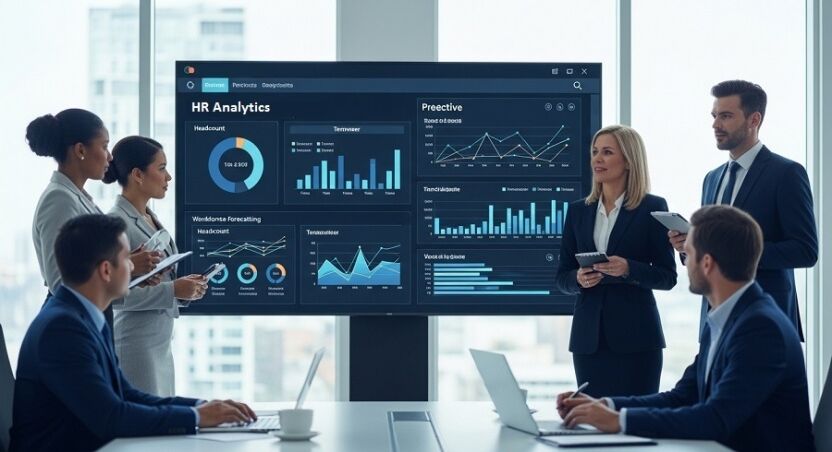
Most organizations believe they are using HR analytics because it enables them to generate dashboards, headcount reports, and turnover summaries. In practice, these activities represent only the earliest stage of analytics maturity. While they may seem useful, they provide limited strategic value.
The HR analytics maturity model explains how organizations evolve from retroactive reporting into predictive workforce intelligence that actively informs and guides leadership decisions. Each stage reflects not just more advanced analysis, but a fundamental shift in how workforce data is trusted, governed, and used to guide decisions.
Understanding this progression is critical. Without it, HR teams often invest in tools, dashboards, or metrics that fail to influence decisions, leaving analytics underutilized and credibility unchanged. This article builds on the foundation of modern HR & workforce analytics by detailing how analytics maturity develops, and what it takes to move beyond reporting toward foresight.
Key Takeaways
- HR analytics maturity progresses from descriptive reporting to predictive and prescriptive workforce intelligence
- Most organizations stall at early stages due to data quality issues, weak governance, or a lack of leadership adoption
- Predictive analytics enables proactive decisions around turnover, capacity, and skills before issues escalate
- Advancing maturity requires organizational alignment and decision ownership, not just better tools
The HR Analytics Maturity Model Is Composed of Interdependent Capability Layers
The HR analytics maturity model is not a linear journey toward more advanced reporting. It is a set of interdependent capability layers that enable organizations to convert workforce data into decision-ready insights. Full maturity requires progress across all layers, not just one.
The first layer is analytics capability, which defines what the organization can actually analyze. This starts with descriptive analytics that summarize past workforce data, moves to diagnostic analytics that explain why trends occur, then to predictive analytics that forecast future risks, and finally to prescriptive analytics that suggest actions. Each level builds on the previous one and relies on a strong analytical foundation to produce reliable results.
The second layer is the data foundation behind analytics. Reliable workforce insights require consistent data definitions, complete employee records, and accurate historical data across HR systems. Gaps in job structures, inconsistent turnover rules, or disconnected systems quickly undermine analytics efforts. Even the best analytics tools can’t deliver predictive insights without clean, well-governed data.
The third layer is decision integration, or whether analytics truly affects decisions. Less mature organizations look at data after the fact, using it to justify what already happened. More mature organizations use analytics upfront—during planning, hiring, performance reviews, and budgeting. Analytics matters only when it informs action, not when it explains results later.
The fourth layer is organizational enablement and governance, which ensures insights lead to accountability. This includes clear ownership of workforce metrics, leadership expectations for data-backed decisions, managers who can interpret insights, and regular review cycles. Without governance and accountability, even advanced analytics remains something organizations observe rather than use to drive action.
Together, these layers create a holistic maturity model. Many organizations advance unevenly, with strong tools but weak adoption, or solid data but limited leadership involvement. True HR analytics maturity occurs only when analytics capability, data quality, decision integration, and governance reinforce one another, so that insights drive decisions, not just reports.

Need an Affordable HR Solution for Your Business?
SutiHR offers scalable tools designed for growing companies.
Descriptive Analytics Provides Workforce Visibility but Offers Limited Insight
Descriptive analytics forms the foundation of workforce measurement by providing visibility into historical data and core HR metrics. It answers basic questions about headcount, turnover, absenteeism, and workforce composition by summarizing what has already occurred. While essential for establishing transparency and consistency, descriptive analytics offers limited explanatory power on its own, highlighting trends without revealing underlying causes or informing future decisions.
Typical outputs include:
Headcount and demographic reports
Example: A monthly report showing total headcount by department, location, and employment type, used primarily for leadership updates or compliance audits.
Turnover and retention summaries
Example: An annual turnover percentage reported at the company level without segmentation by role, tenure, or manager.
Time-to-hire and requisition volume
Example: Average time-to-fill reported across all roles, without distinguishing between high-impact roles and entry-level positions.
Compliance and audit reporting
Example: EEO or ACA reports generated annually to meet regulatory requirements, with no operational follow-up.
At this stage, analytics delivers awareness but rarely influences action. Leaders are kept informed about what is happening, but not why it happened or how to prevent it from recurring. However, diagnostic analytics is the next form of analytics, frequently used alongside descriptive analytics, and it provides insights.
Diagnostic Analytics Explains Workforce Trends and Root Causes
Diagnostic analytics moves workforce reporting beyond surface-level trends by uncovering the underlying drivers behind outcomes. Rather than simply identifying what changed, it examines relationships between metrics, such as turnover, engagement, performance, and workload, to explain why those changes occurred. By isolating root causes and distinguishing correlation from coincidence, diagnostic analytics enable HR and business leaders to focus interventions where they will have the greatest impact, transforming data from descriptive summaries into actionable understanding.
Examples include:
Turnover analyzed by manager, role, tenure, or workload
Example: Identifying that voluntary turnover is highest among employees with 12–18 months of tenure under a specific manager, suggesting issues with onboarding or leadership.
Performance outcomes correlated with training or onboarding quality
Example: Discovering that employees who completed role-specific training within their first 30 days consistently receive higher performance ratings after six months.
Absenteeism patterns are examined alongside scheduling or engagement data
Example: Finding higher absenteeism rates in teams with mandatory overtime or rotating schedules, indicating burnout risk.
Diagnostic analytics enables HR to move conversations from speculation (“people just don’t want to work”) to evidence-based discussions of workforce drivers. These more informed conversations allow business leaders to understand the root causes of some workforce issues they may be facing and strategically develop action plans to eliminate the barriers.

Want to experience seamless HR management?
Schedule a personalized demo and see how SutiHR can help streamline recruitment, payroll, benefits, and employee engagement—all in one platform.
Predictive Analytics Enables Proactive Workforce Intelligence
Predictive analytics uses historical data patterns to forecast what is likely to happen next. So basically, the HR leader will take a subset of data for a specific moment in time, for example, five years, and they will use the data that they have to forecast or make an educated guess as to what will happen in the future.
Common use cases include:
Identifying employees or roles with elevated turnover risk
Example: A predictive model flags high-performing employees in critical roles who have stalled compensation growth and increased absenteeism—indicating increased flight risk.
Forecasting staffing shortages or excess capacity
Example: Using historical attrition and hiring velocity to predict that a customer support team will be understaffed within 90 days if no hiring action is taken.
Anticipating performance decline or burnout indicators
Example: Detecting that employees with sustained overtime and declining engagement scores are statistically likely to see performance drops within the next quarter.
Modeling workforce demand under growth scenarios
Example: Estimating how many additional sales or operations hires will be required to support a 20% revenue increase without degrading service levels.
At this stage, HR analytics shift from reporting outcomes to shaping them.
Prescriptive Analytics Connects Insight Directly to Action
Prescriptive analytics represents the point at which workforce insight becomes operational guidance rather than retrospective analysis. Instead of merely explaining what happened or predicting what may occur, prescriptive analytics evaluates multiple scenarios and recommends concrete actions to optimize outcomes. By embedding decision logic, thresholds, and trade-off analysis into analytics models, organizations can move from informed interpretation to consistent, data-driven action, essentially closing the gap between insight and execution.
Examples include:
Evaluating which retention levers reduce turnover risk most effectively
Example: Modeling whether compensation adjustments, manager training, or workload redistribution would most reduce turnover risk for a high-risk population.
Comparing cost, capacity, and performance trade-offs
Example: Assessing whether hiring additional staff or redistributing workloads would be more cost-effective for reducing overtime-related burnout.
Prioritizing interventions by impact and feasibility
Example: Ranking proposed workforce initiatives by expected ROI, implementation effort, and operational disruption to guide leadership investment decisions.
Prescriptive analytics only succeeds when organizations are prepared to act. Without accountability and decision ownership, recommendations remain theoretical.
Organizational Barriers Commonly Stall Analytics Maturity
Organizational barriers are the most common reasons HR analytics initiatives fail to mature. Even when dashboards, metrics, and reporting capabilities are in place, progress stalls if the organization lacks the structure, ownership, and behaviors needed to translate insights into action. Competing priorities, unclear accountability, limited analytical capability at the manager level, and weak governance models all create friction that prevents analytics from advancing beyond basic reporting. As a result, many organizations invest in analytics infrastructure but never fully operate it as a decision-making discipline.
Common barriers include:
Inconsistent data definitions across systems
Example: “Turnover” is calculated differently in HRIS, payroll, and finance reports, leading to disputes over which number is correct.
Poor data hygiene that undermines trust
Example: Incomplete job titles or missing manager assignments prevent reliable segmentation and trend analysis.
Analytics owned by HR but ignored by leadership
Example: Dashboards are produced monthly but rarely referenced in executive meetings or planning discussions.
Dashboards disconnected from real decisions
Example: Metrics are reviewed after hiring plans or budget decisions have already been finalized.
These barriers prevent analytics from progressing beyond reporting, regardless of platform capability.
Advancing from Reporting to Predictive Workforce Intelligence
Advancing from basic reporting to predictive workforce intelligence is less about radical transformation and more about disciplined execution. Organizations that successfully mature their analytics capabilities build progressively stronger data foundations, clarify ownership, and embed insights into existing decision processes. By prioritizing adoption, governance, and repeatable use over ambitious but disconnected initiatives, they turn workforce analytics into a practical, forward-looking capability that consistently informs planning and risk management.
Key enablers include:
Aligning metrics to specific workforce decisions
Example: Defining which metrics inform hiring plans, retention strategies, or succession decisions—and reviewing them before decisions are made.
Strengthening longitudinal data quality and governance
Example: Standardizing job families and manager assignments to enable year-over-year analysis.
Embedding analytics into leadership and manager routines
Example: Reviewing workforce risk dashboards as part of quarterly business reviews rather than ad hoc HR meetings.
Starting with focused predictive use cases
Example: Piloting a turnover risk model for a single critical function before expanding across the organization.
Each step reinforces confidence in analytics and increases its influence on decisions.

Ready to Revolutionize Your HR Strategy?
Explore SutiHR’s AI-powered tools and start transforming your HR processes today.
Conclusion
The HR analytics maturity model clarifies how workforce data evolves from static reporting into predictive workforce intelligence that shapes outcomes.
Organizations that remain at early stages gain visibility but little influence. Those that advance toward predictive and prescriptive analytics gain the ability to anticipate risk, allocate resources intentionally, and guide leadership decisions with evidence.
True maturity is not defined by dashboards or algorithms; it is defined by whether insight consistently informs action. When analytics changes the way decisions are made, HR moves from reporting on the workforce to leading it.
Frequently Asked Questions
The HR analytics maturity model describes how organizations progress from descriptive reporting to diagnostic, predictive, and prescriptive workforce intelligence.
Predictive analytics allows organizations to anticipate workforce risks such as turnover, burnout, and capacity gaps before they impact performance.
Yes. Predictive analytics can be implemented incrementally and is driven by data quality and focus rather than organizational size.
Predictive analytics forecasts likely outcomes. Prescriptive analytics recommends actions to improve those outcomes.
Analytics maturity develops incrementally as data quality, leadership trust, and governance improve.


