
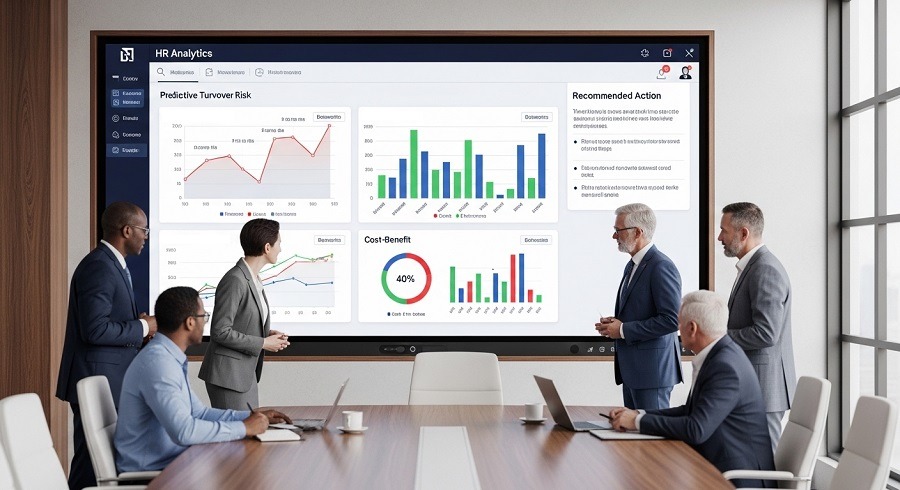
When it comes to HR data and analytics, most organizations stop at reporting workforce trends. Some organizations are using predictive models to forecast turnover or staffing shortages. However, few organizations will operationalize the final stage of analytics maturity: prescriptive HR analytics.
Prescriptive analytics doesn’t simply explain what happened or forecast what may happen; it answers the question that is essential to the leadership team:
What should we do next?
When prescriptive HR analytics is used effectively, it will transform workforce data into prioritized, evidence-based recommendations. These recommendations will guide hiring, retention, workforce planning, and investment decisions. Prescriptive analytics closes the gap between analytics and execution, ensuring that insights lead to measurable impact.
This article explores how prescriptive workforce analytics works, its core components, practical use cases, organizational requirements, and why it represents a competitive advantage for modern HR functions.
Key Takeaways
- Prescriptive HR analytics recommends specific actions to optimize workforce outcomes
- It builds on predictive analytics by evaluating intervention trade-offs
- Effective prescriptive models balance impact, cost, and operational feasibility
- Governance and decision ownership determine success
- Organizations that operationalize prescriptive analytics transform HR into a strategic decision engine
Prescriptive HR Analytics Represents the Highest Level of Workforce Intelligence
Prescriptive HR analytics is the most advanced stage of workforce analytics maturity. It is the point where the workforce data collected becomes more than just numbers. It becomes structured decision-making guidance rather than retrospective insight.
Across the analytics progression:
- Descriptive analytics explains what happened
- Diagnostic analytics explains why it happened
- Predictive analytics forecasts what is likely to happen
- Prescriptive analytics determines what action should be taken to influence the outcome
Prescriptive analytics builds on the earlier stages; however, it shifts the end result. Instead of surfacing risk probabilities, it evaluates possible responses and recommends the course of action that maximizes organizational outcomes while managing cost and risk.
For example, a predictive model may identify that high-performing engineers have a 70% likelihood of voluntary turnover within six months. Prescriptive analytics evaluates:
- Which intervention is most effective
- The projected cost of each option
- The expected reduction in turnover probability
- The operational impact of implementation
The output of prescriptive analytics is not a warning. It provides leadership with a prioritized recommendation supported by quantified trade-offs.
At this level of maturity, analytics transitions from awareness to execution. Workforce decisions are guided by modeled outcomes rather than intuition.

Need an Affordable HR Solution for Your Business?
SutiHR offers scalable tools designed for growing companies.
How Prescriptive Analytics Builds on Predictive Insight
Prescriptive analytics depends on the foundation uncovered by predictive analytics. Predictive models uncover and quantify risk exposure, while prescriptive models determine how to respond to reduce or eliminate it.
Predictive analytics answers:
What is likely to happen?
Prescriptive analytics answers:
Given that risk, which action produces the best outcome?
Predictive insight provides the trigger. Prescriptive modeling evaluates alternatives.
For example:
- A predictive model identifies employees with an elevated probability of turnover.
- It segments risk by tenure, compensation growth, performance rating, and engagement signals.
Prescriptive analytics then compares intervention strategies such as:
- Compensation adjustment
- Manager coaching
- Workload redistribution
- Internal mobility
- Career path acceleration
It measures:
- Expected risk reduction
- Financial cost
- Productivity impact
- Scalability across similar employee groups
The result is a structured recommendation, not a risk notification.
This transition marks the difference between identifying vulnerability and optimizing response. It embeds disciplined reasoning into workforce planning and ensures high-impact decisions are guided by modeled outcomes.
Core Components of Prescriptive Workforce Analytics
Prescriptive workforce analytics operates through a structured framework. There are four components that typically work together to convert predictive signals into operational guidance.
Key Takeaways
- Scenario modeling simulates possible futures
- Impact estimation quantifies intervention effectiveness
- Cost-benefit optimization prioritizes financially sound action
- Decision thresholds ensure consistent execution
1. Scenario Modeling
Scenario modeling evaluates the many “what-if” possibilities before action is taken. It forecasts the downstream impact of workforce shifts using historical behavior, cost data, and performance baselines.
Example: If voluntary turnover rises by 5% in a critical department:
- What are the projected replacement costs?
- How will staffing gaps affect output?
- Will overtime increase?
- What is the impact on revenue?
This capability allows leadership to think critically and test alternatives before a disruption occurs.
2. Impact Estimation
Impact estimation is the measurement of how much a specific intervention will change the projected outcomes.
Example: A 7% compensation increase for high-risk engineers may reduce the probability of turnover by 40%, compared to 18% from one-time bonuses.
Impact modeling may also estimate:
- Engagement improvement
- Productivity stabilization
- Hiring cycle reduction
- Knowledge retention
This prevents the organization from implementing broad, expensive interventions that will have minimal measurable returns.
3. Cost-Benefit Optimization
Cost-benefit optimization ensures the recommendations are financially responsible. It takes into account which actions will generate the highest net benefit relative to cost.
Example: Hiring five additional support staff may cost less over twelve months than sustained overtime and burnout-driven attrition.
This transforms workforce decisions from reactive expense management into strategic capital allocation.
4. Decision Rules and Thresholds
Prescriptive logic is put into practice through decision rules. The established rules will automatically trigger action when predefined risk levels are reached.
Example: If the turnover probability exceeds 65% among high-performing employees, initiate a retention review within 30 days.
Additional triggers may include:
- Overtime exceeding 12% of total labor hours
- Engagement decline of 8% quarter-over-quarter
- Succession coverage falling below readiness thresholds
By establishing thresholds, organizations can reduce inconsistency and ensure that risk conditions are addressed systematically.

Want to experience seamless HR management?
Schedule a personalized demo and see how SutiHR can help streamline recruitment, payroll, benefits, and employee engagement—all in one platform.
Practical Use Cases for Prescriptive HR Analytics
Prescriptive analytics delivers the greatest value when embedded directly into workforce decisions. It functions as a structured decision-support system across critical strategic areas.
Retention Strategy Optimization
Rather than applying broad compensation increases, prescriptive analytics determines:
- Which employees require intervention
- Which intervention delivers the highest ROI
- When action should occur
This improves retention precision while controlling labor cost escalation.
Workforce Capacity Planning
Prescriptive models evaluate whether to:
- Hire
- Outsource
- Redistribute workload
- Redesign roles
Each option is assessed for cost, service impact, and operational sustainability.
Burnout Risk Mitigation
When predictive signals identify burnout risk, prescriptive models recommend:
- Staffing adjustments
- Schedule modifications
- Manager intervention
Action occurs before performance decline or voluntary exit.
Succession and Skills Planning
Prescriptive analytics evaluates:
- Which roles require immediate succession action
- Whether internal development or external hiring is optimal
- Where training investment produces measurable ROI
This ensures leadership continuity and reduces capability gaps.
The Difference Between Insight and Action
Many organizations generate dashboards yet struggle to convert insight into consistent action. Risks are discussed, but nothing is done to reduce or eliminate the risk.
Insight increases awareness.
Action changes outcomes.
Prescriptive analytics bridges this gap by:
- Embedding recommendations into dashboards
- Linking metrics to defined decisions
- Assigning ownership for the response
- Establishing execution thresholds
Without accountability, even advanced models remain theoretical.
Organizations that close the insight-action gap create closed-loop systems where workforce data continuously informs, triggers, and evaluates decision outcomes.
Organizational Requirements for Prescriptive HR Analytics
Prescriptive capability requires more than modeling tools. It depends on organizational discipline.
1. Clean, Governed Data
Consistent definitions, standardized job structures, and integrated systems are foundational. Without data integrity, recommendations lack credibility.
2. Clear Decision Ownership
Every key metric must have a defined owner, review cadence, and response protocol.
3. Leadership Alignment
Executives must expect data-backed decision-making and model it consistently.
4. Manager Enablement
Managers must understand recommendations, context, and expected actions.
Technology enables prescriptive analytics; however, human action makes it effective.
Common Pitfalls
Organizations often stall by:
- Attempting advanced modeling before fixing data quality
- Overcomplicating initial use cases
- Failing to pilot within high-impact functions
- Treating recommendations as optional
The most successful organizations begin with focused use cases and scale gradually.
How Technology Enables Prescriptive Capability
Modern HR analytics platform support prescriptive functionality by:
- Centralizing workforce data
- Delivering real-time dashboards
- Supporting predictive modeling
- Embedding recommendations within workflows
- Allowing scenario simulation before decisions are finalized
When analytics is integrated into recruitment, compensation, performance management, and workforce planning systems, the gap between insight and execution is reduced.
Why Prescriptive HR Analytics Is a Competitive Advantage
Organizations that rely on reporting react after a disruption has occurred. However, organizations that leverage predictive analytics can often anticipate the risk. Furthermore, any organization that uses prescriptive analytics can shape outcomes.
They:
- Allocate talent strategically
- Protect high-value employees
- Control labor cost escalation
- Improve performance stability
- Make defensible, data-backed workforce decisions
In competitive labor markets, the ability to evaluate trade-offs before acting is a measurable advantage.

Ready to Revolutionize Your HR Strategy?
Explore SutiHR’s AI-powered tools and start transforming your HR processes today.
Conclusion
Prescriptive HR analytics represents the transition from insight to execution.
It moves beyond visibility and forecasting to provide structured recommendations that guide workforce decisions. Organizations that mature to this stage do not simply monitor trends; they optimize them.
When embedded into governance, leadership routines, and management workflows, prescriptive analytics transforms HR from a reporting function into a strategic performance engine.
That is the difference between analytics capability and workforce intelligence.
Frequently Asked Questions
Prescriptive HR analytics uses workforce data, predictive modeling, and optimization logic to recommend specific actions that improve outcomes. Unlike descriptive or predictive analytics, it does not stop at identifying trends or forecasting risk; it provides structured, data-backed guidance on what organizations should do next.
Predictive analytics forecasts what is likely to happen based on historical patterns. Prescriptive analytics goes further by evaluating multiple response options and recommending the action that produces the best outcome while balancing cost, risk, and operational impact.
Prescriptive analytics is most effective for high-impact workforce decisions such as retention strategy, workforce capacity planning, compensation adjustments, succession planning, and burnout mitigation. These decisions involve trade-offs where structured modeling can significantly reduce financial and operational risk.
Not necessarily. While advanced AI can enhance modeling precision, many prescriptive use cases begin with structured decision rules, scenario modeling, and segmented intervention analysis. The key requirement is reliable data and disciplined governance, not necessarily complex AI infrastructure.
The most common barrier is organizational, not technical. Lack of data governance, unclear decision ownership, and leadership reluctance to act on recommendations often prevent prescriptive analytics from delivering value. Successful adoption depends on embedding analytics into decision processes and accountability frameworks.