Managing a workforce across multiple locations is a fundamentally different operational challenge than managing a single site. What works at one location, a shared spreadsheet, a familiar scheduling routine, and a manager who knows every employee by name, does not scale. As organizations add stores, facilities, offices, or service locations, the labor management complexity compounds: more schedules to build, more payroll feeds to reconcile, more compliance jurisdictions to track, and more distance between senior leadership and the day-to-day labor decisions that determine whether the business operates efficiently or bleeds cost.
For multi-location enterprises, workforce management software is not a productivity enhancement; it is a necessity. Without a centralized platform, labor data fragments across locations, compliance exposure grows silently, and leadership makes decisions based on lagging reports rather than real-time visibility. The organizations that scale successfully are those that implement workforce management infrastructure before the operational cost of fragmentation becomes apparent.
This guide covers the specific workforce management challenges that emerge at scale, the platform capabilities that address them, and how multi-location enterprises should approach evaluation and implementation. For a broader understanding, refer to our workforce management software guide.
Key Takeaways
- Multi-location workforce management requires centralized visibility, per-location compliance configuration, and consolidated labor cost reporting capabilities that single-site tools cannot provide.
- Compliance complexity multiplies with location count. Each state, city, or country where an organization operates may have distinct wage laws, overtime rules, scheduling regulations, and leave requirements.
- Labor cost control at scale depends on real-time data flowing from every location into a single reporting structure, not end-of-period manual consolidation.
- Employee cross-coverage between locations requires time tracking and scheduling infrastructure that follows the employee, not the site.
- Workforce management platforms built for enterprise scale support role-based access, multi-location organizational hierarchies, and the integration architecture needed to connect with payroll, HRIS, and ERP systems across a distributed organization.
Why Multi-Location Workforce Management Requires a Different Approach
The challenges that define multi-location workforce management are not simply larger versions of single-site problems. They are structurally different, and they require purpose-built solutions.
Fragmented Labor Visibility
In a single-location business, a manager or HR administrator can observe operations firsthand and access all labor data from a single system. In a multi-location enterprise, labor data exists at each site in scheduling tools, punch clocks, paper timesheets, or location-specific software. This siloed data collection must be aggregated manually before leadership can see a complete picture. By the time that picture is assembled, it is already out of date.
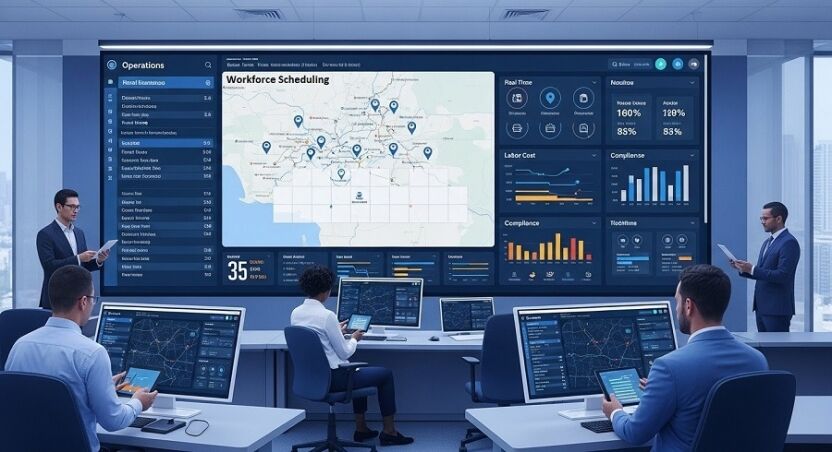
Multi-location WFM platforms centralize data from every location into a single dashboard that updates in real time, giving district managers, regional directors, and executive leadership the labor visibility they need to act on current information rather than last week’s reports.
Multi-Jurisdiction Compliance Complexity
A retailer operating stores in California, New York, Illinois, and Washington faces four different sets of wage laws, overtime rules, meal and rest period requirements, and in several cities within those states, predictive scheduling laws with their own distinct provisions will also apply.
A healthcare system operating hospitals in multiple states must manage FLSA compliance, state-specific nursing ratio requirements, and potentially multiple union contracts simultaneously.
A logistics company with distribution centers across the country must track varying minimum wage rates, overtime thresholds, and leave entitlements by location.
Manual compliance management across this landscape is not just burdensome, it is unreliable and costly. Multi-location WFM software addresses this by allowing compliance rules to be configured independently at the location level. This provides the necessary flexibility, so each site automatically enforces the regulations applicable to its jurisdiction without requiring managers to manually track rule variations.
Labor Cost Reporting Without Consolidation
Controlling labor costs across multiple locations requires the ability to compare performance across sites, identify outliers, and understand the drivers of cost differences. This analysis is impossible when each location maintains its own records in disconnected systems. The manual consolidation process of pulling reports from each site, normalizing the data, and building a multi-location view is time-consuming and produces a snapshot that is already outdated by the time it reaches leadership. Centralized WFM reporting generates multi-location labor cost analyses in real time, enabling continuous performance management that drives cost discipline at scale.
Cross-Location Employee Movement
Multi-location enterprises frequently share employees between sites. For instance, a retail associate may cover multiple stores, a nurse may work shifts at different facilities within a health system, and a technician may service customers across a regional territory. When time tracking is location-specific rather than employee-centric, these workers generate fragmented time records that are difficult to consolidate for payroll, manage for overtime compliance, and schedule efficiently without manual coordination. Enterprise WFM platforms track employees, not just locations, ensuring complete time records and accurate overtime calculations regardless of how many sites they work across.
Manager Access and Accountability at Scale
Delegating scheduling and labor management decisions to location-level managers is operationally necessary in a distributed enterprise. But delegation without visibility creates accountability gaps. If a store manager consistently overschedules on high-traffic days, a district manager with no real-time labor data has no basis for intervention until the payroll impact appears. Multi-location WFM platforms support role-based access structures that give each manager the data and tools they need for their location while providing higher-level leaders with oversight visibility across all sites within their scope.

Need an Affordable HR Solution for Your Business?
SutiHR offers scalable tools designed for growing companies.
Single-Location vs. Multi-Location Workforce Management: Key Differences
| Labor Management Challenge | Single-Location Approach | Multi-Location WFM Requirement |
|---|---|---|
| Schedule visibility | Manager reviews one location | Centralized dashboard across all sites |
| Compliance rules | One jurisdiction to manage | Per-location rule configuration by state/city |
| Payroll data flow | Single payroll feed | Consolidated multi-site payroll integration |
| Labor cost reporting | One P&L view | Location, district, and enterprise roll-up |
| Employee cross-coverage | Not applicable | Cross-site scheduling and time capture |
| Manager oversight | Direct daily visibility | Role-based access with escalation controls |
| Overtime control | Single-site thresholds | Per-employee tracking across all locations |
| Audit documentation | Single record set | Jurisdiction-specific records by location |
Core Workforce Management Capabilities for Multi-Location Enterprises
The following capabilities are the foundation of an enterprise workforce management platform. Each addresses a specific gap that emerges when organizations scale beyond a single location.
1. Centralized Multi-Site Scheduling
Enterprise scheduling platforms allow district managers and regional operations leaders to view, compare, and manage schedules across all locations within their portfolio from a single interface. Individual store or site managers retain control over their own schedules within defined parameters. These parameters often include labor budget limits, minimum coverage thresholds, and compliance constraints. Meanwhile, leadership maintains oversight without being operationally involved in each location’s day-to-day scheduling decisions. Centralized scheduling also enables rapid response to coverage emergencies: when a location is short-staffed, a manager can broadcast an open shift to employees across nearby sites rather than making individual phone calls.
2. Per-Location Compliance Configuration
A purpose-built multi-location WFM platform allows compliance rules to be configured at the individual location level or at the jurisdiction level, which automatically apply to all locations within that jurisdiction. Minimum wage rates, overtime thresholds, meal and rest period requirements, predictive scheduling rules, and leave entitlements are each configured according to the applicable law for each site. When laws change, the platform update is automatically pushed out to all affected locations, rather than requiring manual rule adjustments by location managers who may not be aware of the legislative change.
3. Enterprise Labor Cost Reporting
Multi-location labor cost reporting in enterprise WFM platforms operates across three levels: the individual location, the district or regional grouping, and the enterprise as a whole. Each level of the hierarchy provides the reporting granularity appropriate to its decision-making scope. A store manager compares their location’s labor costs against budget, a district manager compares labor performance across 10 stores, and a VP of Operations reviews regional variance and enterprise-wide overtime trends. All this analysis flows from the same underlying data source, ensuring consistency and eliminating the reconciliation effort required by manual consolidation.
4. Consolidated Payroll Integration
For multi-location enterprises processing payroll for thousands of employees across dozens of locations, the payroll integration architecture of a WFM platform is a critical evaluation criterion. The platform must be able to pass validated time-and-attendance data from every location into the payroll system via a consolidated feed. This data must be differentiated by location, department, and employee classification, without requiring location-by-location manual export and import. Bidirectional integrations that pull pay rate changes and employee record updates from payroll back into the systems ensure both systems stay synchronized without manual maintenance.
5. Cross-Location Time Tracking and Overtime Management
Employee-centric time tracking is the foundation of cross-location workforce management. When an employee works at multiple locations within a pay period, the WFM platform gathers their hours across all sites and applies the correct overtime calculation based on the employee’s classification and the jurisdiction governing their employment. This is particularly important in healthcare and retail environments, where cross-site coverage is routine, and overtime violations are among the most common sources of wage-claim exposure.
6. Role-Based Access and Organizational Hierarchy
Enterprise WFM platforms support a multi-level organizational pecking order that mirrors the business structure: locations roll up to districts, districts roll up to regions, and regions roll up to the enterprise. Each level of the ladder has a corresponding access role with the data visibility and editing permissions appropriate to that scope.
A store manager sees only their location’s data. A district manager sees all locations in their district. An HR compliance officer sees all locations enterprise-wide for audit and compliance purposes. This structure ensures that the right people have access to the right data without exposing sensitive organizational information beyond its appropriate scope.
7. Mobile Workforce Management Tools
Multi-location enterprises frequently have operations managers, district managers, and field-based HR staff who need to access workforce data on the move. Mobile Workforce Management applications that provide full scheduling, time tracking, and reporting functionality, not just a simplified view of desktop features, allow distributed management teams to make informed labor decisions from any location. For employees, mobile clock-in with geofencing ensures accurate time records, regardless of the location where they work on a given day.
Managing Multi-Jurisdiction Compliance at Scale
Compliance is the most acute risk management challenge for multi-location enterprises, and the one where the gap between manual processes and automated controls is most significant. These are the specific compliance domains that multi-location WFM platforms must address.
Wage and Hour Law Variation by Jurisdiction
Federal law establishes baseline wage and overtime requirements, but state and local laws frequently exceed those baselines. As of 2026, minimum wage rates range from the federal floor of $7.25 per hour to over $17 per hour in California and several other states, with additional local ordinances in major cities setting even higher minimums. Overtime thresholds, daily overtime rules, and double-time requirements also vary by state. For an enterprise operating across multiple states, the payroll compliance burden of manually tracking these variations is significant, and the penalty exposure for getting them wrong is intensifying for every affected employee and every pay period in which the error persists.
Predictive Scheduling Laws in Retail and Food Service
Predictive scheduling laws, also known as fair workweek laws, have expanded significantly in recent years, with legislation enacted or under consideration in a growing number of states and cities. These laws typically require employers to post schedules a set number of days in advance (ranging from 7 to 14 days depending on the jurisdiction), pay premium compensation when schedules change within the protected window, and offer additional hours to existing employees before hiring new staff.
For multi-location retailers, the specific requirements differ by city: San Francisco’s Formula Retail Employee Rights Ordinance has different provisions than New York City’s Fair Workweek Law, which differs from Chicago’s, which differs from Seattle’s. A WFM platform that can configure location-specific predictive scheduling rules and automate the advance posting and change notification workflows is the only scalable approach to compliance management across this landscape.
Multi-State Leave Law Compliance
State and local paid leave laws have proliferated rapidly, creating a patchwork of entitlements that vary significantly by location. Paid sick leave, paid family and medical leave, bereavement leave requirements, and jury duty pay obligations each have jurisdiction-specific rules governing accrual rates, usage caps, carryover provisions, and employer obligations. For multi-location enterprises, managing these variations manually or applying a single uniform policy that may not satisfy the requirements in each jurisdiction creates both compliance exposure and employee relations risk. WFM platforms with integrated leave management modules allow leave entitlements to be configured by location, so each employee automatically accrues and uses leave under the rules applicable to their work location.
Data Privacy and Cross-Border Compliance
For enterprises with locations in multiple countries, workforce data management entails an additional layer of compliance: data privacy regulations governing how employee time, attendance, and biometric data are collected, stored, and transferred across borders. GDPR in Europe, PIPEDA in Canada, and various state-level privacy laws in the United States each impose distinct requirements on workforce data management. Enterprise WFM platforms deployed across international locations must support data residency configurations, consent management for biometric time capture, and access controls that comply with the privacy frameworks applicable in each jurisdiction.

Want to experience seamless HR management?
Schedule a personalized demo and see how SutiHR can help streamline recruitment, payroll, benefits, and employee engagement—all in one platform.
Implementing Workforce Management Across Multiple Locations
Enterprise WFM implementations are more complex than single-site deployments, but the added complexity is manageable when the implementation is structured in phases that progressively build organizational capability, rather than attempting a simultaneous enterprise-wide rollout.
Phase 1: Platform Configuration and Compliance Setup
The first phase establishes the organizational structure in the platform. This includes locations, departments, roles, and the reporting hierarchy that connects them. Compliance rules are configured at the jurisdiction level for all operating locations. Payroll integration mapping is completed and tested. This phase typically takes four to six weeks and should involve both HR leadership and the payroll team to ensure that the compliance configuration and integration architecture accurately reflect the organization’s actual requirements.
Phase 2: Pilot Deployment
Piloting the platform at a subset of locations, typically a single district or region representing a cross-section of the organization’s location types, validates the compliance configuration, integration performance, and user experience before enterprise-wide deployment. Pilot locations should include examples of the highest-complexity scenarios the organization faces: locations in jurisdictions with predictive scheduling laws, sites with the highest volume of cross-location employee movement, and facilities with the most complex pay rule requirements. Issues identified during the pilot phase are resolved before the broader rollout, significantly reducing the implementation risk of full deployment.
Phase 3: Phased Enterprise Rollout
Following a successful pilot, the enterprise rollout proceeds in geographic or organizational phases rather than simultaneously across all locations. This approach manages the change management burden for location managers and HR staff, allows the implementation team to address location-specific configuration requirements as they emerge, and ensures that early-adopting locations can serve as internal references for those coming later in the rollout sequence. Most enterprise WFM rollouts across 50 to 200 locations complete the full deployment in four to eight months.
Phase 4: Manager Enablement and Continuous Optimization
The long-term value of a multi-location WFM platform is realized through consistent, disciplined use of its capabilities by location managers. Post-implementation training programs that focus on practical scheduling workflows, labor cost management, and compliance tool usage, rather than system navigation alone, to determine whether the platform delivers its intended ROI. Ongoing performance reporting that identifies locations with high overtime, low schedule adherence, or compliance exceptions provides leadership with the data to intervene proactively and continuously improve labor management practices across the enterprise.
Signs Your Multi-Location Enterprise Needs a Centralized WFM Platform
- Labor cost reporting requires manual consolidation of data from multiple location systems.
- Compliance management across states or cities is handled through policy memos rather than automated system controls.
- Cross-location employee coverage creates payroll records that require manual reconciliation.
- District and regional managers cannot view real-time labor data across their locations without requesting reports from individual sites.
- Overtime is consistently discovered at payroll processing rather than controlled during the schedule build.
- Predictive scheduling compliance is managed manually or is not actively tracked.
- Leave entitlements are applied uniformly across all locations regardless of jurisdiction-specific requirements.
- The organization is adding locations faster than its current labor management processes can support.
Conclusion
Workforce management at scale is not a single-site problem multiplied by the number of locations. It is a structurally different challenge that requires centralized visibility, per-location compliance automation, and consolidated reporting capabilities that single-site tools and manually assembled reports cannot provide.
Multi-location enterprises that invest in purpose-built workforce management infrastructure gain the operational control and compliance confidence needed to manage labor costs, satisfy regulatory obligations in every jurisdiction where they operate, and scale without adding proportional administrative overhead. Those who delay investment find that the cost of fragmentation in payroll errors, compliance penalties, overtime overruns, and management time compounds as rapidly as the location count itself.
For organizations evaluating workforce management platforms, the key question is not whether centralized infrastructure is necessary, but which platform offers the depth of compliance configuration, integration architecture, and reporting capabilities to serve the organization as it continues to grow.

Ready to Revolutionize Your HR Strategy?
Explore SutiHR’s AI-powered tools and start transforming your HR processes today.
Frequently Asked Questions
Multi-location workforce management software is a centralized platform that manages scheduling, time tracking, attendance, and labor analytics across all business locations within a single system. It provides real-time visibility, ensures location-specific compliance, and delivers consolidated workforce insights across the entire organization.
WFM software handles different labor laws by configuring compliance rules—such as wages, overtime, breaks, and leave—at the location or jurisdiction level. It automatically enforces these rules across scheduling, time tracking, and payroll, and instantly updates all affected locations when regulations change.
Yes, workforce management software can track employees working across multiple locations by consolidating their time and attendance data into a single system. It aggregates total hours across sites, ensures accurate overtime calculations, and provides visibility to prevent scheduling conflicts or unintended overtime.
Multi-location WFM software integrates with payroll, HRIS, and ERP systems to sync employee data, streamline payroll processing, and align labor costs with financial reporting. It can also connect with POS and other systems for demand forecasting, with two-way data synchronization being key for accuracy and efficiency.
Multi-location WFM implementation typically takes 3–5 months for mid-sized setups and 5–9 months for larger enterprises, depending on scale and complexity. Timelines mainly depend on compliance requirements, integration depth, and the availability of internal resources for setup and training.