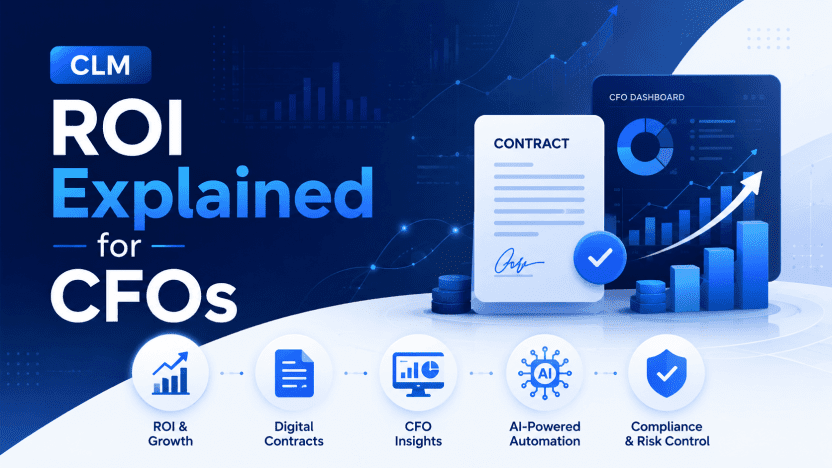
Contracts are no longer just legal documents stored in shared folders or buried inside email threads. They are revenue drivers, compliance safeguards, negotiation tools, and operational assets that directly impact business performance. Yet many organizations still manage contracts through disconnected systems, spreadsheets, manual approvals, and outdated workflows.
That approach creates hidden costs that finance leaders eventually notice. Missed renewals, delayed revenue recognition, legal bottlenecks, poor vendor visibility, and uncontrolled spending are a few challenges.
This is where Contract Lifecycle Management (CLM) software becomes a strategic investment rather than just another operational tool.
But convincing a CFO to invest in CLM requires more than discussing automation features. Finance leaders want measurable business value. They want clear ROI, operational impact, cost savings, and long-term scalability.
The real question is not “Do we need CLM software?” It is “What is the financial cost of continuing without it?”
In this article, we break down how to calculate CLM ROI, identify measurable business outcomes, and build a compelling business case that resonates with CFOs and executive stakeholders.
Why CFOs Care About CLM ROI
Modern CFOs are increasingly focused on:
- Cost optimization
- Operational efficiency
- Risk reduction
- Cash flow visibility
- Compliance management
- Revenue acceleration
- Process automation
- Predictable financial planning
Contracts influence every one of these areas.
- Sales contracts impact revenue.
- Vendor agreements affect procurement spending.
- Renewals influence retention.
- Compliance clauses reduce legal exposure.
- Approval workflows determine operational speed.
When contracts are poorly managed, the financial consequences become significant. According to industry studies, organizations lose substantial annual revenue due to inefficient contract management processes, missed obligations, and poor visibility into contractual commitments.
A modern CLM platform helps finance teams gain control over these inefficiencies while improving cross-functional collaboration between legal, procurement, finance, sales, and operations.
The Hidden Costs of Manual Contract Management
Many organizations underestimate how inefficient contract management actually costs them. The losses are often spread across departments, making them difficult to identify until they become major operational issues.
1. Revenue Leakage
Revenue leakage occurs when organizations fail to capture expected revenue due to:
- Missed renewals
- Delayed approvals
- Incorrect pricing terms
- Poor obligation tracking
- Expired contracts
- Billing inconsistencies
Even a small delay in contract approvals can slow deal closures and impact quarterly revenue targets. With AI-powered CLM solutions like SutiCLM, organizations can automate approvals, track obligations, and accelerate contract execution to reduce revenue loss.
2. Excessive Legal and Administrative Costs
Manual contract reviews consume significant legal resources.
Legal teams often spend hours:
- Reviewing repetitive clauses
- Searching for contract versions
- Tracking redlines
- Managing email approvals
- Handling low-risk agreements
This creates bottlenecks that slow down business operations.
Intelligent CLM platforms reduce this burden through:
- Pre-approved clause libraries
- AI-powered contract analysis
- Automated workflows
- Centralized repositories
- Smart search capabilities
The result is lower operational overhead and improved legal productivity.
3. Compliance and Risk Exposure
Regulatory violations and missed obligations can create serious financial consequences.
Common risks include:
- Non-compliant clauses
- Expired certifications
- Auto-renewal penalties
- Vendor non-compliance
- Missed deadlines
- Poor audit readiness
Without centralized visibility, organizations struggle to proactively manage contractual risks.
AI-driven CLM systems help identify risky clauses, flag deviations, monitor obligations, and maintain audit trails automatically.
4. Procurement Inefficiencies
Procurement teams often face:
- Slow vendor onboarding
- Duplicate supplier contracts
- Uncontrolled spending
- Poor negotiation visibility
- Missed discount opportunities
CLM platforms streamline procurement operations by standardizing contract workflows and improving spend visibility across vendors and suppliers.
What ROI Metrics Matter Most to CFOs?
To justify CLM investment, organizations need measurable metrics that align with financial priorities.
Here are the most important ROI categories CFOs evaluate.
1. Reduced Contract Cycle Time
One of the fastest measurable wins is shorter contract turnaround time.
Traditional approval cycles may take:
- Weeks for procurement agreements
- Days for NDAs
- Months for enterprise contracts
With automation, organizations can dramatically reduce approval bottlenecks.
Financial Impact
Faster contracts mean:
- Faster revenue realization
- Quicker vendor onboarding
- Improved sales velocity
- Increased operational agility
For sales-driven organizations, even reducing contract turnaround by a few days can significantly improve cash flow and quarterly performance.
2. Increased Employee Productivity
CLM automation eliminates repetitive manual work.
Teams spend less time:
- Searching for documents
- Managing email approvals
- Tracking versions
- Following up manually
- Reviewing standard clauses
This allows legal, procurement, finance, and sales teams to focus on higher-value activities.
Example ROI Calculation
If:
- Legal teams save 15 hours weekly
- Procurement saves 10 hours weekly
- Sales operations save 8 hours weekly
The annual productivity savings can become substantial when calculated across employee salaries and operational costs.
3. Lower Compliance Costs
Regulatory non-compliance is expensive.
Industries such as healthcare, finance, manufacturing, and technology face increasing pressure around:
- Data privacy
- Vendor compliance
- Regulatory reporting
- Audit management
- Contract governance
CLM software helps organizations maintain:
- Centralized audit trails
- Automated alerts
- Compliance workflows
- Obligation tracking
- Document retention policies
Reducing even one compliance incident can justify the platform investment.
4. Improved Renewal Management
Many businesses lose revenue simply because contracts renew late or expire unnoticed.
A CLM system helps:
- Track renewal dates
- Send automated reminders
- Identify renegotiation opportunities
- Prevent unwanted auto-renewals
This directly improves revenue retention and vendor management.
How AI is Increasing CLM ROI
Modern CFOs are particularly interested in AI because it improves both efficiency and decision-making. AI-driven CLM platforms go far beyond basic document storage.
Today’s intelligent contracting systems offer:
AI-Powered Clause Recommendations
The system suggests approved clauses based on:
- Contract type
- Industry
- Risk level
- Historical agreements
This accelerates contract creation and improves consistency.
Automated Risk Scoring
AI can identify:
- Non-standard clauses
- High-risk language
- Missing obligations
- Compliance concerns
This helps legal and finance teams prioritize contract reviews more effectively.
Predictive Analytics
Advanced CLM solutions provide insights into:
- Renewal probability
- Vendor performance
- Negotiation trends
- Approval bottlenecks
- Contract value forecasting
This transforms contracts into strategic business intelligence assets.
Intelligent Search and Data Extraction
Instead of manually reviewing hundreds of documents, teams can instantly locate:
- Payment terms
- Termination clauses
- Renewal dates
- Liability language
- Compliance requirements
AI dramatically improves contract visibility and decision-making speed.
Building a CFO-Friendly CLM Business Case
A successful CLM proposal should focus on business outcomes rather than technical features.
Here is how to structure your business case.
Step 1: Identify Current Pain Points
Document operational inefficiencies such as:
- Slow approvals
- Revenue delays
- Compliance issues
- Manual contract tracking
- Legal bottlenecks
- Poor audit visibility
Use measurable examples whenever possible.
Step 2: Quantify Financial Impact
Estimate the cost of:
- Delayed deals
- Employee hours wasted
- Missed renewals
- Compliance penalties
- Vendor inefficiencies
Finance leaders respond strongly to quantified operational waste.
Step 3: Demonstrate Scalability
CFOs want solutions that scale with organizational growth.
Show how CLM supports:
- Increased contract volume
- Global operations
- Regulatory expansion
- Cross-functional collaboration
- Enterprise governance
Scalability strengthens long-term ROI justification.
Step 4: Highlight Cross-Departmental Benefits
CLM is not just a legal tool.
It benefits:
- Finance
- Procurement
- Sales
- HR
- Operations
- Compliance
- Vendor management
Demonstrating enterprise-wide impact makes investment approval easier.
Why Businesses Choose AI-Powered CLM Platforms Like SutiCLM
Modern enterprises need more than document storage. They need intelligent contracting capabilities that improve visibility, reduce risk, and accelerate business processes.
SutiCLM helps organizations:
- Automate contract creation and approvals
- Centralize contract management
- Improve compliance tracking
- Reduce legal bottlenecks
- Accelerate contract cycles
- Enable AI-driven contract intelligence
- Gain real-time visibility into obligations and renewals
By combining workflow automation, AI-powered insights, and centralized governance, organizations can achieve measurable ROI while improving operational efficiency across departments.
Final Thoughts
CFOs rarely approve technology investments based on features alone.
They look through:
- Operational efficiency
- Cost reduction
- Revenue acceleration
- Risk mitigation
- Strategic visibility
That is exactly where modern CLM platforms deliver value.
The ROI of CLM is no longer limited to document management. Intelligent contracting platforms now influence revenue operations, compliance management, procurement optimization, and enterprise decision-making.
Organizations that continue relying on manual contract processes risk slower growth, increased compliance exposure, and rising operational inefficiencies. The question is no longer whether businesses need CLM software. It is whether they can afford to operate without it.