
If you’re unsure of the difference between a helpdesk and a service desk, understanding how each one functions is crucial for building effective support operations.
Helpdesks address immediate end-user issues, while service desks manage the entire lifecycle of IT services.
Helpdesks and service desks share the goal of delivering efficient user support, though their methods differ. At the helpdesk level, operational targets typically include 70 to 80% first?contact resolution rate. At the service desk level, more than 85% of users usually give positive feedback.
Additionally, self-service portals handle 30 to 40% of all requests, allowing many users to solve issues on their own without needing an agent. This is where a comprehensive solution like SutiDesk really shines, as its robust capabilities go beyond simple ticket tracking to fully support these high-efficiency metrics.
This article explains which option aligns best with your business needs.
Helpdesk: A Brief Description
A helpdesk fixes immediate problems. It serves as a centralized support service, assisting with and resolving technical issues or addressing customer inquiries. It can be accessed in person, by phone, by email, or via a company portal, many businesses start their support journey with a focused solution like SutiDesk to manage these incoming channels effectively.
Helpdesk focuses on the essentials:
- Answer user questions
- Fix routine issues
- Route complex problems to the right team
Helpdesk characteristics include:
- Basic ticketing systems that track requests but offer limited process automation or workflow management.
- Individual problem-solving with less emphasis on knowledge sharing or continuous improvement.
- A reactive approach, where teams respond to issues after they occur rather than preventing them.
3 Key Features of a Helpdesk Solution
1. Ticket Management
It is the core feature of a helpdesk system. It helps support agents manage tickets while ensuring proper categorization, assigning them to the appropriate technician, and tracking progress until resolution. With SutiDesk, ticket management is streamlined and intuitive, allowing support teams to easily handle the high volume of requests typical of a fast-paced helpdesk environment.
2. Knowledge Base
It is the centralized repository of information, documentation, and solutions to common issues and frequently asked questions. It allows users to access self-help resources and guides seamlessly, thus enabling them to find resolutions to their problems independently. Support agents also benefit from it by having a complete source of reference materials and troubleshooting steps at their fingertips.
3. Self-Service
It allows users to find solutions and perform certain tasks independently without the requirement of any direct assistance from the support agents. Through the self-service portal, users can search for relevant information, follow step-by-step guides, and troubleshoot common issues on their own. The portal typically includes resources such as knowledge articles, FAQs, video tutorials, and community forums, all within a user-friendly interface.
Overall, a helpdesk provides fast, and essential support focused on resolving immediate user issues efficiently.
Service Desk: A Brief Description
A service desk offers support to resolve a broad range of IT issues. It acts as a single point of contact between the user and the service provider. Unlike a helpdesk, a service desk takes a more proactive and strategic approach to find solutions for a problem.
Service desk covers these basics:
- Manages IT service requests
- Provides proactive user support
- Oversees change and assets
Service desk characteristics include:
- Comprehensive service management covering requests, problems, and changes
- Alignment with ITIL best practices for effective service delivery
- Proactive monitoring and analysis to prevent future incidents
3 Key Features of a Service Desk Solution
1. Incident Management
Incident management focuses on the systematic handling of incidents and service disruptions. It involves a structured approach to identify, analyze, and resolve incidents to minimize their impact on business operations. The main aim is to restore normal service operations promptly, keeping stakeholders informed throughout the incident-lifecycle. Effective incident management helps mitigate downtime, enhance user satisfaction, and maintain the overall stability of IT services.
2. Problem Management
Problem management aims to identify and address the prime causes of recurring incidents and problems. It involves a systematic approach to investigate underlying issues, determine their causes, and implement long-term solutions to prevent their recurrence. Service desk teams analyze patterns, trends, and data to identify common problems and prioritize them based on their impact on the organization.
3. Change Management
Change management focuses on controlling and overseeing the process of implementing changes to IT services, systems, or infrastructure in a structured and controlled manner. It involves evaluating the potential impact of proposed changes, planning and coordinating implementation, and ensuring that changes are executed without disrupting the stability of existing services.
A service desk delivers strategic, end-to-end IT support designed to enhance service quality and long-term operational efficiency.
Helpdesk vs. Service Desk: What’s the Difference?
The key difference between a helpdesk and a service desk is the range of services they provide. Here are five metrics that distinguish the two:
1. Organizational Role
A helpdesk usually executes basic IT functions, whereas a service desk plays a central part of an organization’s IT strategy.
2. Service Scopes
Helpdesk solutions usually focus on quick resolution of an issue, whereas service desk focuses on a broad range of ITSM (IT Service Management) activities, including strategic planning and process management.
3. Proactive vs. Reactive
Helpdesks are usually reactive; they only come into action when an issue arises. Service desks adopt a more proactive approach by resolving issues through problem management and optimizing IT services.
4. Simple vs. Complicated
Helpdesks are best suited to execute simple and less complex IT issues where quick resolution is required. Service desks are focused on resolving more complex IT scenarios where coordination is required between multiple departments and systems.
5. Costs
Service desks usually rely more on sophisticated technology and resources, which makes them costlier to maintain compared to helpdesks.
Helpdesks are ideal for handling immediate, routine IT issues, while service desks provide a broader, strategic approach to IT service management.
The table below offers a quick comparison – helpdesk vs. service desk:
| Helpdesk | Service Desk | |
| Core Purpose | Quickly fixes and resolves technical issues | Delivers complete IT service management |
| Users | Customers | Businesses |
| Focus | Small & medium sized businesses | Medium to large businesses with complex IT environments |
| User Interactions | Support for day-to-day issues | Support for both end-user interactions and backend IT processes |
| Service Level | Basic service level agreements | Formal service level agreements |
| ITIL Compliance | May not offer ITIL compliance | Aligns with the ITIL framework for IT service management |
| KPIs | Response times, and ticket resolution speed | Incident reduction, problem prevention, and process optimization |
| Orientation | Task oriented, providing the required solution to the employee as quickly as possible | Process oriented, emphasizes more on how the support process can be made better |
| Automation | Automates tasks like ticket categorization, prioritization, and routing | Automates tasks like logging and tracking resolved issues, and tracking IT assets |
| Issue Examples | Inquiries from customers about account access, product usage, or billing matters | Requests to evaluate network security, enhance hardware, and upgrade software |
Helpdesk vs. Service Desk: Does the Difference Really Matter?
While both the helpdesk and service desk are considered crucial for supporting users and ensuring seamless operations, each delivers value in its own unique way. While comparing a helpdesk and a service desk, scope plays a key role. If a situation requires quick, reactive support, a helpdesk is the ideal solution.
It can:
- Troubleshoot software issues
- Reset passwords
- Address immediate technical problems
Helpdesks are primarily focused on resolving individual issues effectively, especially when users need immediate support. For businesses whose primary need is this rapid response, ticket-based support, a solution like SutiDesk can be configured as an essential helpdesk tool right out of the box.
A service desk can:
- Handle service requests
- Coordinate with teams to ensure service continuity
- Implement major changes
In brief, a helpdesk solution focuses on resolving immediate issues, while a service desk takes a broader, Information Technology Infrastructure Library or ITIL-aligned approach by managing overall IT services and supporting organizational changes.
By identifying which option best meets your customers’ needs, you can make a decision that strengthens your overall support strategy.
How SutiDesk Delivers a Strong Helpdesk Experience
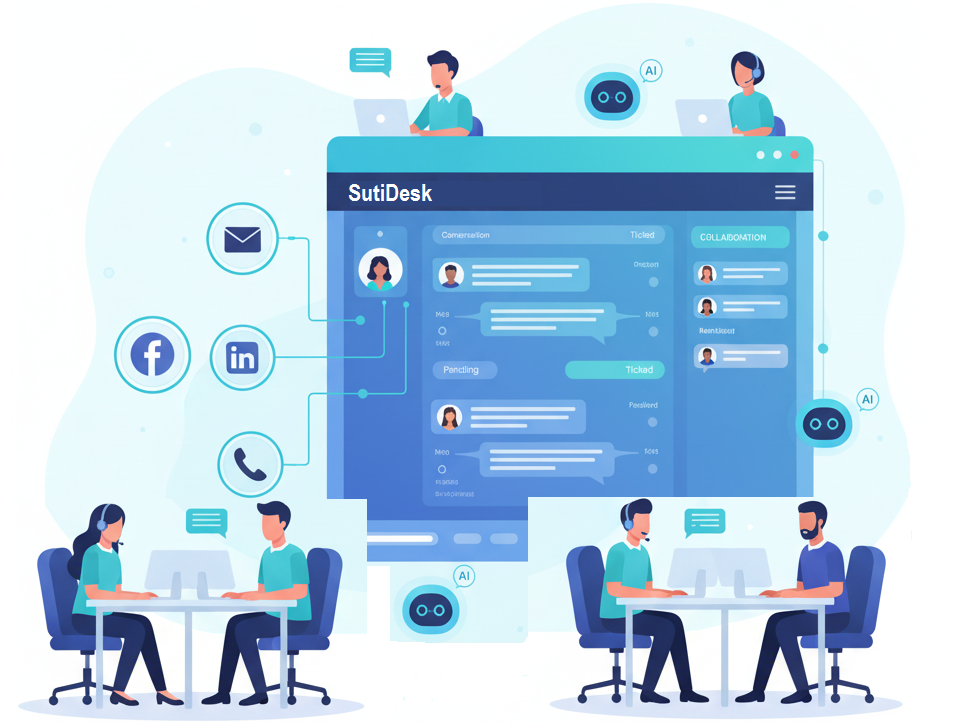
Whether you are handling inquiries, tickets, or managing multi-channel communication, SutiDesk is the best solution available. It automates repetitive tasks and reduces response times – all from one intuitive interface.
Its key features include multichannel capabilities that ensure seamless assistance across every touchpoint, AI-powered chatbots that provide 24/7 support by answering common queries, escalating issues, and supplying essential information before routing to a human agent, as well as customizable workflows that align with unique business processes.
With these features working together, your support operations become more streamlined and responsive. SutiDesk ensures that no request goes unnoticed and that every customer receives timely, high-quality assistance. This makes it an ideal solution for businesses looking to make their service standards high.
Final Thoughts
Choosing between a helpdesk and a service desk isn’t about selecting the “better” tool—it’s about identifying which solution aligns with your operational needs, service goals, and long-term IT strategy. A helpdesk excels at resolving immediate issues quickly, while a service desk delivers a more comprehensive, ITIL-aligned framework for managing and improving IT services.
By understanding the strengths of each, businesses can implement the right level of support, boost efficiency, and ensure a smooth, consistent experience for both users and internal teams.