HR teams are under increasing pressure to improve efficiency while delivering a better experience for employees and managers. Recruiting, onboarding, attendance, leave management, performance reviews, employee requests, and reporting all require time and coordination. As organizations grow, managing these processes through spreadsheets, email, and disconnected applications becomes difficult to sustain.
AI-powered HR software is emerging to address these challenges. Modern HR platforms combine employee management, workflow automation, self-service, analytics, and AI-assisted capabilities to reduce repetitive work and make better use of workforce data. But choosing the right platform requires more than comparing which vendor has the most AI features.
Why AI-Powered HR Software Matters
HR technology has evolved from simply storing employee information to supporting a broader range of workforce processes. Employees expect faster access to information, managers need better visibility, and HR teams need to spend less time on routine administration.
AI adds another layer by helping teams analyze information, identify patterns, assist with repetitive tasks, and provide more intelligent support throughout the employee lifecycle.
SHRM reported that 43% of organizations were using AI for HR-related tasks in 2025, compared with 26% in 2024, showing how quickly adoption is increasing.
The important question for HR leaders is not simply whether a platform uses AI. It is whether the technology can solve practical HR challenges while improving efficiency, employee experience, and decision-making.
What Modern AI-Powered HR Software Should Deliver
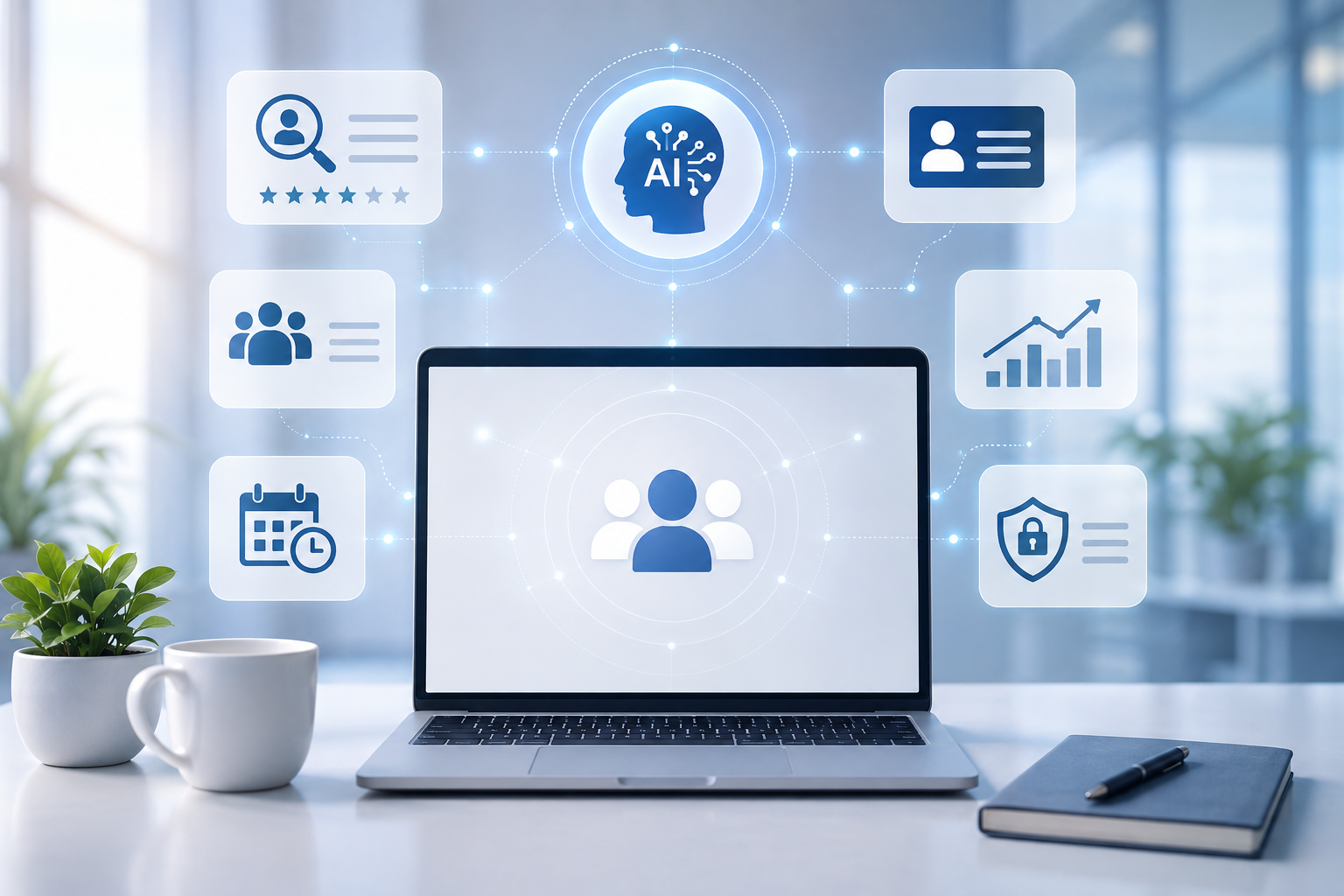
A modern HR platform should provide a connected foundation for managing the employee lifecycle. This can include recruitment, onboarding, employee records, attendance, leave, time tracking, performance management, reporting, and employee self-service.
It is also important to understand the difference between automation and AI. Automation follows predefined rules, such as routing a leave request to a manager. AI can analyze information, identify patterns, generate recommendations, and help users find relevant information. The strongest platforms combine both, using automation for predictable processes and AI where analysis or interpretation adds value.
Key Capabilities HR Leaders Should Evaluate
AI-Assisted Recruitment
Recruitment teams often spend significant time reviewing applications and comparing candidate qualifications with job requirements. AI can help organize candidate information, match resumes with job requirements, and prioritize applications for recruiter review.
The goal should be to make screening more efficient without removing human judgment. HR leaders should look for capabilities that allow recruiters to understand recommendations, review candidate information, and make final decisions themselves.
HR Workflow Automation
Many HR processes involve repetitive steps that can consume considerable administrative time. Modern HR software can automate onboarding, leave requests, attendance processes, employee information changes, approvals, performance reviews, and other recurring activities.
Automated notifications and workflow rules help move tasks to the right people while applying consistent processes across the organization.
Employee Self-Service
Employees regularly need to check leave balances, access documents, update information, review attendance, and find answers to HR-related questions. Employee self-service gives them direct access to these activities without requiring HR to manage every request.
AI can further improve the experience by helping employees find relevant information and navigate HR processes more naturally, reducing the administrative workload on HR teams.
HR Analytics and Workforce Insights
HR leaders need more than reports; they need a clear understanding of what is happening across the workforce. A modern platform can bring together information related to headcount, attendance, leave, recruitment, performance, and other HR activities.
AI can help identify patterns and trends within this information, making it easier for HR leaders to turn workforce data into actionable decisions.
Look Beyond the AI Feature List
Most modern HR platforms now offer some form of AI, so simply comparing AI features may not tell you which platform is the better fit.
Instead, evaluate how each capability works within an actual HR process. For example, if a vendor offers AI-powered recruitment, consider whether it helps identify relevant candidates, whether recruiters can review recommendations, and whether candidate information flows into onboarding after hiring.
The same principle applies to AI assistants and workforce analytics. An AI capability is valuable when it helps users complete real tasks or make better decisions, not simply because it appears on a feature list.
Evaluate AI Accuracy and Transparency
Trust is especially important when AI is used in HR because its outputs can influence recruitment, employee development, performance, and other important areas.
During a vendor evaluation, ask how AI recommendations are generated, what information they use, whether users can review or override outputs, and what controls are available when an AI-generated result is inaccurate. Human oversight should remain part of processes involving significant decisions about employees or candidates.
Transparency also helps employees and HR teams understand how AI supports their work instead of treating it as a black-box system.
Integration Matters More Than You Think
HR software rarely operates alone. Organizations may rely on payroll, accounting, recruitment, identity management, attendance, and other business applications. When these systems are disconnected, teams may need to enter the same information multiple times or manually transfer data between applications.
When evaluating a platform, look at available integrations, data synchronization, APIs, security controls, and whether integrations are prebuilt or require significant customization. Strong integrations also give AI access to more complete and consistent employee information.
Consider Implementation and User Adoption
Even sophisticated HR software can deliver limited value if employees, managers, and HR administrators find it difficult to use. Successful implementation requires intuitive workflows, appropriate permissions, training, onboarding resources, and ongoing support.
HR leaders should evaluate common workflows from the perspective of different users, not just administrators. Managers and employees will interact with the system for approvals, attendance, leave, documents, and other everyday activities, so ease of use directly affects adoption.
Security and Data Governance Should Be Part of the Decision
HR platforms manage sensitive employee information, including personal records, attendance, performance, and compensation data. AI adds another consideration because organizations need to understand how employee information is accessed and used by AI-powered capabilities.
Evaluate role-based access, authentication, encryption, audit trails, privacy controls, data retention, integration security, and controls around AI-generated outputs. Security and data governance should be part of the initial software evaluation rather than an afterthought.
Think About Long-Term Scalability
The right HR platform should support the organization as its workforce and HR requirements evolve. Growth may introduce new employees, locations, workflows, integrations, reporting requirements, or HR modules.
When evaluating scalability, consider more than employee capacity. Look at whether the platform can adapt to changing processes and support broader HR requirements without forcing another system replacement.
How to Measure the Value of AI-Powered HR Software
Before implementing new HR software, define what success should look like. Useful measures can include administrative time saved, employee self-service adoption, recruitment efficiency, approval turnaround times, reporting time, and reductions in manual data entry.
SHRM reported that 56% of HR professionals surveyed did not formally measure the success of their AI investments, highlighting the need for clear measures before introducing new capabilities.
Instead of measuring success by AI feature usage alone, connect the technology to process improvements. For example, measure whether AI-assisted recruitment reduces screening time, whether self-service reduces routine HR inquiries, or whether intelligent reporting helps leaders access workforce information faster.
Where SutiHR Fits
SutiHR is designed for organizations looking to combine AI-assisted capabilities with broader HR management in a connected platform. It supports areas such as recruitment, employee management, attendance, leave, time tracking, performance management, compensation, and reporting.
This connected approach allows AI and automation to work within broader HR processes rather than adding isolated AI tools to disconnected systems.
Final Thoughts
Choosing AI-powered HR software is ultimately about finding the right balance between technology, people, and process. The strongest platform is not necessarily the one with the most AI features, but the one that addresses your organization’s specific HR challenges and delivers measurable improvements.
Evaluate AI capabilities alongside workflow automation, employee self-service, integrations, security, user adoption, analytics, and scalability. Most importantly, assess each capability within a real HR process and determine whether it can make everyday work more efficient while keeping human judgment where it matters.

Ready to modernize your HR operations?
See how SutiHR combines AI-assisted capabilities with connected HR management to simplify everyday HR processes.
FAQS
AI-powered automation is particularly useful for repetitive, data-driven processes such as resume screening, employee queries, workflow routing, reporting, and routine HR administration.
Start by identifying repetitive processes, reviewing the quality of available HR data, defining clear use cases, and establishing appropriate controls for AI-assisted decisions.
Ask how recommendations are generated, what data is used, whether users can review or override results, and what controls exist when an AI output is inaccurate.
User adoption directly affects the value of HR software, so organizations should test common workflows from the perspectives of HR teams, managers, and employees before selecting a platform.
Measure outcomes such as administrative time saved, recruitment efficiency, approval turnaround, self-service adoption, reduced manual work, and faster access to workforce information.