With the pace of business today, managing HR compliance has become increasingly complex. Employment regulations seem to be constantly evolving, data privacy expectations continue to rise, and organizations are expected to maintain flawless documentation across every stage of the employee lifecycle. For HR teams, compliance is no longer limited to annual audits and policy updates; it is now a daily requirement.
Regardless, many organizations are still managing compliance manually or through several disconnected systems. Oftentimes, policies are tracked in shared drives, approvals live in email threads, and compliance checks rely on individual knowledge rather than enforceable systems. These approaches can work temporarily when an organization is small. However, as an organization grows, these approaches often do not work at scale. As workforces grow, become remote, or span multiple jurisdictions, manual compliance processes can quickly break down.
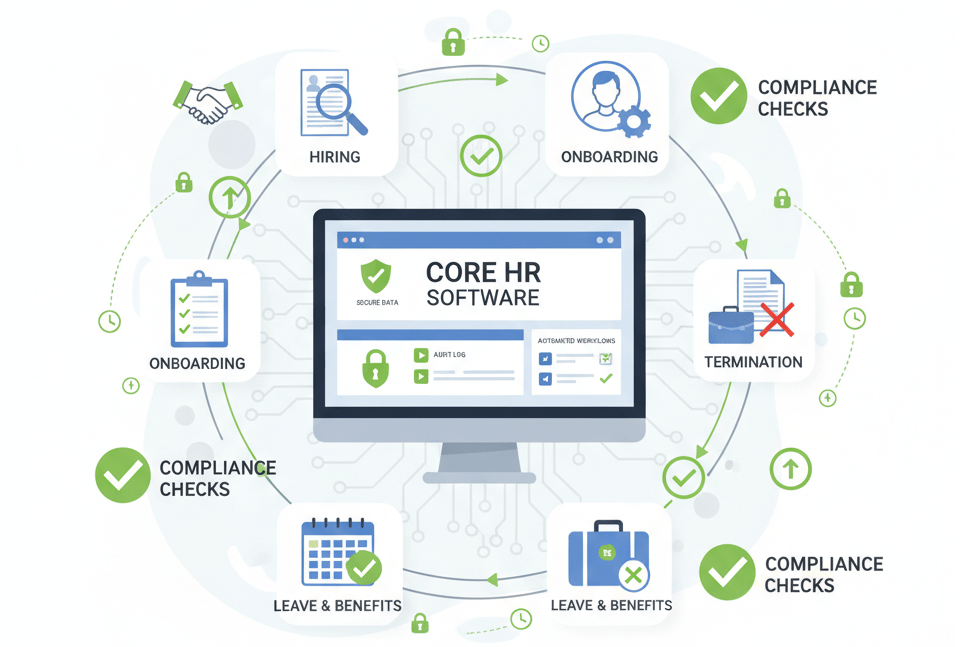
Core HR software streamlines these broken systems by combining everything in one place and embedding compliance directly into everyday HR workflows. Rather than relying on after-the-fact reviews, modern Core HR platforms automate compliance across the entire employee lifecycle. This ensures requirements are met consistently, documentation is captured automatically, and audit readiness becomes a natural part of daily operations. This lifecycle-based compliance model is a core principle of modern Core HR software and HRIS platforms built for today’s regulatory environment.
Key Takeaways
- Compliance risk exists at every stage of the employee lifecycle
- Manual compliance processes do not scale with workforce growth
- Core HR software embeds compliance into daily HR workflows
- Automation improves consistency, documentation, and audit readiness
- Lifecycle-based compliance reduces risk without increasing admin effort
Why Compliance Must Be Managed Across the Entire Employee Lifecycle
Compliance is not a single event that can be completed once and never thought about again. It is a continuous responsibility that begins before an employee is hired and often extends to years beyond termination. Each stage of the employee lifecycle introduces new regulatory requirements that are unique to that stage.
During hiring, organizations must comply with equal employment regulations, background check requirements, and eligibility verification. During employment, organizations must be aware of and comply with wage laws, leave entitlements, benefits eligibility, and performance documentation must be managed accurately. When an employee is terminated, there are regulations around final pay requirements, benefits continuation notices, and record retention obligations that must be followed.
When compliance is handled through disconnected systems or manual processes, these requirements are managed inconsistently, which opens the organization up to compliance risk. Core HR platforms address this challenge by structuring the employee lifecycle into defined stages, each supported by automated workflows, validations, and documentation controls. This lifecycle-based approach aligns with best practices outlined in comprehensive Core HR software guides and significantly reduces compliance exposure.
Compliance Automation During Hiring and Onboarding
Hiring and onboarding represent one of the highest-risk phases of the employee lifecycle. During the application process, it is often a best practice to ensure that the process is consistent, to include interview questions, and to reduce potential discrimination legal action. Also in the onboarding process, there is a large amount of documentation that is required;if any of that documentation is lost, inconsistently collected, or incomplete records are kept, organizations can expose themselves to regulatory scrutiny from day one.
Core HR systems automate compliance during this phase by standardizing hiring workflows and ensuring required documentation is collected before employees begin work. Offer letters, eligibility verification, policy acknowledgments, and onboarding forms are captured digitally and stored directly within employee records.
Automated workflows ensure onboarding steps occur in the correct order and within required timelines. New hire data flows seamlessly into payroll and benefits systems, reducing duplicate entry and preventing errors that often occur when onboarding is handled across multiple platforms.
Managing Ongoing Compliance During Active Employment
Once employees are onboarded, compliance requirements continue throughout their employment. There are wage and hour laws, labor laws, benefits eligibility, and performance documentation that must be managed consistently and accurately. With remote work, many organizations will have employees who reside in different states, which adds additional complexity with multi-state laws.
Core HR platforms automate ongoing compliance by enforcing rules tied to employee status, role, and location. If an employee is promoted, given a merit increase, or has a compensation change, a validation and approval workflow is triggered in the system. As employees use their self-service capabilities to apply for time off, their leave requests are evaluated against eligibility rules and tracked automatically within the system. As employees complete training, their certifications are tracked in the system and monitored for expiration, and automatic renewal reminders are sent out.
By embedding these controls into daily HR operations, Core HR systems reduce reliance on manual oversight and ensure compliance requirements are met continuously rather than reactively. When an audit begins, everyone can breathe easy knowing that the core HR system has triggered every control as needed to ensure compliance without manual intervention.
Automating Compliance for Leave, Benefits, and Life Events
Life happens, especially when it is least expected. Being prepared for the least expected is often not at the forefront of an employee’s mind. When an employee experiences a life event, such as parental leave, medical leave, benefits changes, or relocation, additional compliance requirements are often introduced. Each event may trigger different regulatory requirements, documentation obligations, and eligibility recalculations.
Core HR software automates these processes by linking life events to predefined workflows. Leave eligibility is calculated automatically, required documentation is requested and stored, and benefits systems are updated in real time. This automation ensures compliance while providing employees with a consistent, transparent experience.
Compliance Automation at Termination and Offboarding
Termination is another high-risk stage of the employee lifecycle. Depending on the termination type, there are different final pay regulations that must be followed. Benefits continuation notices are also required to be sent out within a certain timeframe, and records will have different retention requirements depending on if the termination was voluntary or involuntary. All these exit processes must be handled accurately and promptly.
Core HR platforms automate offboarding workflows to ensure required steps are completed consistently and on time. As an HR administrator begins a termination, notifications will be triggered, necessary documentation will be requested, and system updates will be made across payroll, benefits, and access controls. Final pay calculations and compliance documentation will automatically be recorded, which will create a clear audit trail without an HR admin needing to remember each step.
This structured approach reduces legal risk and ensures organizations meet regulatory obligations even during sensitive transitions
Audit Readiness Through Continuous Compliance Automation
One of the most significant advantages of lifecycle-based compliance automation is continuous audit readiness. Instead of preparing for audits reactively, organizations using Core HR systems maintain compliance documentation and audit trails as part of everyday operations.
Every employee action, hire, promotion, leave, or termination, is logged with timestamps, approvals, and supporting documentation. During audits or regulatory inquiries, HR teams can quickly produce complete, defensible records from a single system of record, reinforcing the value of Core HR platforms as compliance foundations.
Why Compliance Automation Is Essential for Scaling Organizations
As organizations grow, compliance complexity increases. If an organization opens a new location in a new city, town, or state, there will be new regulations. As new locations are added, teams will grow, and larger teams often mean an increase in documentation volume. Manual compliance processes do not scale efficiently and often fail under pressure.
Core HR software provides the structure needed to scale compliance without increasing administrative burden. Automated workflows, centralized documentation, and system-enforced rules ensure compliance remains consistent as the organization evolves, supporting sustainable growth and long-term risk management.
Conclusion
Compliance cannot be managed effectively through manual processes or disconnected systems. Modern organizations require a lifecycle-based approach that embeds compliance into everyday HR operations.
Core HR software automates compliance across the employee lifecycle, reducing risk, improving accuracy, and maintaining continuous audit readiness. By shifting compliance from reactive oversight to system-enforced workflows, organizations gain control, confidence, and scalability in an increasingly complex regulatory environment.
Frequently Asked Questions
Compliance automation refers to embedding regulatory requirements directly into HR workflows. Core HR systems enforce rules, collect documentation, and maintain audit trails automatically rather than relying on manual tracking.
Core HR software reduces compliance risk by standardizing processes, enforcing validations and approvals, and maintaining centralized documentation across the employee lifecycle. This minimizes errors and inconsistencies.
Yes. Modern Core HR platforms apply location-based rules automatically, supporting state-specific wage laws, leave requirements, and record retention obligations within a single system.
Lifecycle-based compliance ensures documentation and approvals are captured continuously. During audits, HR teams can access complete, time-stamped records without manual reconstruction.
No. Small and mid-sized organizations often benefit the most. Automating compliance early prevents risk from compounding as the organization grows and reduces administrative burden from day one.