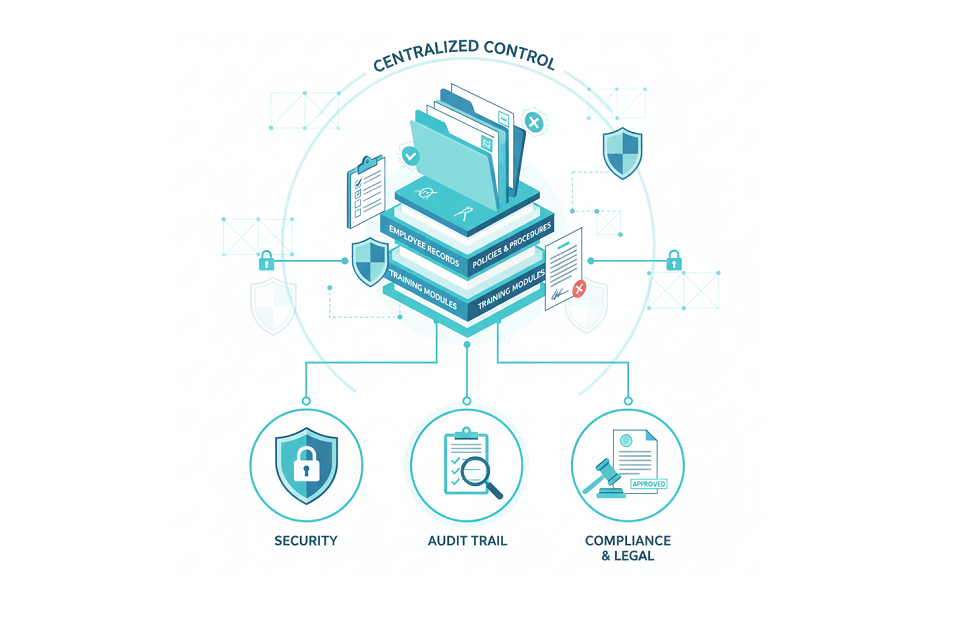
A comprehensive document governance framework is the backbone of HR compliance and operational stability. Without structured rules that govern how documents are created, accessed, reviewed, stored, and disposed of, HR departments face increased exposure to legal penalties, audit failures, data breaches, and inconsistent employee experiences. As organizations expand, their document ecosystem becomes more complex—crossing departments, locations, and digital systems. This makes governance not just a best practice, but an essential foundation for maintaining efficiency, transparency, and accountability across the employee lifecycle. A strong governance model ensures that every document—whether a tax form, performance review, disciplinary action, or benefits file—is handled consistently, securely, and in compliance with regulatory standards.
Key Takeaways
- Protect compliance & reputation: A governance framework reduces risks of legal penalties, audit failures, and data breaches.
- Enable efficiency & transparency: Standardized rules ensure documents are accurate, secure, and easily retrievable across HR and related departments.
- Integrate technology & culture: Automated systems enforce retention, permissions, and workflows, while HR leaders drive adoption through training and communication.
- Support scalability: A phased rollout—starting with high-risk records—builds a strong foundation that adapts as regulations and business needs evolve.
- Elevate HR’s role: Governance transforms HR from an administrative function into a strategic partner in compliance and organizational trust.
Core Components of an HR Document Governance Framework
A governance framework establishes the “rules of the road” for managing HR documents throughout their lifecycle. This includes identifying what documents exist, how they should be classified, who can access them, how long they must be retained, and how they should be reviewed and disposed of. These elements must remain consistent not only within HR but also across departments that handle employee documents, such as payroll, legal, benefits, and compliance.
Key Takeaways
- Classification is the foundation for accurate retrieval and legal alignment.
- Permission structures ensure sensitive information is safeguarded at every step.
- Retention schedules prevent accidental destruction, over-retention, and audit risk.
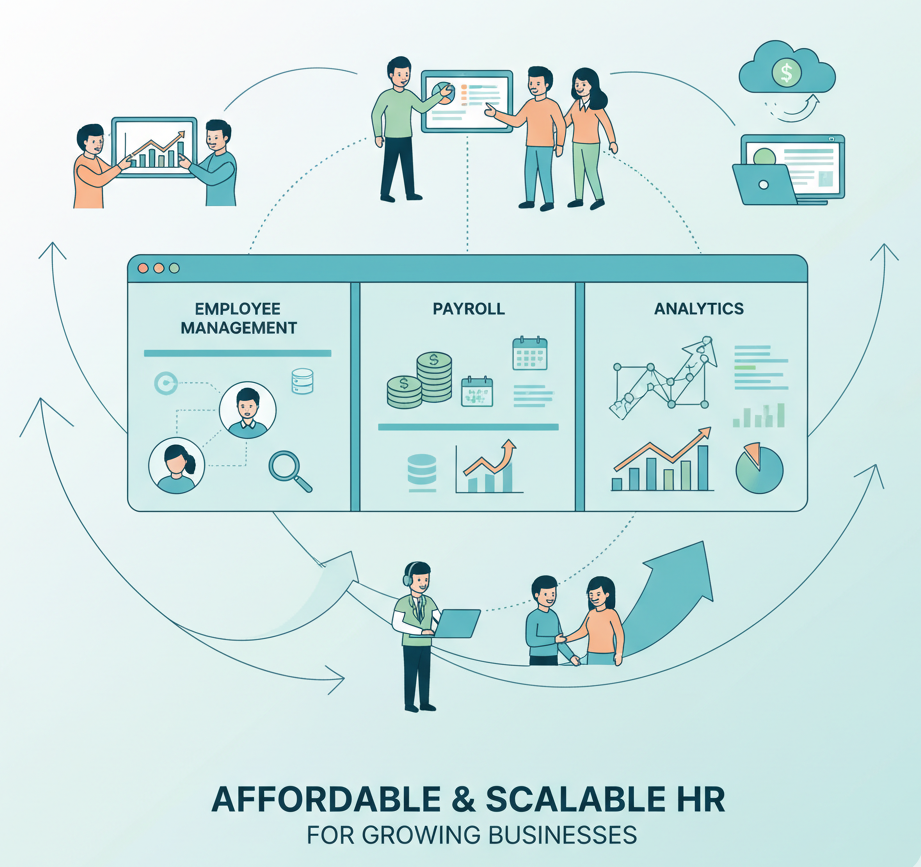
Need an Affordable HR Solution for Your Business?
SutiHR offers scalable tools designed for growing companies.
Document Classification & Categorization
Effective classification organizes documents into logical groups that reflect legal standards and internal workflows. Categories often include onboarding, payroll, performance, legal, compliance, benefits, and separation documents. Beyond grouping, classification should define metadata rules (e.g., employee ID, date, document type), which improve searchability and indexing. This approach allows HR teams to maintain visibility and consistency across thousands of files, even in large, global organizations.
Access Controls & Permission Structures
Because HR documents frequently contain highly sensitive data—such as medical records, compensation details, and disciplinary notes—strict access governance is critical. Role-based permissions prevent unauthorized viewing, editing, or sharing, while audit trails record every action taken within the system. Mature governance frameworks also include periodic access reviews to ensure permissions remain aligned with evolving job roles and organizational changes.
Retention & Disposal Standards
Retention rules must balance legal compliance with operational efficiency. Various laws—such as the FLSA, ADA, OSHA, IRS regulations, and international frameworks such as GDPR—dictate how long organizations must retain specific records. A governance framework outlines each requirement and automates enforcement through a document management system. Proper disposal processes are equally important; improper destruction of records can lead to substantial legal penalties or hinder litigation defense.

Want to experience seamless HR management?
Schedule a personalized demo and see how SutiHR can help streamline recruitment, payroll, benefits, and employee engagement—all in one platform.
Workflow Governance & Process Standardization
Document governance extends beyond rules to include the processes that guide how documents flow through HR operations. These processes ensure every document is created, reviewed, and approved in a predictable manner that supports compliance and reduces the operational burden on HR teams.
Key Takeaways
- Workflow standardization creates uniformity and ensures no required step is skipped.
- Version control protects the integrity of HR documents and reduces administrative rework.
- Monitoring transforms governance into a continuous, proactive practice.
Workflow Mapping & Approval Routing
Workflow mapping defines the sequence of actions required for each document type. For example:
- Onboarding documents may need to be completed by the employee, verified by HR, approved by payroll, and stored in the DMS.
- Disciplinary records may require manager creation, HR review, legal approval, and restricted filing.
Mapping these workflows eliminates ambiguity, accelerates processing, and supports distributed teams by ensuring everyone follows the same standardized path.
Version Control & Change Management
Without version control, organizations face risks such as outdated policies circulating, conflicting instructions, or altered documents without traceability. Governance frameworks define how edits are made, who must review them, how previous versions are archived, and how new versions are communicated. This ensures the entire organization operates from accurate, up-to-date information.
Monitoring & Audit Readiness
Audit readiness requires continuous oversight. Governance frameworks include ongoing internal audits that check for missing forms, expired documents, incomplete files, or permissions that no longer match job roles. Digital audit trails significantly reduce preparation time for external audits and legal claims by providing clear documentation of every action taken throughout a document’s lifecycle.
Implementing HR Governance Successfully
Successful implementation requires alignment across systems, people, and processes. Technology plays a central role: a modern document management system (DMS) operationalizes governance by automating permissions, workflows, retention schedules, and audit trails. But governance is also cultural. HR leaders must clearly communicate expectations, provide training, and reinforce the strategic importance of compliance and consistency.
Organizations should also adopt a phased implementation approach—starting with high-risk areas such as compliance records and gradually expanding to all HR documentation. Continuous evaluation helps refine policies as regulations evolve and business needs shift.
Conclusion
A compliant HR document governance framework is more than a safeguard—it’s a strategic asset. By embedding clear standards for classification, permissions, retention, and workflows, organizations can ensure every HR record is secure, accurate, and audit-ready.
The payoff is significant: stronger employee trust, smoother audits, reduced legal exposure, and improved operational efficiency. To get started, HR leaders should audit current practices, identify high-risk gaps, and pilot governance tools in critical areas before scaling across the enterprise.
As regulations evolve and organizations grow, a well-designed governance framework provides the adaptability and stability needed to protect sensitive information, maintain compliance, and position HR as a driver of organizational success.
FAQs
Without governance, organizations face compliance violations, audit failures, data breaches, and lost records. These risks can lead to legal penalties, financial losses, and reputational damage.
Governance enforces standardized workflows, approvals, and retention policies. With audit trails and searchable records, HR teams can prepare faster and reduce last-minute errors during external audits.
Documents containing sensitive employee data—such as medical records, payroll files, disciplinary actions, identity documents, and certifications—must have the highest levels of security, permissions, and monitoring.
Best practice is to conduct quarterly internal audits. High-risk areas (e.g., safety certifications, legal forms) may require monthly reviews to stay compliant with evolving regulations.
A document management system (DMS) automates governance by applying retention rules, monitoring user actions, restricting access, managing versions, and routing approvals. This reduces manual workload and strengthens compliance integrity.