

Managing accounts payable process requires you to understand the end-to-end process clearly.
Every AP process includes four steps – invoice capture, invoice approval, payment authorization, and execution.
Manually managing these steps would result in errors, limits visibility into invoice payments, and gives you no visibility into cash-flow.
Key Takeaways
- Manual AP processes create significant visibility gaps, making it difficult to track invoice status and requiring multiple resources to waste time on email chains and status updates.
- AP automation eliminates manual data entry through OCR technology, automatically capturing invoices, extracting line items and amounts, and syncing directly to ERP systems.
- Automated workflows enable device-agnostic approvals, allowing approvers to review and process invoices from anywhere while maintaining proper authorization hierarchies based on invoice amounts.
- Finance departments gain enhanced cash flow visibility through automated tracking of payment due dates, early payment discounts, and late payment fees, enabling better financial decision-making.
- Complete AP automation requires seven core features: OCR, document workflows, PO management, centralized operations, approval history, integrated payables, and simplified transitions.
How Manual Processes Limit Visibility
Understanding the root cause of AP inefficiencies is crucial before implementing solutions. Key challenges we’ll explore:
- Invoice status tracking difficulties
- Resource waste through email chains
- Operational delays and vendor relationship impacts
Let’s examine how these visibility gaps specifically impact your day-to-day operations and bottom line.
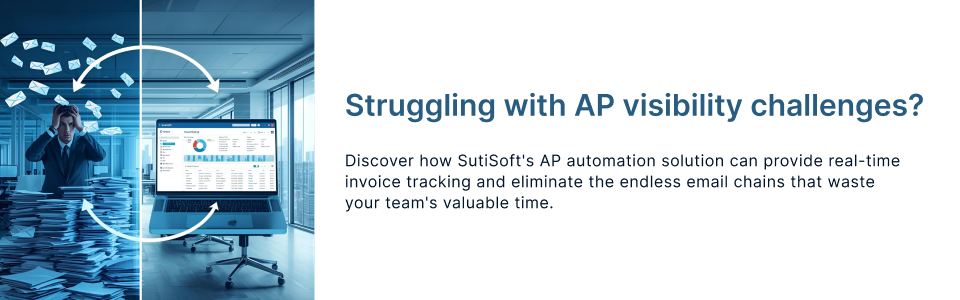
The main drawback of handling AP process manually is the lack of visibility into invoice status. When a business unit wants to know the status of an invoice, it may not be readily accessible.
This requires you to send a series of emails that waste the time of multiple resources checking on the invoice and payment. Right from frontline personnel to senior management, everyone has to spend time on tracking and validating invoices.
Lack of visibility makes it difficult to find information, which would cause delays in day-to-day operations. Not paying invoices on time can deteriorate relationships rapidly, which could have a negative impact on the businesses offering products to customers.
Mitigating Costs through Automation
Automation offers a comprehensive solution to the visibility of your finances and efficiency challenges identified above. This section details the specific technological approaches and workflow improvements that directly address manual process limitations.
Core automation benefits covered:
- Digital invoice capture and OCR technology
- Automated approval workflows and scheduling
- ERP integration and data synchronization
Here’s how modern AP automation technology transforms each step of your current process.
With automated platforms like SuitAP, businesses can address the key challenges by automating the AP processes. Automation offers key benefits that can cut down errors and manual work in managing the internal processes.
Invoices can be captured digitally and stored in the ERP system – line items, amounts, and coding are extracted using optical character recognition technology. Invoices can be directly synced to the ERP system while eliminating the data entry.
Automated workflows send approval requests with invoices attached as a reference; approvers can be determined based on invoice amounts. And, approvers can approve or reject invoices from any device.
All the approved payments go on a scheduled date, and approval records, invoice copies, receipts, and payment records are attached to the invoice record. Someone has to still keep an eye on what’s happening. Accounts payable solution makes it easy to manage
invoices and identify data discrepancies.
The Payoff
Quantifying the business impact of AP automation helps justify investment and sets expectations for implementation success. Value realization areas:
- Time savings and efficiency gains
- Financial visibility and cash flow management
- Vendor relationship improvements
These measurable benefits demonstrate the ROI of AP automation beyond simple cost reduction.
By automating the accounts payable processes, businesses can cut down the time AP staff spend on chasing information and processing invoices. This can also reduce the time spent on entering invoices into the accounting system. Another benefit is that automating AP processes facilitates vendor payments on time.
For the finance department, automating AP process provides better visibility into payment due dates, early payment discounts, and late payment fees. This facilitates cash flow management and makes decisions promptly. The improved efficiency and visibility enable businesses to understand which payment methods are beneficial to the vendor.
Invest in AP Automation
Selecting the right AP automation solution requires understanding essential features and capabilities that ensure long-term success. This section provides a practical checklist for evaluating solutions and ensuring your investment delivers maximum value.
Use this feature checklist to evaluate potential solutions and ensure your chosen platform delivers comprehensive automation capabilities.
- Optical character recognition
- Document workflows
- Purchase order management
- Centralizing accounts payable operations in one place
- Approval history and storing payment details
- Integrated payables
- Simplified transitions
These features can help you keep track of AP process while offering granular insights into invoices, approvals and payments.
Revolutionizing Your end-to-end AP Process with Automation
Transform your accounts payable operations from a source of frustration into a strategic advantage. The benefits of AP automation extend far beyond simple cost savings—you’ll gain unprecedented visibility into your financial operations, strengthen vendor relationships through timely payments, and free your finance team to focus on strategic initiatives that drive business growth.
Ready to eliminate manual AP bottlenecks and gain complete visibility into your financial processes?
SutiSoft’s comprehensive AP automation solution includes all seven essential features: OCR technology, automated workflows, purchase order management, centralized operations, approval history tracking, integrated payables, and simplified transitions.
Don’t let manual processes continue to drain your resources and damage vendor relationships. Start your free trial today and experience firsthand how SutiSoft can transform your accounts payable operations in just 30 days.
FAQs
Q: What are the four main steps in the accounts payable process?
A: The end-to-end AP process includes invoice capture, invoice approval, payment authorization, and payment execution. Each step can be automated to eliminate manual errors and improve efficiency.
Q: How does OCR technology improve invoice processing?
A: Optical Character Recognition (OCR) technology automatically extracts key information like line items, amounts, and coding from invoices, eliminating manual data entry and reducing errors while syncing directly to your ERP system.
Q: Can approvers process invoices while traveling or working remotely?
A: Yes, automated AP solutions enable approvers to review, approve, or reject invoices from any device with internet access, ensuring business continuity regardless of location.
Q: What visibility benefits does AP automation provide for finance teams?
A: AP automation offers real-time visibility into payment due dates, early payment discount opportunities, late payment fees, cash flow status, and vendor payment histories, enabling better financial planning and decision-making.
Q: How does AP automation help with vendor relationships?
A: Automation ensures timely payments, reduces payment delays, provides vendors with self-service portals for payment status inquiries, and maintains detailed payment records, all of which strengthen vendor relationships and trust.