In today’s ever-evolving workplace, employee empowerment isn’t just a trendy catchphrase; it’s a business imperative. As work environments become more remote, mobile, and tech-enabled, companies need solutions that foster autonomy while still ensuring accuracy and compliance.
That’s where self-service HR tools come in. Designed to let team members handle routine HR functions themselves, these tools represent a big win for both employees and HR professionals. In fact, enabling self-service is one of the most effective steps organizations can take to improve employee experience, streamline operations, and support talent management.
Let’s dive into what employee self-service (ESS) really means, why it matters, and how to implement it effectively.
What Is Employee Self-Service in HR?
Employee Self-Service (ESS) is a feature found in modern HR software that allows employees to manage a wide range of HR-related tasks on their own, without needing to go through the HR department for every request.
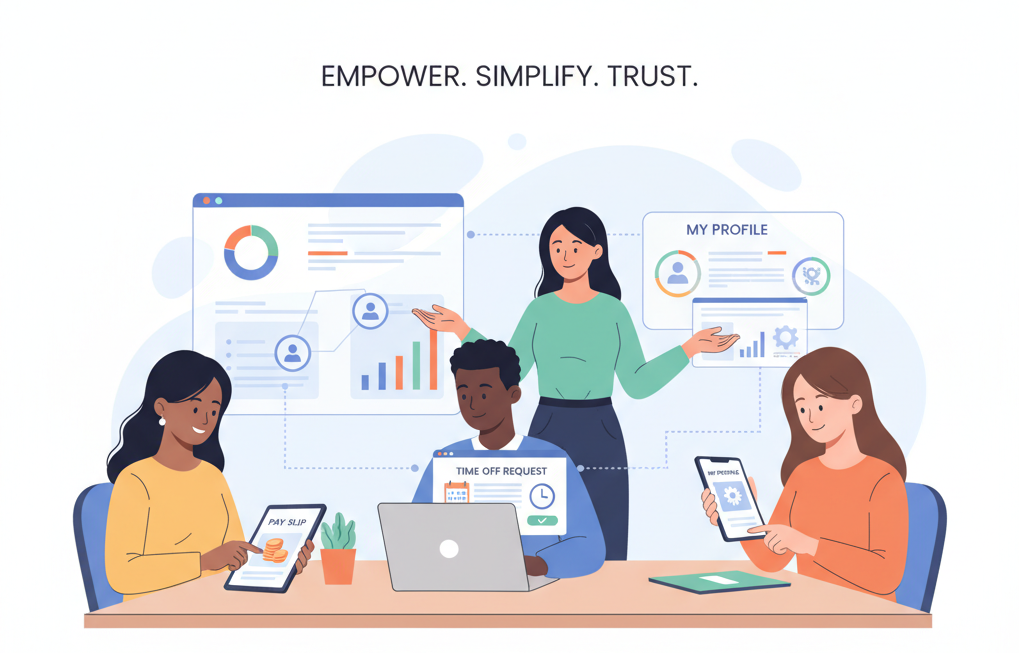
Instead of sending emails or submitting paper forms, employees can log into a user-friendly portal to update their personal details, request time off, access pay stubs, or review company policies.
It’s fast. It’s simple. And for many, it’s a game-changer.
Why Self-Service HR Matters
At its core, ESS is about giving employees the tools they need to succeed – on their own terms. When team members are trusted to handle simple HR tasks, they feel more in control, which in turn boosts their motivation and morale. Meanwhile, HR professionals regain valuable time to focus on strategic priorities, such as workforce planning, organizational development, and problem-solving.
Instead of getting buried in repetitive admin work, HR teams can take on high-impact projects that actually move the needle.
Here are just a few of the most important benefits of empowering employees through self-service tools.
1. Greater Efficiency and Time Savings
Manual processes are often time-consuming, frustrating, and prone to error. Think about the number of emails your HR department receives each week just to update an address or confirm vacation days.
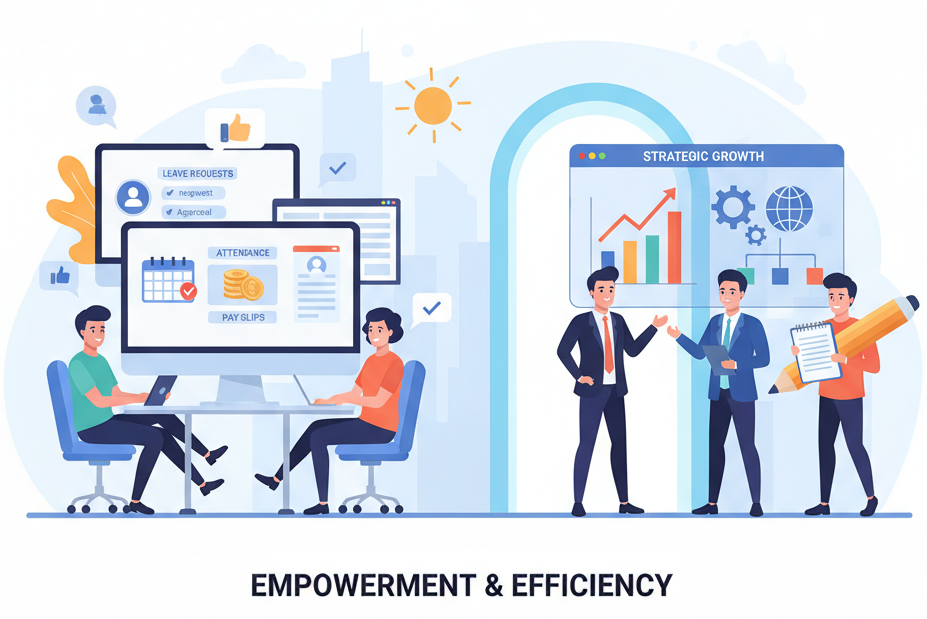
With self-service, employees can:
- Update personal contact and tax information
- Download pay slips and tax forms
- Submit and track paid time off (PTO) requests
- Access benefit elections and updates
- Review performance evaluations
These seemingly small changes add up to significant time savings. For employees, it means getting answers fast. For HR, it means fewer distractions and more focus on strategic HR initiatives like talent development and culture building.
2. Improved Employee Engagement and Satisfaction
When employees feel trusted to manage their own information, it signals respect and accountability. That trust leads to higher employee engagement, stronger ownership of responsibilities, and a greater sense of purpose.
This also contributes to improved company culture, where team members feel seen, valued, and empowered.
Autonomy isn’t just a “nice to have”; it’s central to helping employees develop and grow. Self-service tools give them a clearer picture of their benefits, performance goals, and opportunities for advancement.
3. Enhanced Accuracy and Fewer Errors
Who knows an employee’s information better than the employee themselves?
Allowing team members to update their own records ensures that employee data stays accurate and up to date. This eliminates common mistakes that can occur when relaying details through multiple people or departments.
With audit trails and real-time syncing, ESS systems also help maintain compliance with federal and state labor laws, including requirements related to:
- Wages and hours
- Benefit eligibility
- Record-keeping
- Privacy and access control systems
Mistakes in HR can be costly, not just in fines, but in trust. Self-service systems help prevent these issues before they start.
4. Cost Reduction across the Board
By reducing reliance on paper, forms, and administrative support, ESS significantly cuts HR’s overhead. It also reduces risks related to human error and regulatory compliance.
Over time, these savings compound. Businesses save money, and HR saves time, allowing both to focus resources on what matters most: building a better workplace.
5. Transparent Communication and Trust
Trust starts with transparency. Self-service HR platforms are designed to improve both.
When employees have instant access to their data, performance feedback, and benefits, there’s no mystery behind the curtain. Questions about how vacation days are accrued or when open enrollment begins? A few clicks give them the answers.
That visibility empowers employees while reducing uncertainty, confusion, and frustration.

Boost Employee Autonomy Today!
With SutiHR’s self-service tools, empower your team to manage HR tasks effortlessly while freeing up HR for strategic goals. See how it works!
Common Tasks Employees Can Handle Through Self-Service
ESS platforms today are built with a user experience in mind – intuitive, mobile-friendly, and designed to save time. Here are some of the most popular features your employees can access on their own:
- Submit time and attendance records
- Enroll in or update benefits during the hiring process or plan year
- Download tax documents (W-2s, 1099s)
- Request reimbursements and track expense claims
- Access the employee handbook and policy documents
- Review and respond to performance evaluations
- Register for training and development courses
- Explore open internal roles with updated job descriptions
These tasks may seem basic, but when they’re easy to access, it sends a clear message: “We trust you. You’ve got this.”
Best Practices for Implementing Employee Self-Service
Rolling out ESS tools doesn’t have to be difficult. But like any organizational change, its best done with care, planning, and support.
1. Choose the Right HR Software
Not all management software is created equal. Look for a platform that is:
- Scalable
- Cloud-based
- Intuitive for all levels of users
- Mobile-accessible
- Secure and compliant
Solutions like SutiHR check all these boxes and more, making them a great choice for organizations of all sizes looking to modernize their HR operations.
2. Train and Educate
Even the best tools can fall flat if employees don’t know how to use them. Offer step-by-step guides, video tutorials, and live onboarding support to get your team up to speed.
Make sure both new hires and current employees know where to find the platform, what it can do, and how to get help if needed.
3. Define Roles and Permissions Clearly
While self-service is powerful, some tasks should still require HR approval or oversight. Set clear boundaries around which actions employees can take independently, and which require sign-off.
Robust access control systems ensure sensitive actions, like terminations, salary adjustments, or benefit escalations, are still handled appropriately.
4. Keep Data Secure
HR data is some of the most sensitive information a company handles. Choose platforms with strong security measures, encryption, role-based access, two-factor authentication, and regular compliance audits.
Don’t just trust that it’s safe – verify it.
5. Continuously Improve Based on Feedback
Encourage employees to share feedback on their ESS experience. Are there features they wish were easier to find? Are there pain points?
Use that input to make improvements that further enhance the user experience and drive adoption across the organization.
The Role of SutiHR in Employee Empowerment
SutiHR is more than just HR software; it’s a comprehensive solution designed to support HR professionals in creating smarter, more agile workplaces.
With built-in self-service features, real-time analytics, and full lifecycle support for recruiting, onboarding, payroll, performance, and more, SutiHR helps organizations improve employee experience from day one.
Whether you’re managing 25 or 2,500 employees, SutiHR’s tools help ensure:
- Faster response times
- Greater accuracy
- Stronger compliance
- Smarter talent management
- Better outcomes for everyone
Final Thoughts
Empowering your team through self-service isn’t just about efficiency. It’s about respect. Trust, Agility, and giving people the tools they need to thrive.
Modern ESS platforms transform how HR operates, from the hiring process to retirement. They help HR departments reduce manual tasks, free up time for strategic planning, and create a workplace where employees feel confident, capable, and in control.
Ready to empower your workforce with self-service?
Request a free demo of SutiHR today, and discover how easy it is to build a more engaged, efficient, and empowered organization.