A new hire’s first day may be the official start of employment, but the first 90 days often determine how quickly that employee becomes confident, productive, and connected to the organization.
That makes onboarding more than a collection of forms, introductions, and training sessions. HR teams need a structured approach that gives employees clear expectations while helping managers track progress and provide support along the way.
A 30-60-90 day onboarding plan provides that structure. When combined with AI-powered HR software, HR teams can automate repetitive onboarding work, personalize the experience, and give managers better visibility into how a new hire is progressing.
What Is a 30-60-90 Day Onboarding Plan?
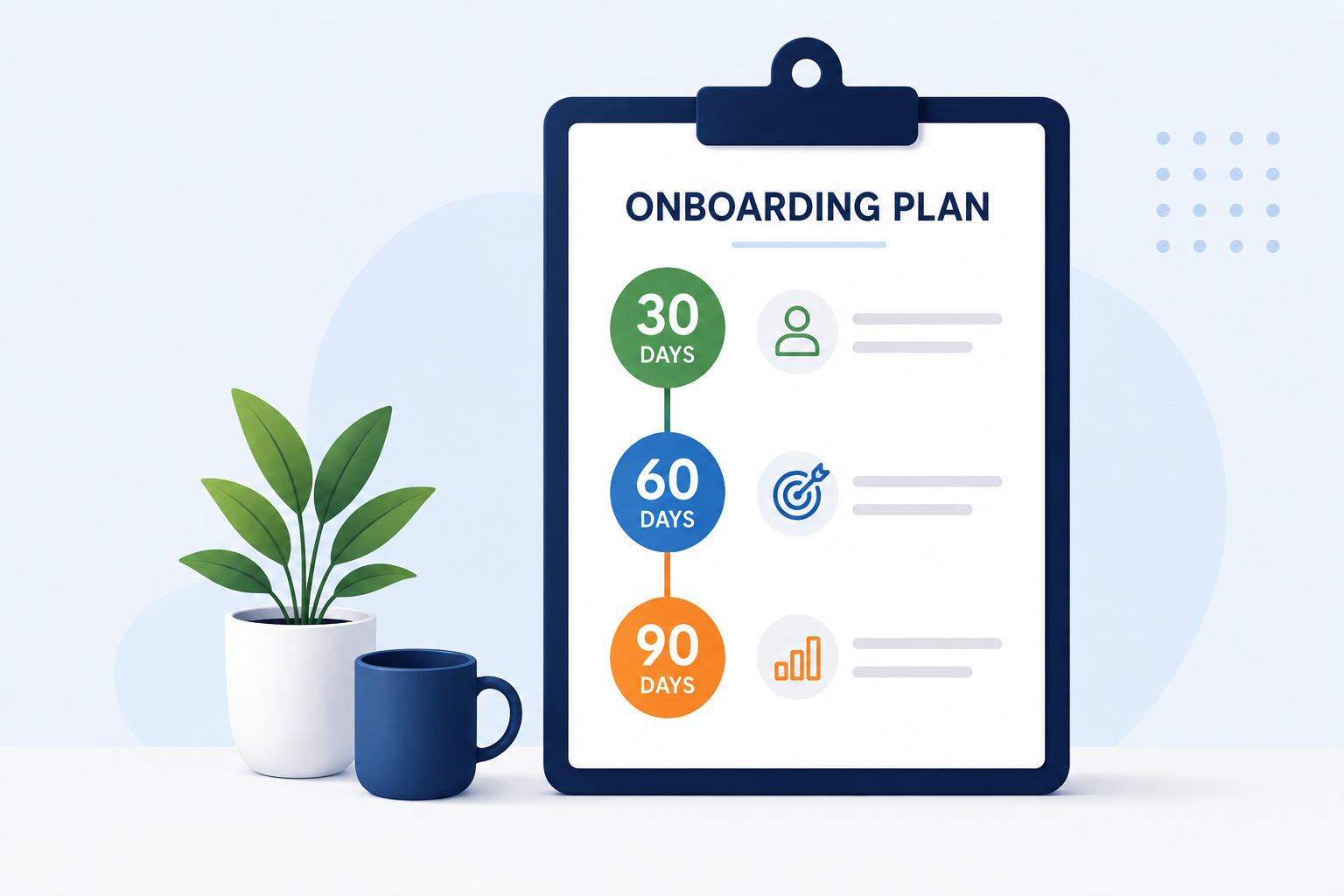
A 30-60-90 day onboarding plan is a structured roadmap that defines what a new employee should learn, accomplish, and take ownership of during their first three months.
The three phases generally move from learning to contribution to ownership.
During the first 30 days, the focus is on understanding the organization, role, team, tools, policies, and expectations. By days 31–60, the employee should begin applying what they have learned and contributing to meaningful work. During days 61–90, the focus shifts toward greater independence, measurable outcomes, and longer-term development.
The plan should provide direction without becoming a rigid checklist. Goals should be adapted to the employee’s role, department, experience level, and responsibilities.
Why HR Teams Need More Than an Onboarding Checklist
Traditional onboarding often depends on emails, spreadsheets, shared folders, and manual follow-ups. That approach may work when an organization has only a few new hires, but it becomes difficult to manage as hiring volume increases.
HR may need to coordinate document collection, policy acknowledgments, training, system access, manager tasks, check-ins, and employee questions while also managing other HR responsibilities.
An HRMS (Human Resource Management System) can bring these activities into one connected workflow. Instead of HR remembering what needs to happen next, the system can assign tasks, send notifications, collect information, and provide visibility into completion.
The result is a more consistent onboarding process without making HR responsible for manually tracking every step.
How to Build a 30-60-90 Day Onboarding Plan
A strong onboarding plan should start with the role rather than with a generic checklist.
First, identify what the employee needs to understand and accomplish to become effective in the position. This could include learning internal processes, completing role-specific training, meeting key stakeholders, understanding company policies, or becoming familiar with specific systems.
Next, establish realistic milestones for each phase.
Days 1–30: Learn and settle in
The first month should establish a strong foundation. Employees should understand their role, team structure, company culture, tools, processes, and immediate priorities. HR can also ensure that required documentation, policies, training, and compliance activities are completed.
The goal is not maximum productivity. It is helping the employee understand how to work effectively within the organization.
Days 31–60: Contribute and build confidence
The second phase should move beyond orientation. Employees can begin taking ownership of defined responsibilities, working on real projects, and collaborating more independently.
Managers should use this stage to provide feedback and identify areas where additional training or support is needed.
Days 61–90: Own and demonstrate progress
By the third month, employees should have a clearer understanding of their responsibilities and be working with greater independence.
This is a good time to review measurable goals, discuss development opportunities, identify process improvements, and evaluate how well the employee is progressing toward longer-term expectations.
The 90-day review should be a conversation about progress and next steps rather than simply a final onboarding checklist.
What Should HR Teams Automate?
The value of onboarding automation is not simply replacing manual tasks with software. It is creating a workflow where the right activity happens at the right time without HR having to coordinate every detail.
Task Assignment and Tracking
Once an employee is added to the HR system, onboarding tasks can be automatically assigned to HR, managers, IT, and the employee.
For example, HR may be responsible for documentation, IT may handle system access, and the manager may need to schedule team introductions or define role-specific goals.
Automated due dates, reminders, and status tracking make ownership clear and reduce the chance of important tasks being overlooked.
Documents and Policy Acknowledgments
Collecting employee information and distributing policies can consume significant administrative time.
An HRMS can provide employees with self-service access to forms, documents, policies, and required acknowledgments. Automated notifications can remind employees about incomplete activities without requiring HR to send individual follow-up emails.
Manager Check-Ins
The 30-60-90 process works best when managers remain involved throughout the employee’s transition.
HR software can schedule reminders for 30, 60, and 90-day check-ins and give managers visibility into outstanding onboarding activities. This creates a consistent process while allowing managers to focus the conversation on the employee’s actual progress.
Employee Self-Service
New hires should not have to contact HR every time they need basic information.
Employee self-service can give them access to relevant HR information, documents, policies, tasks, and onboarding activities from one place. This reduces repetitive HR queries while giving employees greater control over their own onboarding experience.
Role-Based Onboarding Workflows
Not every employee needs the same onboarding journey.
A software developer may need technical training and access to development systems, while a sales employee may need CRM training, product knowledge, and customer-facing preparation.
Smart onboarding workflows can adapt tasks and content according to factors such as role, department, location, and employment type.
Connecting Recruitment and Onboarding
The onboarding experience should not begin with HR manually recreating information that was already collected during recruitment.
An Applicant Tracking System (ATS) can capture candidate information throughout the hiring process. Once the candidate accepts an offer, relevant information can flow into the HRMS, reducing duplicate data entry and creating a smoother transition from recruitment to onboarding.
This connection also creates a more consistent employee journey. Information collected during hiring can support onboarding workflows, while the HR team can continue managing the employee through other areas of HR Management and workforce administration.
How AI Can Make the 30-60-90 Plan More Intelligent
Automation handles repeatable processes. AI can help make those processes more relevant.
AI-powered HR software can use employee and role information to help create more personalized onboarding experiences. New hires can receive information and activities that are more closely aligned with their position, department, responsibilities, and development needs.
AI can also support HR teams by identifying incomplete activities, surfacing potential bottlenecks, and helping employees find answers to routine questions.
The goal is not to remove people from onboarding. It is to reduce the administrative work surrounding the experience so HR and managers have more time for meaningful conversations, coaching, and relationship building.
How to Know If Your Onboarding Plan Is Working
Completing onboarding tasks does not necessarily mean that onboarding is successful.
HR teams should look at outcomes as well as completion rates. Useful measures include time to productivity, new-hire feedback, manager check-in completion, training progress, and 90-day retention.
Feedback is particularly valuable. A new hire may complete every required task and still feel unclear about expectations or disconnected from the team.
Regular 30, 60, and 90-day conversations give HR and managers opportunities to identify those issues early and adjust the onboarding experience.
Common Mistakes to Avoid
One of the biggest mistakes is treating onboarding as something that ends after the first week. Another is giving every employee exactly the same experience regardless of role or responsibility.
HR teams should avoid creating plans filled with activities but no measurable outcomes. Also, avoid making the manager responsible for remembering every milestone. A smart HR system should provide the reminders, workflow, and visibility needed to keep the process moving.
Final Thoughts
A 30-60-90 day onboarding plan gives HR teams and managers a practical framework for helping new employees move from learning to contribution and, eventually, independent ownership.
The real opportunity is to make that framework easier to execute. Automated workflows can handle repetitive coordination, employee self-service can reduce administrative questions, and AI-powered capabilities can help create a more intelligent and personalized onboarding experience.
With the right HRMS, onboarding becomes more than a checklist. It becomes a connected part of HR management and workforce management that supports employees from their first day through their longer-term journey with the organization.

Ready to Build a Smarter Onboarding Experience?
See how SutiHR helps organizations automate HR workflows and manage the employee journey.
FAQs
Onboarding is the overall process of helping a new employee adjust and become productive. A 30-60-90 day plan provides a structured timeline for that process.
Onboarding is a shared responsibility. HR manages the process, managers guide role-specific goals, and employees complete their activities and milestones.
HR should prepare the plan before the employee’s first day so tasks, documents, training, and goals are ready from the start.
Set specific, achievable goals based on what the employee needs to learn, contribute, and eventually own in their role.
The 90-day review can transition into regular performance and development discussions, with longer-term goals and priorities established for the employee.