
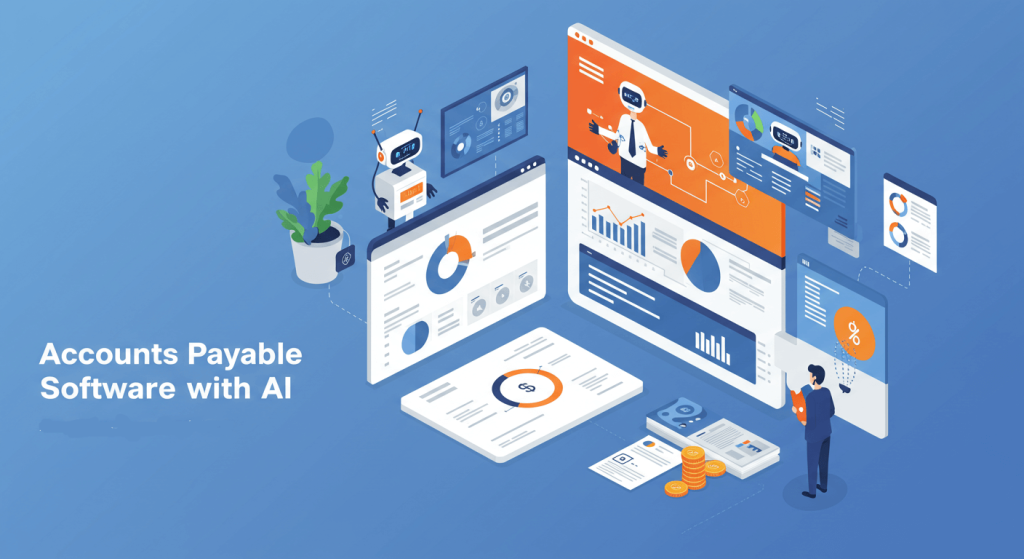
As automation continues to change the landscape of so many industries, one of the areas experiencing the most profound change is Accounts Payable (AP).
Traditionally burdened with manual, tedious, and error-prone tasks, AP departments now leverage AI technologies to enhance efficiency, accuracy, and strategic value.
This article explores the key aspects of AI in Accounts Payable, the core technologies driving the transformation, the challenges, and what the future holds for finance teams.
Key Takeaways
- AI transforms AP from transactional to strategic: Artificial intelligence elevates accounts payable departments beyond manual data entry, enabling finance teams to focus on strategic analysis, vendor relationship management, and business growth initiatives.
- Intelligent automation delivers immediate efficiency gains: AI-powered systems reduce invoice processing time by up to 75% and minimize human errors from 2% to 0.8% while enabling straight-through processing.
- Advanced fraud detection and compliance become automated: Machine learning algorithms continuously monitor payment patterns to identify duplicate invoices, suspicious activities, and compliance violations in real-time.
- Data-driven insights enable proactive financial management: AI provides predictive analytics for cash flow forecasting and vendor performance assessment, empowering CFOs to make informed decisions about liquidity and supplier relationships.
- Implementation requires strategic change management: Successful AI adoption demands significant investment to ensure deployments that deliver measurable ROI.

Understanding Accounts Payable (AP) and Its Traditional Challenges
Before diving into AI’s transformative potential, it’s essential to understand why accounts payable has remained one of finance’s most problematic areas.
The challenges plaguing traditional AP departments aren’t just operational inconveniences—they’re strategic barriers that prevent finance teams from delivering real business value.
Accounts Payable involves managing and paying a company’s bills and invoices. Historically, AP processes have faced significant challenges:
- Manual Data Entry: High reliance on human input leads to errors.
- Invoice Processing Delays: Slow turnaround times affecting vendor relationships.
- Fraud Risk: Difficulty in tracking irregularities.
- Compliance Issues: Complex regulatory requirements.
- Limited Visibility: Poor insight into financial obligations and cash flow.
The traditional AP model often limited the department’s role to a purely transactional function, leaving little room for strategic impact.
How AI Is Transforming Accounts Payable
The shift from manual to AI-powered accounts payable isn’t just an upgrade—it’s a complete reimagining of how financial operations can drive business success. Let’s explore the five key areas where artificial intelligence is delivering immediate, measurable impact:
Key AI Transformations Covered:
- Intelligent Data Capture
- Automated Invoice Matching
- Predictive Analytics and Cash Flow Management
- Fraud Detection and Risk Mitigation
- Dynamic Approval Workflows
Each transformation represents a quantum leap in efficiency, accuracy, and strategic value, fundamentally changing what’s possible in accounts payable.
Intelligent Data Capture
AI-powered optical character recognition (OCR) and natural language processing (NLP) can automatically extract and interpret invoice data from varied formats. This significantly reduces the need for manual entry and minimizes errors.
Example: Modern AI solutions can extract supplier names, invoice numbers, payment amounts, and due dates with remarkable accuracy.
Automated Invoice Matching
AI systems can automatically match invoices with purchase orders (POs) and goods received notes (GRNs). If discrepancies arise, the system can flag them for human review or suggest corrections.
Benefit: Drastically lowers the time and effort needed for three-way matching and enhances compliance.
Predictive Analytics and Cash Flow Management
AI can forecast future payment obligations and cash flow needs by analyzing historical payment trends and seasonal patterns. It provides finance teams with proactive insights to make smarter financial decisions.
Impact: Improved liquidity management and strategic financial planning.
Fraud Detection and Risk Mitigation
AI algorithms can detect unusual patterns that may indicate fraud, such as duplicate payments or suspicious vendor activities. Machine learning models continuously learn from new data, improving their fraud detection capabilities.
Example: Identifying vendors who submit multiple invoices for the same service under slightly different names.
Dynamic Approval Workflows
With AI, invoice approval workflows can become dynamic and context-aware. The system can route invoices to the right approver based on invoice value, vendor history, or urgency.
Outcome: Faster, more efficient processing, with reduced bottlenecks.
Key Technologies Behind AI in Accounts Payable
Understanding the technological foundation of AI-powered AP systems demystifies how these remarkable improvements become reality. These aren’t futuristic concepts—they’re proven technologies working together to create intelligent automation:
Core Technologies Explained:
- Machine Learning (ML)
- Natural Language Processing (NLP)
- Robotic Process Automation (RPA)
- Predictive Analytics
- Computer Vision
This technical overview provides the knowledge foundation needed to make informed decisions about AI implementation in your organization.
Now, let’s take a look at each of these five items in more detail:
Machine Learning (ML)
ML models are trained on historical invoice data to recognize patterns, predict anomalies, and make decisions without explicit programming.
Natural Language Processing (NLP)
NLP allows AI to understand and interpret human language within invoices, emails, and contracts.
Robotic Process Automation (RPA)
While not strictly AI, RPA combined with AI (“Intelligent Automation”) automates repetitive tasks like data entry, invoice filing, and report generation.
Predictive Analytics
Based on data analysis, Advanced AI tools can predict payment behaviors, cash flow trends, and even supplier risks.
Computer Vision
Used in combination with OCR, computer vision enables AI systems to “see” and process invoices regardless of their format or layout.
Benefits of AI-Driven Accounts Payable
The business case for AI in accounts payable becomes compelling when you see the concrete benefits organizations are achieving today. These aren’t projected improvements—they’re real results that leading companies are already experiencing:
Discover how AI transforms accounts payable from a cost center into a strategic business enabler, delivering measurable value across multiple dimensions, such as:
- Enhanced Efficiency: Faster processing times mean more invoices are processed with fewer resources.
- Cost Reduction: Lower labor costs and fewer errors resulting in financial savings.
- Better Compliance: Automated audit trails make compliance with financial regulations much easier.
- Stronger Vendor Relationships: Timely payments improve supplier trust and can open doors for better terms.
- Strategic Finance Role: Finance teams can shift focus from transactional tasks to strategic financial analysis and decision-making.
Challenges in Implementing AI in Accounts Payable
While the benefits of AI are substantial, successful implementation requires navigating real challenges that every organization faces.
Understanding these obstacles upfront allows for better planning and more realistic expectations when mastering the end-to-end AP process with automation:
Data Quality
AI’s effectiveness is heavily dependent on the quality of input data. Inconsistent or incomplete data can hamper AI performance.
Change Management
Transitioning from traditional AP processes to AI-driven models requires a cultural shift and training investment.
Integration Complexity
Integrating AI with existing ERP and finance systems can be technically challenging.
Cost of Implementation
Initial investment in AI tools and technologies can be high, although the ROI over time is usually significant.
Security Concerns
Handling sensitive financial data means that robust cybersecurity measures must be in place.
What the Future Holds: AI’s Evolving Role in Finance
The current state of AI in accounts payable is just the beginning.
Understanding the trajectory of these technologies helps organizations prepare for what’s coming and position themselves advantageously:
Future Developments on the Horizon:
- Touchless Invoice Processing
- Smarter Vendor Management
- Real-Time Financial Visibility
- Hyper-Automation
- Embedded AI in ERP Systems
- Ethical and Responsible AI
These emerging capabilities represent the next wave of financial automation, offering a glimpse into how AI will continue reshaping the entire finance function.
Touchless Invoice Processing
The goal is “straight-through processing” where invoices move from receipt to payment without human intervention unless exceptions arise.
Smarter Vendor Management
Streamline invoice processing with accounts payable automation software and help assess vendor performance, monitor risks, and suggest alternatives proactively.
Real-Time Financial Visibility
AI-driven dashboards will offer real-time insights into payables, helping CFOs and finance leaders make agile decisions.
Hyper-Automation
Combining AI, RPA, and advanced analytics will create hyper-automated AP departments capable of scaling with minimal human intervention.
Embedded AI in ERP Systems
More ERP vendors will natively embed AI functionalities, making them accessible even to mid-sized businesses.
Ethical and Responsible AI
As AI becomes ubiquitous in finance, companies will need to ensure ethical AI practices — addressing biases, ensuring transparency, and maintaining accountability.
How Companies Can Prepare for the AI Revolution in Accounts Payable
Preparation is the key differentiator between organizations that successfully harness AI and those that struggle with implementation. This practical roadmap provides actionable steps and best practices to optimize accounts payable processes:
Essential Preparation Steps:
- Assess Current Processes
- Invest in Data Quality
- Choose the Right Technology Partners
- Start Small and Scale
- Train and Upskill Teams
- Develop a Governance Framework
Follow this strategic framework to ensure your organization is positioned for AI success, avoiding common implementation mistakes while maximizing the return on your technology investment.
Assess Current Processes
- Identify inefficiencies and areas where automation can bring quick wins.
Invest in Data Quality
- Ensure financial data is clean, structured, and accessible.
Choose the Right Technology Partners
- Select AI vendors with proven expertise in finance and accounts payable automation.
Start Small and Scale
- Begin with pilot projects to understand the nuances before full-scale implementation.
Train and Upskill Teams
- Equip finance teams with the necessary skills to manage and work alongside AI systems.
Develop a Governance Framework
- Create policies around AI use to ensure ethical and secure deployments.

Conclusion
The integration of AI into accounts payable represents more than technological advancement—it’s a paradigm shift that redefines the strategic value of finance operations.
Organizations that embrace AI-driven AP automation don’t just improve efficiency; they unlock competitive advantages through enhanced cash flow management, stronger vendor relationships, and data-driven financial insights.
The path forward is clear.
Companies must act decisively to assess their current processes, invest in quality data infrastructure, and partner with proven technology providers.
Start with pilot implementations to demonstrate value, then scale systematically across the organization.
The businesses that begin this transformation today will establish themselves as industry leaders, while those that delay risk falling behind in an increasingly automated financial landscape.
Ready to transform your accounts payable operations? Discover how SutiAP’s AI-powered automation can eliminate manual bottlenecks, reduce processing costs by up to 75%, and provide real-time financial visibility.
Start your free trial today and experience the future of intelligent accounts payable management.
The AI revolution in accounts payable isn’t coming—it’s here. Make sure your organization is positioned to lead, not follow, in this transformative era of finance technology.
Frequently Asked Questions
Q: How does AI-powered invoice processing actually work in practice?
A: AI systems use optical character recognition (OCR) and natural language processing to automatically extract data from invoices in various formats (PDF, paper, electronic). The system then validates this information against purchase orders and receipt records using machine learning algorithms, flagging only exceptions for human review while processing standard invoices automatically.
Q: What’s the typical ROI timeline for implementing AI in accounts payable?
A: Most organizations see immediate efficiency gains within 30-60 days of implementation, with full ROI typically achieved within 6-12 months. Companies processing 1,000+ invoices monthly can save approximately $120,000 annually by reducing manual processing costs, eliminating late payment fees, and capturing early payment discounts.
Q: Can AI systems integrate with existing ERP and accounting software?
A: Yes, modern AI-powered AP solutions are designed to integrate seamlessly with popular ERP systems like SAP, Oracle, and Microsoft Dynamics, as well as accounting platforms like QuickBooks and NetSuite. This integration ensures data consistency and enables real-time financial reporting without disrupting existing workflows.
Q: What happens to AP staff when AI automates their traditional tasks?
A: Rather than replacing jobs, AI typically transforms roles within the AP department. Staff transition from manual data entry and invoice matching to more strategic responsibilities like vendor relationship management, financial analysis, exception handling, and process optimization, creating more engaging and valuable positions.
Q: How secure is AI-powered accounts payable processing for sensitive financial data?
A: Leading AI AP solutions implement enterprise-grade security measures including data encryption, role-based access controls, audit trails, and compliance with standards like SOX and GDPR. Many systems offer additional security features like anomaly detection to identify potentially fraudulent activities in real-time.