Contracts are central to an organization’s financial stability, it influences revenue generation, cost control, and overall risk exposure. Yet, despite their importance, contract management is often overlooked compared to other core business functions. Many businesses still depend on outdated systems, siloed data, and manual processes, which create inefficiencies, increase operational costs, and limit growth potential.
With the rising complexity of modern businesses, corporate sectors are handling an ever-growing volume of contracts from supplier agreements to customer deals. Managing these documents effectively is critical, as poorly handled contracts can introduce compliance issues, financial leakage, and legal risks. Advancements in contract management offer a powerful opportunity to modernize these processes, improve visibility, and unlock significant business value.
Read the blog to explore how an effective contract lifecycle management strategy can streamline operations, enhance compliance, mitigate risks, and drive sustainable revenue growth.
Why Risk Mitigation Matters & How CLM Helps
Risk mitigation is essential for protecting a company’s assets, reputation, and financial health while enabling confident growth. By identifying potential threats early and taking proactive measures, businesses can avoid financial losses, legal issues, and operational disruptions. This is especially important in contract-driven processes, where overlooked risks can lead to costly consequences.
Here are some common contract-related challenges:
- Limited contract visibility, resulting in missed renewals and overlooked obligations
- Lack of adherence to contract processes, increasing legal and business risks
- Exposure to risk due to inconsistent or non-standard contract language
- Challenges in integrating third-party contracts into workflows, leading to incomplete or fragmented data
- Poor data quality and insufficient awareness of the importance of accurate metrics and reporting
Contract lifecycle management plays a key role in strengthening risk mitigation efforts. It centralizes contracts, improves visibility, and ensures compliance with policies and regulations. CLM also enables better partner evaluation, standardized workflows, and real-time tracking of obligations. By embedding risk management at every stage of the contract lifecycle, businesses can reduce uncertainty, enhance control, and build a more resilient, compliant business environment.
In our next section, we will discuss it in more detail.
Why CLM Has Become a Strategic Enabler for Risk and Compliance
Contract lifecycle management has evolved from a functional tool into a strategic capability that helps businesses overcome inefficiencies, reduce risk, and drive enterprise-wide value. Modern businesses require CLM to extend beyond individual departments and operate as a unified, enterprise-level solution.
Below is how CLM delivers real business outcomes across the organization:
- Driving Financial Performance and ROI
CLM directly contributes to revenue growth by accelerating contract cycles, reducing negotiation delays, and enabling faster deal closures. This allows businesses to recognize revenue sooner and improve cash flow.
It also strengthens profitability by identifying revenue leakage and highlighting opportunities for renewals or pricing adjustments. On the cost side, CLM prevents unfavorable auto-renewals, enforces supplier terms, and reduces administrative expenses by automating routine tasks like delivering clear financial returns.
- Strengthening Enterprise Risk and Compliance
CLM provides a centralized contract repository, creating a single, reliable source of truth across the organization. This eliminates inconsistencies, reduces internal conflicts, and ensures all stakeholders work with accurate, up-to-date information.
It also enforces compliance by embedding approved legal clauses and maintaining detailed audit trails for regulatory requirements. Additionally, CLM enables proactive obligation management by tracking key milestones, deadlines, and deliverables, sending timely alerts to prevent breaches and ensure accountability.
- Improving Efficiency and Business Agility
By automating workflows and approval processes, CLM removes bottlenecks and speeds up contract execution. It empowers teams beyond legal and procurement by providing standardized templates and clause libraries, enabling business users to create compliant, low-risk contracts independently.
This not only improves efficiency but also allows legal teams to focus on more strategic, high-value work.
- Unlocking Strategic Insights from Contract Data
CLM transforms contract data into actionable intelligence. Leaders gain visibility into vendor performance, risk concentration, and value delivery across partnerships. These insights support better decision-making, helping organizations identify opportunities, mitigate risks, and strengthen their competitive position.
- Enhancing Collaboration and Cross-Functional Alignment
CLM fosters stronger collaboration across departments by creating a unified platform that enables legal, procurement, finance, and sales teams to work together seamlessly. It eliminates communication gaps by providing shared access to contract data, standardized processes, and real-time updates. This alignment ensures that all stakeholders are on the same page throughout the contract lifecycle, reducing delays and misunderstandings.
CLM is no longer an operational tool; it is a strategic asset that drives financial performance, improves compliance, enables smarter, faster business decisions, and positions businesses for sustainable growth and long-term success.
How AI-Powered CLM Drives Revenue, Compliance, and Risk Management
AI is revolutionizing contract lifecycle management by transforming how businesses handle contracts, enabling smarter decisions, faster execution, and stronger risk control. AI-powered CLM solution automates repetitive tasks such as contract creation, review, and approval, reducing cycle times and accelerating deal closures. This directly contributes to revenue growth by allowing businesses to recognize opportunities while minimizing delays caused by manual processes.
From a compliance perspective, AI enhances accuracy and consistency. It can automatically analyze contracts to ensure adherence to regulatory requirements and company policies, flagging deviations or non-standard clauses before they become issues. This reduces legal exposure and strengthens corporate governance.
AI also plays a critical role in risk management. Advanced algorithms can detect potential risks in contracts, such as unfavorable terms, missing obligations, or high-risk counterparties, providing proactive alerts to mitigate issues before they escalate. Predictive analytics can identify patterns that indicate future risks or opportunities, giving leadership the insights needed to make data-driven decisions.
By combining automation, intelligence, and predictive capabilities, AI-enabled CLM empowers organizations to drive revenue, maintain compliance, and manage risks more effectively, turning contract management into a strategic business advantage.
How SutiCLM Enables Revenue Growth, Compliance, and Risk Control
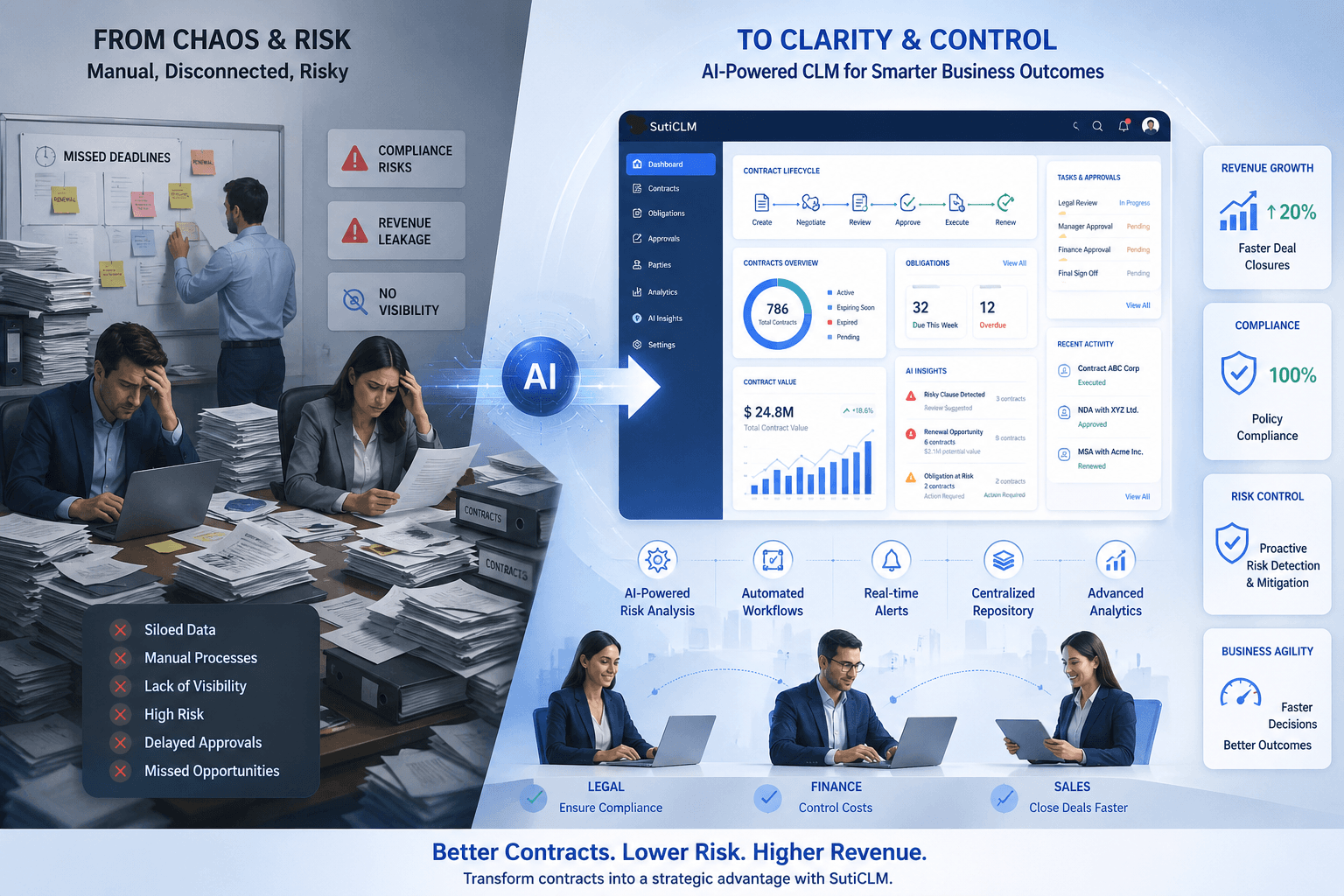
SutiCLM empowers businesses to transform contract management into a strategic advantage by driving revenue, strengthening compliance, and minimizing risk. By automating the entire contract lifecycle from creation and negotiation to execution and renewal, it significantly reduces cycle times, enabling faster deal closures and quicker revenue realization.
The platform enhances revenue opportunities by identifying key milestones such as renewals, expirations, and pricing adjustments, ensuring that no opportunity is missed. At the same time, it safeguards margins by eliminating revenue leakage and enforcing agreed-upon terms with customers and suppliers.
From a compliance perspective, SutiCLM standardizes contract processes through pre-approved templates and clause libraries, ensuring consistency and compliance with legal and regulatory requirements. Its centralized repository provides a single source of truth, complete with audit trails that simplify reporting and support regulatory audits.
In terms of risk management, SutiCLM offers real-time visibility into contractual obligations, deadlines, and performance metrics. Automated alerts and tracking mechanisms help prevent breaches, missed commitments, and financial penalties. By combining efficiency, visibility, and control, SutiCLM enables organizations to operate with greater confidence, reduce uncertainty, and achieve sustainable business growth.
Final Thoughts
Contracts are no longer just legal documents; they are strategic assets that directly influence revenue, compliance, and risk exposure. Businesses that continue to rely on manual, fragmented contract processes risk inefficiencies, missed opportunities, and increased vulnerability to financial and legal setbacks.
Adopting a robust contract lifecycle management strategy enables businesses to take control of their contracts, streamline operations, and gain complete visibility across the contract lifecycle. By embedding compliance, automating workflows, and proactively managing obligations, CLM helps businesses reduce risk while improving efficiency and accountability. Solutions like SutiCLM further improve these capabilities by combining automation, intelligence, and centralized control into a single platform. This empowers teams to accelerate deal cycles, prevent revenue leakage, and ensure adherence to contractual and regulatory requirements while minimizing operational overhead.