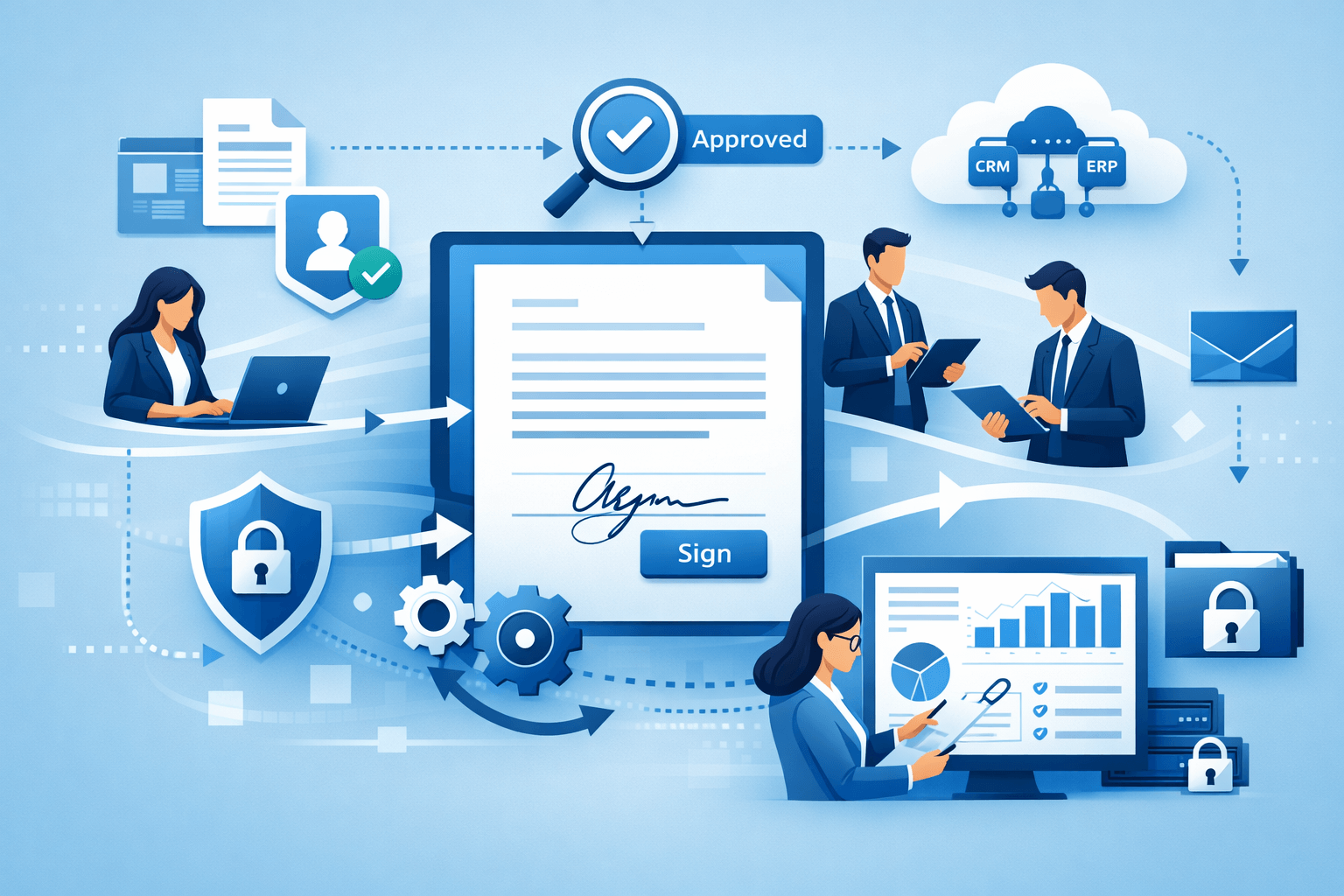
In the modern digital workplace, the way organizations manage agreements has evolved dramatically. Paper contracts, wet signatures, and manual approvals have become bottlenecks that slow down operations and increase risk. Modern eSignature platforms are now at the heart of digital transformation, enabling faster agreements, better compliance, and complete visibility across document lifecycles.
But an electronic signature solution is more than a tool for clicking “Sign.” It’s a cohesive system designed to handle document creation, identity verification, automated workflows, policy enforcement, storage, integrations, and analytics, all seamlessly connected. Understanding how these components interact is essential for legal teams, HR departments, procurement professionals, and IT leaders evaluating platforms or designing governance for their organizations.
Let’s explore the core components of modern eSignature software, how they interact, and why platform architecture matters far more than feature checklists.
Why Modern eSignature Software Goes Beyond Just Capturing Signatures
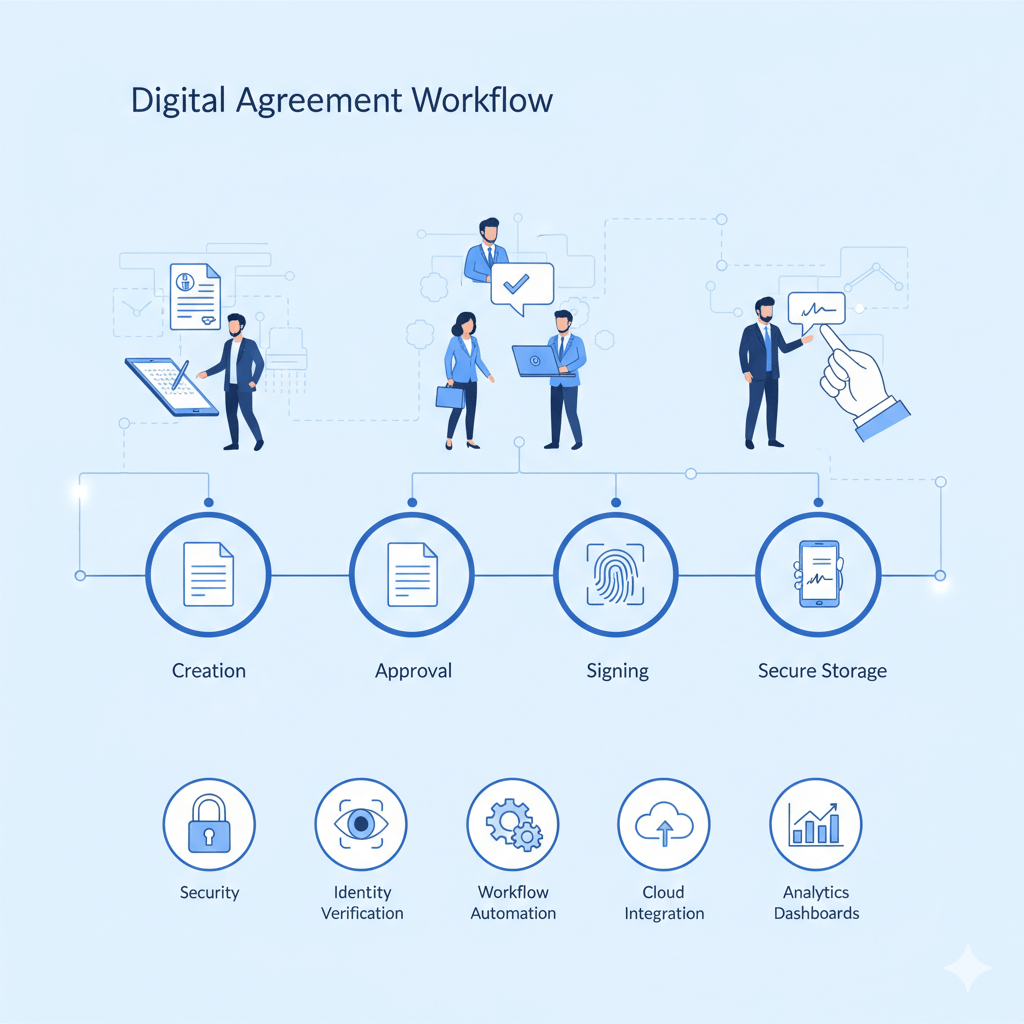
Unlike simple signature apps that only let you sign PDFs, modern eSignature platforms manage the entire lifecycle of agreements. That lifecycle begins with document creation and template management, extends through review, authentication, and workflow routing, and concludes with secure storage, reporting, and compliance auditing.
The most successful platforms integrate deeply into business processes rather than functioning as disconnected modules. They ensure that policies, rules, and data flow seamlessly from creation to execution, giving organizations speed, accuracy, and control.
Much like how digital supply chain platforms optimize order flows or expense systems manage financial processes, eSignature platforms rely on interdependent components working in harmony. A failure in one part, such as identity verification, workflow routing, or integration with ERP/CRM systems, can cascade, causing delays, errors, or compliance issues.
The Core Components That Power Modern eSignature Software
While every platform has its own terminology, most modern eSignature software is structured around six interconnected functional layers:
- Document Authoring and Template Management
- Signer Identity Verification and Security
- Compliance and Policy Enforcement
- Workflow Automation and Routing
- Integration with Enterprise Systems
- Reporting, Insights, and Audit Trails
Each component serves a distinct purpose, but the overall efficiency of the platform depends on how well these capabilities work together to maintain consistency and control throughout the agreement lifecycle.
Document Authoring and Template Management – The Foundation of Consistency
Every agreement begins with content. Smart eSignature platforms allow teams to create smart templates that standardize documents and reduce repetitive work. Templates can include signature fields, initials, dates, checkboxes, text blocks, or conditional fields that appear only when specific conditions are met.
Benefits of robust template management include:
- Consistency Across Documents: Standard clauses, formatting, and language reduce risk and confusion.
- Error Prevention: Mandatory fields and validation rules prevent incomplete submissions.
- Time Savings: Reusable templates accelerate the creation of common agreements like NDAs, vendor contracts, or HR forms.
Some platforms even offer dynamic fields that adjust based on document type or signer role, further enhancing efficiency. Templates are the first point of control in the agreement lifecycle, without them, downstream workflows are prone to errors and delays.
Signer Identity Verification and Security – Trust Built Into Every Signature
The value of a digital signature depends entirely on the trustworthiness of the signer. Intelligent eSignature software supports multiple authentication methods, ranging from basic email verification to advanced certificate-based digital signatures.
Common verification methods include:
- Email or SMS confirmation
- Knowledge-based authentication (KBA)
- Government-issued ID verification
- Digital certificates for high-assurance or regulated documents
Layered verification ensures that agreements are legally binding and compliant with standards such as ESIGN, UETA, and eIDAS. This flexibility allows organizations to match security levels with document sensitivity, for example, onboarding forms may require only email verification, while multi-million-dollar contracts may demand strict digital certification.
Compliance and Policy Enforcement – Rules That Work Automatically
Organizations face increasing regulatory scrutiny and internal governance requirements. Modern eSignature platforms enforce rules automatically, reducing human error and strengthening compliance.
Policy enforcement can include:
- Ensuring all mandatory fields are filled before sending
- Restricting who can sign based on roles or departments
- Enforcing required clauses or attachments
- Triggering retention rules or archiving procedures
Automated compliance means documents are legally defensible and audit-ready without constant manual checks. By integrating rules directly into the system, platforms reduce delays, prevent errors, and free teams to focus on strategic tasks.
Workflow Automation and Routing – Directing Documents Intelligently
Not all agreements follow the same path. Multi-party approvals, parallel signatures, conditional routing based on document type, department, or value, these are common challenges.
Workflow automation transforms eSignature platforms from simple signing tools into complete agreement management solutions.
- Documents can be routed based on organizational hierarchy.
- Conditional approvals can be triggered depending on document type or value.
- Escalations automatically occur if approvals are overdue.
- Parallel signatures and sequential workflows ensure proper order and compliance.
Smart routing ensures that documents move efficiently, bottlenecks are minimized, and accountability is clear at every stage.
Integration With Enterprise Systems – Embedding Signatures Into Operations
The full impact of eSignature software comes when it’s integrated with other business systems:
- ERP platforms to record signed contracts or trigger financial processes
- CRM systems to initiate contracts from sales opportunities
- HRIS systems to automate onboarding or policy acknowledgment forms
- Document management systems like Google Drive for central storage
Integrations prevent siloed data, reduce manual data entry, and automatically trigger downstream actions, creating an end-to-end digital agreement lifecycle.
Reporting, Analytics, and Audit Trails – From Data to Insights
A signature alone doesn’t provide insight. Leaders need visibility into document progress, bottlenecks, compliance, and performance metrics.
Modern eSignature platforms provide dashboards and analytics showing:
- Time-to-sign for different departments or roles
- Pending and completed agreements
- Compliance violations or exceptions
- Document-specific activity logs
Audit trails capture every event, including document creation, edits, signature timestamps, IP addresses, and authentication methods. This ensures legal defensibility and makes it easy to respond to audits or disputes.
How these Components Work Together in Real-World Workflows
A modern eSignature platform is a unified system. Here’s a typical flow:
- A user selects a template for a document.
- Fields and clauses are automatically populated.
- Signer authentication is enforced.
- The workflow routes the document to the appropriate approvers.
- Signers receive notifications and complete signatures.
- Completed agreements are securely stored and synced with enterprise systems.
- Analytics dashboards update to reflect real-time status.
Each step depends on data accuracy from the previous stage. A failure anywhere, template, authentication, workflow, or integration, can cascade and slow the entire process.
Beyond Features: Why Platform Architecture Matters
Many vendors emphasize features – templates, workflows, APIs, and dashboards. But a platform’s architecture determines whether these features work seamlessly together.
Strong architecture provides:
- Unified Data Models: Users, documents, and audit logs are consistent across the platform
- Automated Policy Enforcement: Rules are applied at every stage
- Minimal Manual Handoffs: Integrations and routing reduce errors and delays
- Comprehensive Audit Trails: Every event is captured and retrievable
- Scalable Control: Systems support organizational growth without breaking workflows or compliance
Even a feature-rich platform can create friction if it has fragmented architecture — resulting in delays, errors, and blind spots in compliance.
Business Impact of Modern eSignature Platforms
For HR, legal, finance, and operations leaders, the benefits are tangible:
- Accelerated Agreement Cycles: Templates and automated workflows reduce turnaround times from days to hours
- Improved Compliance and Risk Management: Policy enforcement and verified signatures reduce legal exposure
- Enhanced Visibility and Control: Dashboards provide real-time insights into pending approvals, bottlenecks, and compliance performance
- Reduced Operational Costs: Automation reduces errors, rework, and administrative overhead
- Stronger Legal Defensibility: Comprehensive audit trails and authentication protect against disputes
Conclusion
Electronic signatures are no longer just a convenience, they are a core part of modern business operations. But capturing a signature alone is not enough. Organizations need platforms that bring together document creation, identity verification, compliance enforcement, workflow automation, integrations, and reporting into a seamless and auditable process.
Modern eSignature software transforms agreement management into a faster, more controlled, and transparent workflow. When these capabilities are built on a strong architectural foundation, organizations gain better visibility, stronger compliance, and greater confidence that every agreement is executed accurately.
Ready to streamline your agreement workflows? Discover how SutiSign simplifies secure, compliant, and efficient electronic signing.