Hiring has become more competitive, data-driven, and technology-dependent than ever before. Recruiters are expected to fill positions faster, improve candidate experience, and make better hiring decisions while managing increasing application volumes and tighter budgets. At the same time, organizations need hiring processes that integrate seamlessly with onboarding, payroll, and broader HR operations.
Recruitment software has evolved to meet these challenges. Modern platforms combine applicant tracking, workflow automation, AI-assisted recruiting, and analytics to help HR teams streamline hiring from job requisition to offer acceptance. However, choosing the right solution requires more than comparing feature lists. HR leaders must evaluate how well a platform aligns with their hiring processes, integrates with existing systems, supports future growth, and delivers measurable business value.
This blog presents the key factors every HR team should consider before investing in recruitment software and explains how to identify a solution that supports long-term hiring success.
Why Recruitment Software Matters More Than Ever
Recruitment has moved beyond posting jobs and collecting resumes. Today’s hiring teams manage candidates across multiple job boards, social platforms, referral programs, and career sites while coordinating hiring managers, interviewers, and HR administrators throughout the recruitment process.
Manual hiring processes often lead to delayed responses, inconsistent communication, duplicate data entry, and limited visibility into recruiting performance. These inefficiencies increase time-to-hire, create a poor candidate experience, and make it difficult for organizations to compete for top talent.
Recruitment software centralizes hiring activities into a single platform. Instead of relying on spreadsheets, emails, and disconnected applications, HR teams gain structured workflows that automate repetitive tasks, improve collaboration, and provide greater visibility into every stage of the hiring lifecycle.
As organizations continue adopting AI and automation, recruitment software is becoming a strategic investment that helps HR teams hire faster while improving decision-making and operational efficiency.
What Modern Recruitment Software Should Deliver
Today’s recruitment software should do far more than organize resumes. The right platform should simplify hiring while providing recruiters and hiring managers with the information they need to make confident decisions.
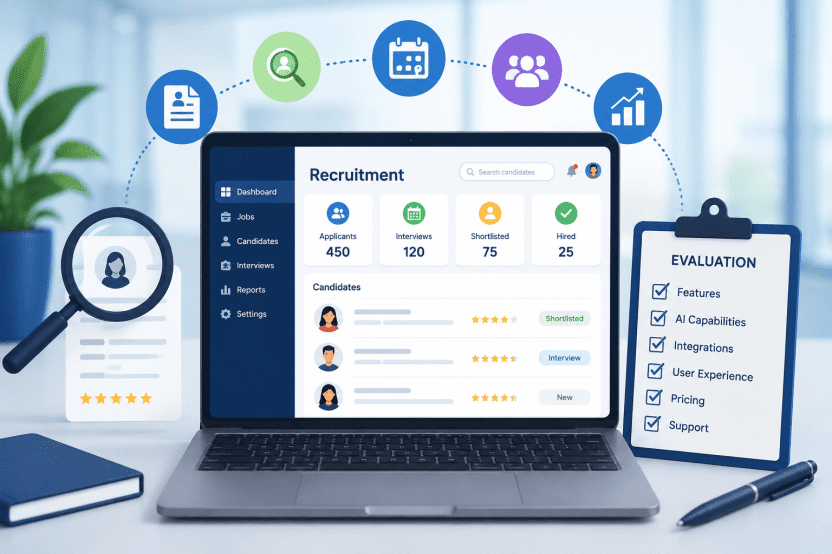
A modern solution typically supports applicant tracking, automated job posting, resume parsing, interview scheduling, candidate communication, hiring analytics, and reporting from a centralized dashboard. Many platforms also use artificial intelligence to rank candidates, recommend suitable applicants, identify hiring trends, and automate repetitive administrative tasks.
Equally important is the candidate experience. A streamlined application process, timely communication, and transparent hiring stages help organizations build a stronger employer brand while reducing candidate drop-off during recruitment.
For organizations planning long-term growth, recruitment software should also integrate with onboarding, employee records, payroll, and performance management to create a connected employee lifecycle rather than operating as a standalone recruiting tool.
Key Capabilities HR Leaders Should Evaluate
Applicant Tracking and Resume Management
An effective applicant tracking system should automatically organize resumes, maintain candidate profiles, and allow recruiters to search applications using skills, experience, education, certifications, or keywords. AI-assisted resume parsing further reduces manual effort by extracting candidate information from multiple document formats.
Recruitment Workflow Automation
Automation helps eliminate repetitive administrative work throughout the hiring process. Job requisitions can follow predefined approval workflows, interview invitations can be scheduled automatically, candidate status updates can trigger notifications, and hiring teams can collaborate without relying on lengthy email chains.
Well-designed workflows improve recruiter productivity while ensuring every candidate follows a consistent hiring process.
AI-Assisted Candidate Evaluation
Artificial intelligence is becoming an important part of recruitment, but it should support recruiters rather than replace them. AI can identify suitable candidates, recommend matches based on job requirements, highlight missing qualifications, and prioritize applications for review.
The goal is to reduce manual screening while allowing recruiters to make final hiring decisions using their professional judgment.
Reporting and Recruitment Analytics
Recruitment decisions should be supported by data rather than assumptions. Modern recruitment platforms provide dashboards that track hiring pipelines, recruiter workload, application sources, interview conversion rates, time-to-fill, and hiring performance across departments.
These insights help HR leaders identify bottlenecks, improve recruiting strategies, and allocate hiring resources more effectively.
Look Beyond Feature Lists
Most recruitment software platforms now offer applicant tracking, resume parsing, interview scheduling, reporting, and candidate communication. While these capabilities remain essential, they rarely differentiate one solution from another.
Instead of comparing the number of available features, evaluate how effectively the software supports your hiring objectives. Consider whether it simplifies recruiter workloads, improves collaboration between HR and hiring managers, reduces administrative effort, shortens hiring cycles, and enhances the overall candidate experience.
A platform that helps recruiters hire better talent faster often delivers greater long-term value than one with an extensive feature list that is rarely used.
Understand the Total Cost of Ownership
Subscription pricing represents only part of the overall investment when implementing recruitment software.
A complete evaluation should include software licensing, implementation and configuration, data migration, integrations with HR or payroll systems, user training, ongoing administration, customer support, and future expansion costs. Looking beyond the initial subscription fee provides a more accurate understanding of the total cost of ownership.
Organizations should also evaluate whether the vendor’s pricing model supports future growth. Flexible pricing that accommodates additional recruiters, employees, business locations, or hiring volumes can provide greater long-term value than a lower upfront price that becomes more expensive as hiring needs evolve.
Evaluate AI Accuracy and Transparency
Artificial intelligence should improve recruiting decisions while maintaining transparency and human oversight.
During vendor demonstrations, ask how AI recommendations are generated, whether recruiters can review or override suggested candidates, how models learn from hiring history, and whether AI decisions can be audited when needed.
Transparent AI builds confidence among recruiters while ensuring hiring decisions remain fair, explainable, and aligned with organizational hiring policies.
Integration Matters More Than You Think
Recruitment software should integrate seamlessly with the systems your HR team already relies on. Poor integrations often create duplicate data entry, inconsistent employee records, and unnecessary administrative work.
Before selecting a platform, verify that it connects with your HRMS, payroll, onboarding, background screening, identity management, and communication tools. Smooth data flow between recruitment and HR operations eliminates manual transfers while improving accuracy throughout the employee lifecycle.
Organizations should also confirm whether integrations are prebuilt or require custom development, how frequently data is synchronized, and which information is exchanged between systems after a candidate is hired.
Consider Implementation, User Adoption, and Vendor Support
Even the most advanced recruitment platform delivers limited value if recruiters and hiring managers struggle to use it.
Successful implementations depend on intuitive navigation, configurable workflows, role-based permissions, guided onboarding, user training, and responsive customer support. Faster implementation and higher user adoption allow organizations to realize value sooner while minimizing disruption during the transition from manual or legacy recruiting systems.
Vendor support also plays an important role after implementation. Regular software updates, knowledgeable support teams, product training, and dedicated customer success resources help organizations continue improving recruitment processes as hiring needs evolve.
Choosing Between Recruitment Software Platforms
The recruitment software market includes solutions designed for organizations of every size and hiring complexity. Some platforms focus exclusively on applicant tracking, while others combine recruiting with broader human resource management capabilities.
Dedicated recruiting platforms such as Greenhouse, Workable, JazzHR, Zoho Recruit, and Lever are often chosen by organizations whose primary requirement is applicant tracking and recruitment automation. These solutions typically provide specialized hiring capabilities and flexible recruiting workflows.
Integrated HR platforms such as BambooHR and SutiHR combine recruitment with employee records, onboarding, payroll, attendance, leave management, and performance management. This approach allows HR teams to manage the complete employee lifecycle from a single system while reducing the need for multiple software applications.
Rather than asking which platform offers the most features, organizations should evaluate which solution best aligns with their hiring volume, business processes, implementation expectations, and long-term HR strategy.
Where SutiHR Fits
SutiHR is designed for organizations that want recruitment to be part of a connected HR ecosystem rather than a standalone application. In addition to AI-assisted applicant tracking, it supports onboarding, employee records, payroll, attendance, leave management, performance management, and workforce analytics from a unified platform.
This integrated approach reduces duplicate data entry and enables HR teams to move candidates from recruitment to onboarding without transferring information between separate systems. Organizations planning to modernize multiple HR processes often benefit from having recruitment integrated with broader workforce management rather than maintaining disconnected applications.
For growing businesses, this creates a scalable foundation that supports hiring today while accommodating future workforce expansion without replacing existing HR systems.
Final Thoughts
Selecting recruitment software is a long-term business decision rather than simply choosing another HR application. The right platform should improve hiring efficiency, reduce administrative work, strengthen collaboration between recruiters and hiring managers, and provide meaningful insights that support better hiring decisions.
When evaluating vendors, look beyond feature comparisons and consider implementation, integrations, AI transparency, scalability, pricing, user adoption, and long-term vendor support. Organizations that follow a structured evaluation process are more likely to invest in recruitment software that continues delivering value as hiring needs evolve.

Ready to modernize your recruitment process?
Schedule a quick demo to see how SutiHR helps HR teams streamline hiring with AI-assisted recruitment and connected HR management.
FAQs
Yes. Many cloud-based recruitment platforms offer scalable AI features that help growing businesses automate hiring, reduce manual tasks, and improve recruiter productivity without requiring enterprise-level resources.
Recruitment software helps organizations overcome hiring challenges such as manual resume screening, slow hiring processes, and poor candidate communication. It automates routine tasks, improves efficiency, and helps recruiters hire qualified candidates faster.
Implementation timelines vary based on organizational size, workflow complexity, and integrations. Cloud-based platforms can often be deployed within a few weeks, while larger enterprise implementations may take longer.
Yes. Automated communication, self-service interview scheduling, streamlined applications, and faster hiring decisions help create a more engaging and professional experience for candidates throughout the recruitment process.
By automating repetitive tasks, improving recruiter efficiency, shortening hiring cycles, and providing better visibility into recruitment performance, organizations can reduce administrative effort and lower overall hiring costs.
Integration is highly recommended. Connecting recruitment software with onboarding, payroll, HRMS, and employee records eliminates duplicate data entry, improves data accuracy, and creates a seamless transition from candidate to employee.