Buyers evaluating procurement platforms in 2026 now ask “what AI capabilities does this have?” before they ask about price. That shift reflects a broader market expectation: AI in procurement software is no longer a differentiator by itself. Mid-market finance and procurement teams expect AI to be present, and the question has moved from “do you have AI?” to “what does your AI actually do, and where does it create measurable value in the procurement process?”
This blog explains where AI shows up in modern procurement software, what it does in practice (not just in vendor marketing), and what a mid-market buyer should expect when evaluating a platform labeled “AI-powered.”
Where AI Shows Up In Procurement Platforms Today
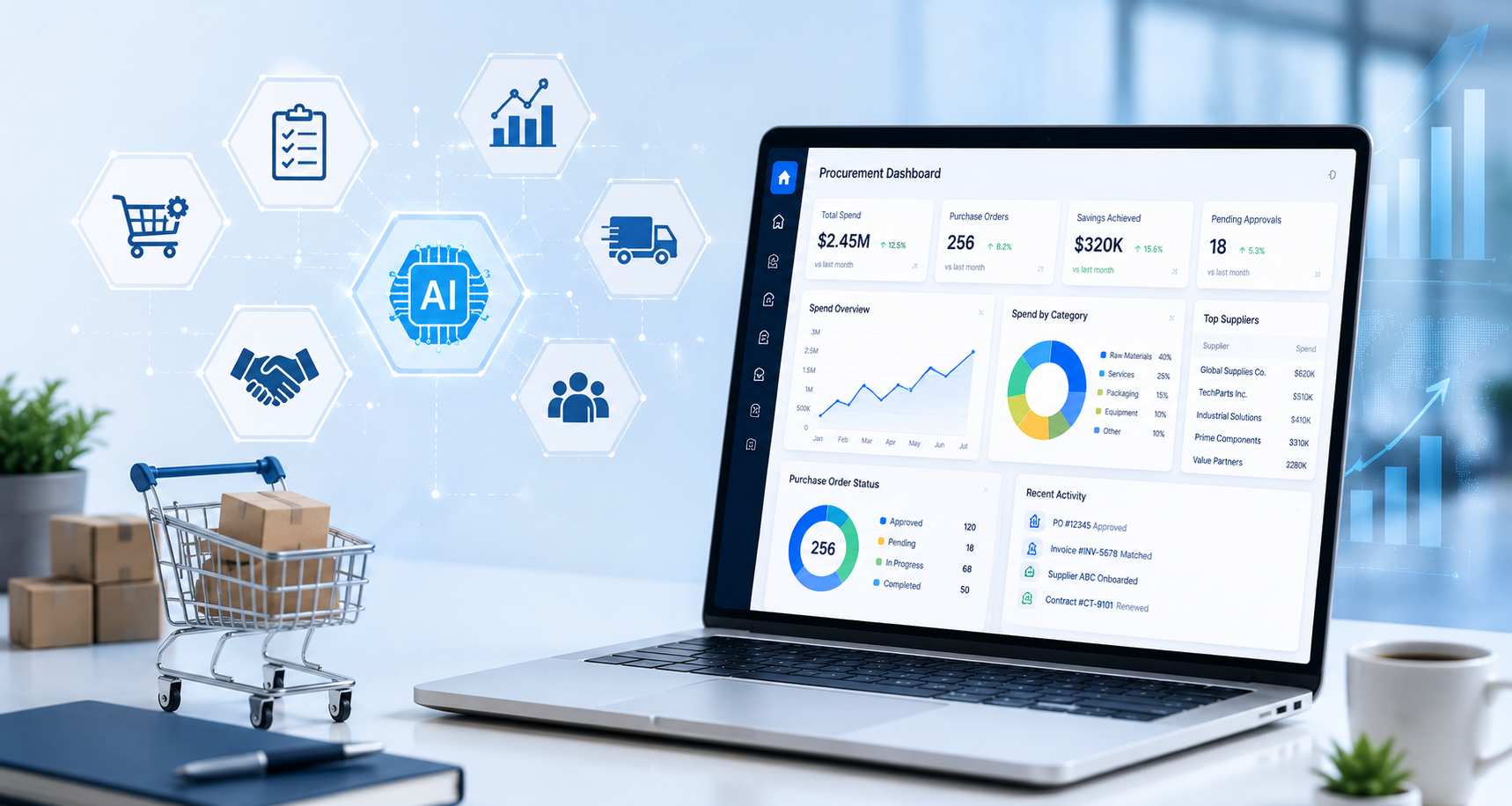
AI in procurement software appears in three places where the technology is mature and delivering measurable operational value: OCR-based document capture, automated approval routing, and budget monitoring with real-time alerting.
OCR and Data Extraction from Purchase Orders and Requisitions
OCR (optical character recognition) and data-extraction AI read purchase orders, invoices, and requisition forms across formats. Accuracy varies by platform. Enterprise platforms with human-in-the-loop validation, such as SutiAP‘s expert-review pipeline, deliver 100% post-review accuracy. The AI runs first; anything below full confidence is routed to an expert review team who validates and retrains the model. Most procurement tools in the mid-market rely on OCR without that validation layer, and verification falls to the customer’s team.
For buyers, however, accuracy is only one part of the evaluation. The more important question is what happens after the information is extracted. Does the platform validate the data, route it into the appropriate workflow, and flag low-confidence results for review?
AI-Driven Approval Routing and Workflow Automation
AI-driven approval routing automates requisition and purchase-order approvals based on role, budget threshold, department, and availability, with automatic escalation when an approver is out. Configurable approval workflows can be set by vendor, employee role, account code, class code, or department, in serial or parallel flows. This removes the manual follow-up that procurement and finance teams otherwise absorb when approvals stall because someone is traveling or unresponsive.
For procurement leaders, the value is not simply automating the approval step. It is reducing the time spent determining who should approve a request, following up on stalled approvals, and manually moving transactions between teams.
Real-Time Budget Monitoring and Alerting
Budget monitoring AI tracks committed versus actual spend by department and category, flagging overruns before month-end so finance teams can act while there’s still time to adjust. This capability is distinct from the variance-escalation and policy-drift analytics still in development at most vendors, which aim to surface spending trends (rising average spend, late submissions, approver behavior) before they become formal budget exceptions.
The key benefit is timing. Identifying a potential overrun when a requisition is submitted gives finance and procurement teams an opportunity to act before the spending becomes a committed obligation or reaches the invoice stage.
Agentic AI: The Emerging Capability Buyers are Asking For
Agentic AI refers to the ability to ask a procurement platform spontaneous questions and receive contextual answers. Examples include “which vendor has the best pricing for this category?” or “what’s our approval history with this supplier?” This capability is emerging as a buyer expectation during demos, but it is not yet standard across procurement platforms.
For procurement buyers, the important distinction is between an AI assistant that answers questions and agentic AI that can potentially take action within defined permissions and business rules. Buyers should verify which capabilities are available in production today and which remain on the vendor’s roadmap.
What “AI-Powered Procurement” Marketing Actually Means
AI marketing in procurement software frequently conflates OCR (reading documents) with intelligence (understanding and deciding). A buyer evaluating a platform marketed as “AI-powered procurement” should ask specifically what the AI does, whether it requires human review, and what happens when the AI isn’t confident.
OCR reads invoices and extracts fields. That is a data-capture task. Intelligence involves coding those fields against a chart of accounts, routing them for approval based on policy rules, and flagging anomalies before payment. Platforms that market “AI-powered” without clarifying which tasks the AI owns versus which tasks still require manual intervention are not being transparent about where the automation ends and where the customer’s team picks up the work.
When evaluating a procurement platform’s AI claims, ask for a workflow diagram showing where the AI acts, where human review is required, and where your team must intervene. If the vendor cannot provide that diagram, the AI claim is not operationally defined.
Go beyond asking how accurate the AI is. Ask how much of the end-to-end process it can automate and how it handles exceptions.
The Next Step: Evaluating AI in Your Own Procurement Context
If you are evaluating procurement software and AI capability is part of your decision criteria, request a demo using your own data. Send the vendor invoices or requisition forms in the formats your team actually receives including, PDFs, scanned documents, email attachments, inconsistent layouts. Ask the vendor to show you the AI’s first-pass results and walk you through what happens when the confidence score falls below their threshold.
That demonstration will surface whether the AI claim is real, whether the platform requires your team to verify and correct the AI’s output, and whether the vendor has built the human-in-the-loop validation that makes a 100% accuracy claim defensible. The best procurement AI does not eliminate human judgment. It eliminates the low-value work that should never have required a human in the first place.

Ready to Make Procurement More Intelligent?
See how SutiProcure helps automate purchasing workflows, streamline approvals, improve spend visibility, and reduce the manual work involved in procurement.
FAQs
AI in procurement software uses artificial intelligence to automate or support procurement activities such as document processing, approval routing, spend monitoring, supplier analysis, and procurement-related queries.
AI can reduce manual data entry, accelerate approval workflows, identify spending patterns, flag potential budget issues, and help procurement teams access relevant information faster.
Ask what the AI actually automates, how it handles low-confidence results, where human review is required, what data it can access, how it integrates with existing systems, and how the business impact of its AI capabilities can be measured.
Agentic AI refers to AI capabilities that can understand procurement requests and potentially perform actions within defined permissions and business rules. It is an emerging capability, so buyers should verify which functions are currently available and which are still under development.