HR has quietly undergone one of the most important transformations in modern business. What was once considered an administrative function is now deeply tied to employee experience, productivity, and organizational growth. This shift didn’t happen overnight; it’s the result of changing workforce expectations, rapid advances in AI, and the need for faster, smarter decision-making.
Digital transformation in HR is no longer about simply adopting software. It’s about rethinking how work gets done, how employees interact with systems, and how HR delivers value at scale. At the center of this transformation is the rise of smart employee portals, platforms that combine automation, intelligence, and seamless user experiences.
These portals are redefining how HR operates. They are not just tools; they are becoming the digital backbone of the modern workplace.
Understanding Digital Transformation in HR
Digital transformation in HR goes beyond replacing paperwork with digital forms. It represents a shift from manual, reactive processes to intelligent, connected, and proactive systems.
In practical terms, this transformation means:
- HR processes that run with minimal manual intervention
- Systems that use AI to analyze, predict, and guide decisions
- Employees accessing services instantly without HR dependency
- Data flowing seamlessly across systems instead of being siloed
This shift is driven by one core need: efficiency without sacrificing experience.
Organizations today are not just asking how to digitize HR, they’re asking how to make HR smarter, faster, and more impactful.
The Shift From Traditional to Smart Employee Portals
There was a time when employee portals were little more than digital notice boards. They stored policies, hosted documents, and offered limited self-service functionality. Most employees interacted with them only when absolutely necessary.
That model no longer works.
Modern workplaces demand systems that are intuitive, responsive, and intelligent. Smart employee portals have emerged as the answer, transforming static systems into dynamic platforms that actively support both employees and HR teams.
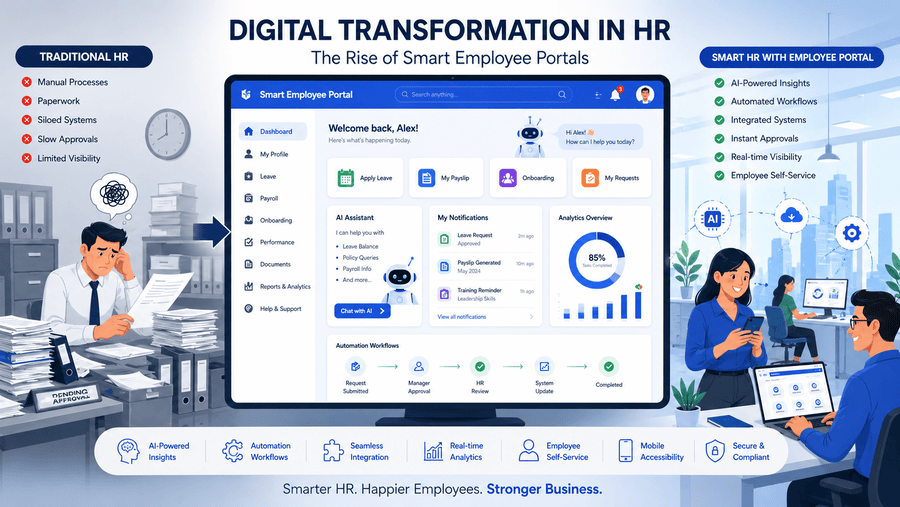
Traditional portals were often:
- Difficult to navigate
- Limited in functionality
- Dependent on manual updates
- Disconnected from other systems
Smart portals, on the other hand, are designed to adapt and respond. They bring together multiple HR functions into a unified experience while leveraging automation and AI to simplify interactions.
This evolution reflects a broader trend: technology must now adapt to people, not the other way around.
Why Smart Employee Portals Are Gaining Momentum
Changing Employee Expectations
Employees today are used to seamless digital experiences in their everyday lives. Whether it’s ordering food, managing finances, or collaborating online, the expectation is simple: technology should be fast, intuitive, and accessible.
When HR systems fail to meet these expectations, it creates friction. Employees become disengaged, processes slow down, and HR teams are pulled into repetitive support tasks.
Smart portals address this gap by offering experiences that feel familiar and easy to use. Employees can access information, complete tasks, and track requests without confusion or delay.
The Need for Operational Efficiency
HR teams are under increasing pressure to do more with fewer resources. Administrative work, data entry, approvals, and follow-ups can consume a significant portion of their time.
Automation within smart employee portals changes this dynamic.
Instead of manually managing processes, HR teams can rely on systems that:
- Trigger workflows automatically
- Send reminders and notifications
- Enforce policies without constant oversight
This shift allows HR professionals to focus on strategic priorities like employee engagement, talent development, and organizational planning.
The Growing Importance of Data
Data has become one of the most valuable assets in HR. Organizations are looking for insights into employee behavior, performance trends, and workforce dynamics.
Smart portals are designed to capture and analyze data in real time. This enables HR teams to move from reactive decision-making to proactive planning.
For example, instead of discovering issues after they escalate, HR can identify patterns early and take action before problems arise.
Core Capabilities of Smart Employee Portals
AI-Driven Interactions
AI is transforming how employees interact with HR systems. Instead of navigating complex menus or waiting for responses, employees can get instant answers through intelligent interfaces.
These systems can:
- Respond to common HR queries
- Guide employees through processes
- Provide recommendations based on user behavior
This not only improves efficiency but also enhances the overall user experience.
Intelligent Automation
Automation is one of the most impactful elements of digital transformation in HR. It reduces the need for manual intervention and ensures consistency across processes.
Common use cases include:
- Onboarding workflows that activate as soon as an employee is hired
- Leave requests that follow predefined approval paths
- Payroll processes that run with minimal manual input
The result is a system that operates smoothly in the background, allowing HR teams to focus on higher-value activities.
Enhanced Employee Self-Service
Employee self-service has evolved significantly. It is no longer just about accessing information; it’s about enabling employees to take control of their HR-related tasks.
Through smart portals, employees can:
- Update personal information
- Apply for leave and track approvals
- Access payslips and tax documents
- Submit requests and monitor progress
The key difference lies in usability. These features are designed to be intuitive, reducing the need for training or support.
Seamless System Integration
One of the biggest challenges in HR has been the use of disconnected systems. Payroll, performance management, attendance tracking, and other functions often operate in silos.
Smart portals act as a central hub, integrating these systems into a single platform. This ensures that data flows seamlessly and eliminates duplication.
Integration also improves accuracy, as information is updated in real time across all connected systems.
Mobile Accessibility and Flexibility
The modern workforce is no longer tied to a single location. Remote and hybrid work models require systems that are accessible from anywhere.
Smart employee portals are built with mobility in mind. Employees can complete tasks, access information, and stay connected using their mobile devices.
This flexibility is not just a convenience; it’s a necessity in today’s work environment.
Transforming the Employee Experience
Employee experience has become a key differentiator for organizations. It influences engagement, retention, and overall productivity.
Smart employee portals play a critical role in shaping this experience.
They eliminate unnecessary steps and reduce waiting times. Employees no longer need to rely on HR for routine tasks. Instead, they have direct access to the information and tools they need.
Transparency is another important factor. Employees can track the status of their requests, understand policies clearly, and stay informed about updates.
This level of visibility builds trust and confidence within the organization.
Automation as the Engine of HR Transformation
Automation is not about replacing human involvement; it’s about enhancing it.
By automating repetitive tasks, organizations can:
- Reduce errors caused by manual processes
- Ensure compliance with policies and regulations
- Improve consistency across workflows
Consider onboarding as an example. Instead of manually coordinating multiple steps, a smart portal can automate the entire process, from document submission to system access, ensuring a smooth experience for new hires.
This not only saves time but also creates a positive first impression.
AI: Turning HR Into a Predictive Function
AI is enabling HR to move beyond reactive processes. It introduces the ability to analyze patterns, identify trends, and make informed predictions.
In practical terms, this means:
- Identifying potential attrition risks
- Recommending training programs based on performance data
- Providing insights into workforce planning
AI doesn’t replace decision-making; it enhances it by providing data-driven insights.
The Future of Smart Employee Portals
The evolution of HR technology is far from over. As AI and automation continue to advance, smart employee portals will become even more sophisticated.
Future developments may include:
- Deeper personalization based on employee preferences
- Advanced predictive analytics for workforce planning
- Greater integration with collaboration tools
- Fully automated HR ecosystems
The goal is clear: to create systems that are not only efficient but also intuitive and adaptive.
Choosing the Right Solution
Selecting the right employee portal is a critical decision. It’s not just about features; it’s about finding a solution that aligns with organizational needs and long-term goals.
Key considerations include:
- Ease of use and user experience
- Scalability to support growth
- Integration capabilities
- AI and automation features
The right platform should not only meet current requirements but also support future transformation.
Conclusion
Digital transformation in HR is reshaping how organizations operate. Smart employee portals are at the forefront of this change, enabling faster processes, better experiences, and more informed decision-making.
They simplify complexity, reduce manual work, and empower both employees and HR teams. More importantly, they position HR as a strategic function that drives business success.
Organizations that embrace this shift are better equipped to adapt, grow, and compete in an increasingly digital world.
If your organization is still relying on outdated systems, now is the time to rethink your approach. A smart employee portal can transform how HR operates and how employees experience the workplace.
SutiHR is designed to bring together AI, automation, and intelligent workflows into a single, seamless platform.
FAQs
A smart employee portal is an AI-powered self-service platform that enables employees to access HR services, manage personal information, submit requests, and receive real-time support. It supports digital transformation by automating HR processes, improving employee experiences, and reducing administrative workloads.
Smart employee portals provide employees with instant access to HR information, leave management, payroll details, company policies, and support services. By offering a seamless and user-friendly experience, these portals increase employee satisfaction, engagement, and productivity.
AI enhances employee self-service portals by delivering instant responses to HR queries, guiding employees through processes, automating routine tasks, and providing personalized recommendations. This reduces HR dependency while improving efficiency and decision-making.
Yes. Smart employee portals automate workflows such as onboarding, leave approvals, payroll-related requests, document management, notifications, and compliance tracking. This allows HR teams to focus on strategic initiatives instead of repetitive administrative work.
Organizations should evaluate employee portals based on ease of use, AI capabilities, workflow automation, mobile accessibility, integration with existing HR systems, security, scalability, and self-service functionality to ensure long-term value and workforce efficiency.