
Explore more in the T&E Knowledge Series for Finance Leaders:
How CFOs Prove ROI with Travel & Expense Automation
Integrated Expense Management Systems
The CFO’s Guide to Policy Compliance and Fraud Prevention
Travel and expense (T&E) management is no longer just about tracking receipts or reimbursing employees. For CFOs and Controllers, it is a critical function that impacts compliance, cost control, visibility, and ROI. Modern T&E management software automates and streamlines the entire process, from booking and expense submission to approval, reimbursement, and reporting, while integrating seamlessly with corporate cards, accounting systems, and ERP platforms.
This guide provides a comprehensive view of expense report software: what it is, why it matters, how it works, and how CFOs can leverage it to drive efficiency, compliance, and strategic value.
What Is T&E Management Software?
T&E management software is a digital platform that centralizes and automates the processes associated with business travel and employee expenses. Instead of relying on manual spreadsheets and paper receipts, finance teams can manage the full lifecycle of expenses in one system. It helps organizations control costs by setting budgets, enforcing policies, and flagging overspending in real time. It ensures compliance by automatically applying rules and policies to each transaction. It improves efficiency by automating receipt capture, approvals, and reimbursement. And it enhances visibility by providing real-time insights into spending patterns and trends.
Why Manual Processes Fail Finance Leaders
Relying on spreadsheets and manual entry exposes companies to unnecessary risk. Fraud and policy violations are more likely to slip through without automated controls. Slow reimbursements frustrate employees and lower morale. Data inaccuracies from human error or lost receipts reduce trust in reporting. Visibility into travel budgets and spending is often delayed, leading to surprises that are discovered too late.
For finance leaders, these inefficiencies create downstream effects such as compliance risks, missed opportunities to cut costs, and added pressure from stakeholders.
The CFO’s Imperatives: Control, Compliance, and ROI
Finance leaders face mounting pressure to cut costs, strengthen compliance, and prove ROI. T&E management is a high-visibility area where automation delivers measurable results. Real-time enforcement of policies reduces unnecessary spending. Audit trails and automated policy checks reduce compliance exposure. Automated expense systems typically pay for themselves within months through time savings, fraud reduction, and improved compliance outcomes.
Key Features to Look For
When evaluating T&E software, CFOs should prioritize features that align directly with finance objectives. Receipt management through OCR-enabled mobile apps ensures fast, accurate capture of expenses. Automated workflows provide configurable approval processes with built-in policy checks. Corporate card integration allows automatic data imports for faster reconciliation. Mobile accessibility ensures easy submission and approvals on the go. Analytics and reporting deliver real-time insights into spending patterns. Finally, integration with accounting or ERP systems enables seamless syncing with the finance infrastructure.
Policy Design and Enforcement
A strong T&E policy is the backbone of effective expense management, and T&E software makes it enforceable in practice. Companies can define reimbursable versus non-reimbursable expenses and set spending limits or vendor preferences. Rules can be embedded into workflows so violations are flagged instantly. Clear audit trails are also maintained, satisfying both internal and external compliance requirements.
T&E Management vs. Manual and Legacy Approaches
Manual processes often involve paper receipts, spreadsheets, and delays, leading to error-prone, time-consuming tasks with a high risk of fraud and non-compliance. Legacy tools provide limited automation and siloed data, making it difficult to scale globally and only partially enforcing policies. By contrast, modern T&E software centralizes operations, offers automated workflows, delivers real-time visibility, and provides built-in policy controls and audit readiness. Scalable, cloud-based, and mobile-first platforms ensure finance leaders can manage expenses with greater efficiency and control.
Market Landscape and Competitor Comparisons
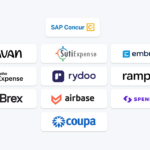
The T&E software market includes a mix of enterprise giants and emerging challengers. Popular platforms include SAP Concur, which is comprehensive but often considered complex and costly. Navan, formerly TripActions, is known for being travel-first with integrated expense tools. Expensify is valued for simplicity but limited when serving complex enterprise needs. Zoho Expense is affordable and strong for small to mid-sized businesses. Ramp, Rydoo, Fyle, and Coupa are newer players with a focus on spend management.
SutiExpense competes by combining enterprise-grade compliance and integration features with flexibility, affordability, and faster implementation.
ROI Proof Points for CFOs
The value of T&E software can be quantified quickly. Automated receipt capture and approvals reduce the workload for finance teams, saving time across the organization. Policy enforcement prevents duplicate or false claims, reducing fraud. Compliance is strengthened through audit readiness and global regulatory support. Employees benefit from faster reimbursements and mobile ease of use, which boosts satisfaction. Case studies show many organizations achieve full ROI within 90 days.
Implementation and Adoption
Success with T&E management depends on both technology and user adoption. Change management requires training employees and clearly communicating benefits. Phased rollouts are often effective, beginning with expense reporting before expanding to full travel integration. Customization of workflows and approval chains ensures alignment with company structure. Finally, measurement is critical. Organizations should track ROI, fraud reduction, compliance improvements, and employee adoption rates to confirm results.
Final Thoughts: Future-Proofing Finance
As business travel returns and compliance pressures grow, CFOs cannot afford to rely on outdated manual systems. Travel and expense management software is more than an operational tool; it is a strategic enabler of visibility, control, and ROI. By modernizing T&E management, finance leaders can reduce costs, strengthen compliance, and build a finance function that is prepared for the future.
Your next step to automated expense reporting is simple — request a demo.