
What Is Recruitment Management Software?
Recruitment Management Software helps HR teams manage hiring activities from a centralized platform. It supports requisition creation, candidate tracking, interview coordination, hiring approvals, reporting, and offer management while reducing manual administrative work across the recruitment lifecycle.
Modern HR teams are expected to hire faster, improve candidate experience, and maintain hiring quality across departments. Candidates expect quick communication, mobile-friendly applications, and a clear understanding of company culture before applying.
Many organizations still rely on spreadsheets, email chains, and disconnected hiring processes that slow recruiting operations and reduce visibility across candidate pipelines.
Recruitment Management Software helps HR teams centralize recruiting workflows, improve hiring coordination, and streamline candidate management from a single platform.
Why Employer Branding Matters in Recruitment
Employer branding directly affects candidate quality. Candidates evaluate employer reputation through career pages, employee reviews, social content, and hiring responsiveness before applying.
Mid-sized organizations often struggle to communicate career growth opportunities and workplace culture effectively to candidates. The gap between what an employer offers and what candidates perceive is often a recruiting challenge, not a marketing problem.
LinkedIn reports that strong employer branding can reduce cost-per-hire by up to 50%.
Employees Shape Employer Credibility
Candidates trust employee experiences more than polished corporate messaging. Businesses that encourage employees to participate in blogs, recruiting campaigns, and professional discussions build stronger credibility with potential hires.
A growing software company hiring implementation specialists may struggle to compete with larger employers on brand recognition alone. Sharing authentic employee experiences helps attract candidates who value growth opportunities and workplace ownership.
Employees often look for:
- Career growth opportunities
- Meaningful project ownership
- Team collaboration
- Transparent workplace culture
Career pages also influence candidate engagement. Many organizations lose applicants because job descriptions are vague or difficult to navigate on mobile devices.
A professional careers page should clearly explain:
- Job responsibilities and reporting structure
- Required skills and growth opportunities
- Workplace expectations and hiring timelines
Clear communication improves candidate confidence while reducing unqualified applications.
Consistent Branding Reduces Candidate Drop-Off
Employer branding extends beyond marketing content. Candidates also evaluate the hiring experience itself. Delayed responses, rescheduled interviews, and inconsistent communication create negative impressions even when the role itself is attractive.
Recruiters using an intelligent Applicant Tracking System (ATS) can maintain standardized communication workflows throughout the hiring process.
Automated status tracking, structured interview coordination, and centralized candidate records help HR teams maintain consistency across departments.
This becomes especially important for organizations hiring across multiple locations, where candidates may otherwise receive inconsistent information from different hiring managers.
Why Mobile Recruiting Is Essential
Mobile recruiting is no longer optional. Candidates expect to search for jobs, submit applications, upload resumes, and communicate with recruiters directly from their phones. Organizations with desktop-only application processes risk losing qualified candidates before recruitment even begins.
This challenge is especially common in industries with hourly workers, healthcare staff, field employees, retail associates, and service professionals, where candidates often complete their entire job search through mobile devices.
According to Glassdoor, over 58% of job seekers search for jobs using mobile devices.
Candidates Expect Mobile Applications
Long application processes increase candidate drop-off. Requiring applicants to manually re-enter resume information or complete lengthy forms discourages qualified candidates from finishing applications.
A manufacturing company hiring warehouse supervisors may receive hundreds of mobile applicants every month. If the application process is slow or difficult to complete on mobile devices, completion rates decline quickly.
Mobile recruiting platforms help candidates:
- Search and apply for jobs quickly
- Upload resumes from mobile devices
- Track application status
- Respond to interview requests
- Communicate directly with recruiters
These capabilities improve completion rates while shortening response times for both recruiters and applicants.
ATS platforms also help HR teams identify which sourcing channels generate the highest-quality candidates.
Recruiters Need Mobile Hiring Access
Recruiters also benefit from mobile accessibility. Hiring teams increasingly work across departments, locations, and hybrid environments. Waiting for desktop access to review applications or coordinate interviews slows hiring decisions.
An Applicant Tracking System (ATS) allows recruiters to review resumes remotely, track candidate progress, approve requisitions, schedule interviews, and share hiring feedback with managers.
Teams often ask, “Can I integrate SutiHR with other HR tools?” The answer is yes, and that integration capability matters when recruiters are coordinating activity across payroll systems, calendars, and communication platforms simultaneously.
Organizations hiring for high-demand roles often lose candidates because approvals and communication take too long. Centralized recruitment software helps HR teams maintain consistent communication and accelerate hiring decisions across recruiters, managers, and HR leadership.
How Social Recruiting Expands Talent Acquisition
Social recruiting has changed how organizations connect with candidates. Businesses are no longer limited to traditional job boards or recruitment agencies. Recruiters now engage candidates through professional communities, employee networks, industry discussions, and social platforms.
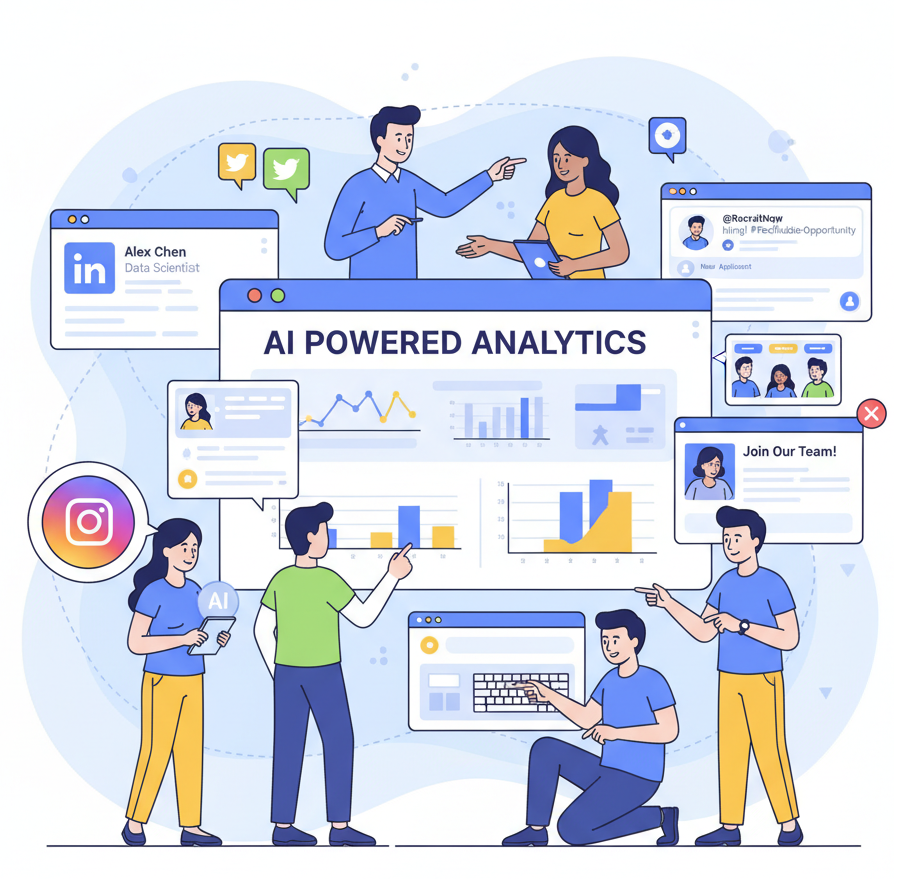
Leverage social media for smarter hiring—integrate with SutiHR’s ATS now!
Social Platforms Support Passive Candidate Engagement
Many experienced professionals are not actively applying for jobs, but they remain open to new opportunities when approached with relevant roles and credible employer messaging.
An IT services company expanding its cybersecurity division may struggle to attract experienced analysts through job boards alone. Recruiters improve visibility by sharing employee achievements, technical expertise, and workplace initiatives across professional platforms.
Modern recruitment platforms support broader job distribution by helping recruiters manage job postings and candidate tracking from one centralized system. Employee referral programs also become easier to manage when recruiters can track referrals, applications, interview feedback, and hiring decisions from one platform.
Social Recruiting Improves Employer Transparency
Candidates research employers extensively before applying. They evaluate company culture, leadership credibility, workplace flexibility, and employee experiences.
Social platforms help organizations present a more realistic view of the workplace while helping recruiters identify stronger candidate alignment earlier in the hiring process.
Recruiters can also evaluate candidate expertise through certifications, industry participation, and professional engagement.
Organizations that combine social recruiting with ATS capabilities improve hiring visibility by organizing applicants from referrals, job portals, and social platforms into a single recruiting workflow.
How Recruitment Management Software Improves Hiring Workflows
Recruitment becomes difficult to manage when hiring activities are spread across email, spreadsheets, shared folders, and disconnected HR tools. Interview delays increase, candidate records become inconsistent, and hiring managers lose visibility into recruitment progress.
Hiring Processes Become Difficult to Manage Across Departments
A company hiring across multiple departments often faces coordination challenges between recruiters, finance teams, department heads, and executive approvers. Without structured workflows, requisition approvals may remain delayed for days.
Candidate feedback also becomes fragmented when managers track hiring notes separately across emails and spreadsheets. Recruiters spend valuable time consolidating hiring information manually instead of focusing on candidate engagement.
Recruitment Management Software centralizes hiring operations so HR teams can manage:
- Requisition approvals
- Job posting distribution
- Candidate tracking
- Resume screening
- Interview scheduling
- Hiring evaluations
- Offer management
Unlike standalone ATS platforms that focus only on candidate tracking, SutiHR connects recruitment workflows with broader HR operations, including onboarding, workforce planning, reporting, and employee management.
Centralized Recruitment Operations Improve Hiring Speed
Hiring delays directly affect business operations. Open positions increase workload pressure on existing employees and slow department productivity.
An organization expanding customer support operations may need to hire multiple representatives within a short timeline. Manual recruitment coordination creates bottlenecks that delay onboarding and impact service quality.
Centralized recruiting systems like SutiHR help recruiters organize candidate pipelines, prioritize qualified applicants, and coordinate interviews more efficiently.
Recruitment analytics help HR teams track:
- Time-to-fill
- Candidate conversion rates
- Source effectiveness
- Interview bottlenecks
- Hiring demand by department
Offer management also becomes faster when recruiters can generate and issue offer letters directly through the recruitment platform.
How Applicant Tracking Systems Improve Candidate Screening Accuracy
Recruiters often manage large applicant volumes for a single position. Reviewing resumes manually creates delays and increases the risk of overlooking qualified candidates.
An Applicant Tracking System (ATS) improves hiring accuracy by organizing candidate data into structured recruiting workflows.
Research shows organizations using ATS platforms can reduce time-to-hire by up to 40%.
Recruiters Need Better Candidate Visibility
A healthcare provider hiring registered nurses across multiple facilities may receive hundreds of applications weekly. Without organized candidate tracking, recruiters struggle to prioritize qualified applicants quickly enough.
ATS platforms help recruiters:
- Organize resumes centrally
- Filter candidates based on qualifications
- Track interview status
- Maintain hiring records
- Coordinate hiring manager feedback
Teams exploring how to connect their ATS with other HR tools via API will find that SutiHR supports integration with payroll, onboarding, and workforce management systems.
Structured ATS Workflows Reduce Delays
Recruitment delays often occur between interview stages when recruiters manually coordinate schedules and feedback across departments.
ATS platforms simplify interview coordination by centralizing calendars, candidate communication, and hiring feedback. Faster coordination improves candidate experience while reducing the risk of losing applicants to competing offers.
Recruiters also gain better visibility into recruiting pipelines, allowing HR leadership to identify delays before they impact staffing goals.
How Workforce Management Software Supports Hiring Planning
Recruitment decisions should align with broader workforce planning objectives. Hiring without visibility into staffing demand, turnover patterns, and operational growth creates long-term workforce management challenges.
Recruitment Decisions Should Align With Workforce Planning
A logistics company preparing for seasonal demand increases may require temporary staffing visibility months before hiring begins. Without workforce forecasting data, HR teams often react too late and struggle to fill positions efficiently.
Workforce planning tools help HR teams:
- Forecast staffing demand
- Monitor turnover trends
- Track workforce availability
- Align hiring with business growth
SutiHR supports workforce visibility by helping HR teams coordinate recruitment activity alongside broader HR operations rather than treating hiring as a separate function.
Workforce Visibility Improves Resource Allocation
Organizations operating across multiple locations often face changing staffing demands throughout the year.
Centralized workforce visibility helps HR leaders allocate recruiting resources more effectively while maintaining hiring consistency across departments.
Benefits of Recruitment Management Software
Recruitment Management Software helps organizations:
- Reduce hiring delays
- Improve recruiter productivity
- Streamline candidate tracking
- Improve interview coordination
- Strengthen hiring visibility
- Reduce manual administrative work
- Improve collaboration across departments
- Support faster hiring decisions
Better Recruiting Depends on Better Operational Control
Effective HR recruiting requires more than job postings and interview scheduling. Businesses need structured hiring processes, centralized visibility, and consistent candidate communication throughout the recruitment lifecycle.
Strong employer branding attracts better candidates. Mobile recruiting improves accessibility for both recruiters and applicants. Social recruiting expands access to qualified talent beyond traditional hiring channels.
SutiHR helps organizations manage requisition creation, applicant tracking, candidate screening, interview coordination, and offer management from one centralized platform designed for growing businesses.
See how SutiHR helps HR teams reduce hiring delays, improve candidate tracking, and streamline recruiting workflows from a single centralized platform.
Frequently Asked Questions
Yes. SutiHR supports integration with HR platforms, including payroll systems, onboarding tools, workforce management software, and communication platforms. This helps HR teams maintain centralized recruiting visibility while reducing manual data entry.
Organizations can connect ATS workflows with payroll, onboarding, and HR management systems using API-based integrations. This allows candidate and employee information to move automatically between systems after hiring decisions are finalized.
Recruitment Management Software can automate:
• Requisition approvals
• Job postings
• Candidate tracking
• Interview scheduling
• Communication workflows
• Hiring notifications
• Offer management
Mobile recruiting improves application completion rates by allowing candidates to apply, upload resumes, and communicate with recruiters directly from mobile devices. It also helps recruiters respond faster while managing hiring activity remotely.