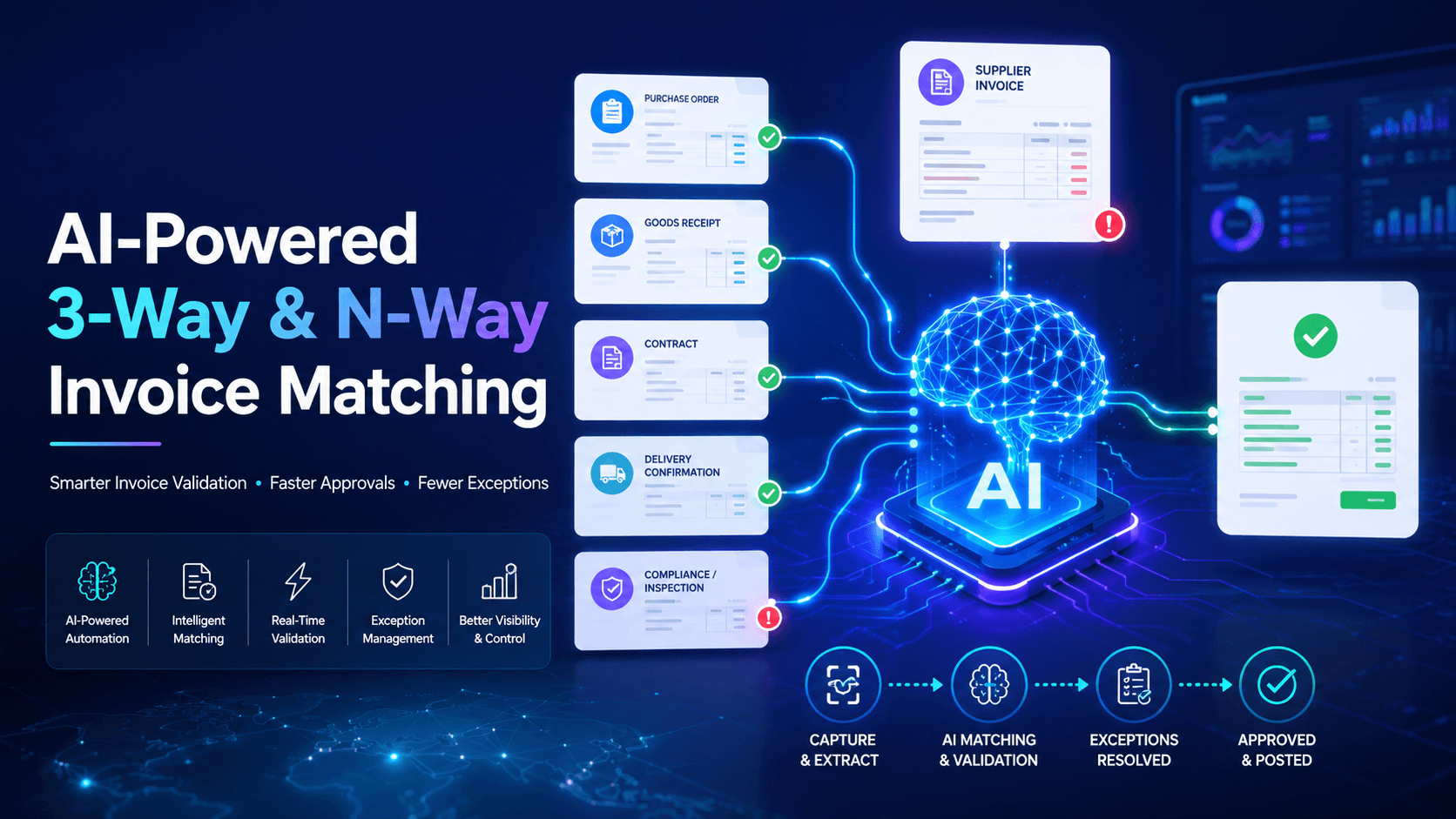
3-way invoice matching ensures that invoices align with purchase orders and goods receipts, while N-way invoice matching extends this validation across additional documents and checkpoints to improve accuracy and control.
In today’s fast-moving finance environment, invoice processing is no longer just about verifying numbers, it’s about managing risk, speed, and accuracy at scale. Yet many organizations still rely on fragmented systems and manual reviews to validate invoices.
This creates friction across the procure-to-pay cycle:
- Delayed approvals
- Frequent mismatches
- High exception volumes
- Limited visibility into liabilities
AI is changing that.
With the evolution of invoice automation, businesses are moving beyond static validation rules toward intelligent systems that can interpret, learn, and optimize invoice matching processes in real time.
This blog explores how AI is transforming 3-way invoice matching and N-way invoice matching workflows into smarter, faster, and more resilient financial operations within modern procure-to-pay (P2P) ecosystems.
Why Invoice Matching Becomes a Bottleneck at Scale
Invoice matching tends to break down not because the process is flawed, but because it doesn’t scale well manually.
As organizations grow:
- Supplier formats vary widely
- Purchase orders become more complex
- Partial deliveries increase
- Contract-based pricing introduces variability
Finance teams are then forced into manual exception handling loops, which slow down the entire accounts payable (AP) function.
Common outcomes include:
- Payment delays and missed early-payment discounts
- Duplicate or incorrect payments
- Increased audit risks
- Operational inefficiencies
This is where AI-powered invoice automation and AP automation become critical for scaling financial operations.
Understanding the Layers of Invoice Matching
3-Way Invoice Matching: The Foundation
At its core, 3-way invoice matching validates three key documents:
- Purchase Order
- Goods Receipt Note
- Supplier Invoice
This ensures that billing aligns with what was ordered and received.
N-Way Invoice Matching: Expanding the Control Layer
N-way invoice matching builds on this by incorporating additional validation sources such as:
- Contract terms and pricing agreements
- Delivery milestones
- Service confirmations
- Inspection and compliance records
This layered validation is essential for industries with:
- Complex supply chains
- Service-based procurement
- High-value transactions
From Rule-Based Matching to AI-Driven Invoice Automation
Traditional systems rely on fixed rules:
- Exact matches required
- Manual intervention for deviations
AI introduces flexibility and intelligence.
Traditional Approach AI-Driven Approach
Static validation rules Context-aware matching
Manual data entry Automated data extraction (OCR-based)
High exception rates Intelligent exception handling
Delayed processing Real-time validation
Limited adaptability Continuous learning
This evolution is redefining invoice reconciliation and touchless invoice processing within modern P2P ecosystems.
How AI Enhances 3-Way and N-Way Invoice Matching Workflows
AI doesn’t replace invoice matching, it enhances every layer of it.
1. Smart Data Extraction
AI captures invoice data from multiple formats such as PDFs, scanned documents, and emails using OCR and contextual understanding. It not only reads text but also interprets structure and meaning to ensure accurate data capture.
2. Contextual Matching
Instead of relying on exact field-to-field matching, AI analyzes relationships between different data points across documents. This allows it to validate invoices more intelligently, even when formats or values slightly differ.
3. Adaptive 3-Way Matching
AI enables flexible matching by applying tolerance thresholds for acceptable variances in price, quantity, or delivery. Over time, it learns from past transactions to refine what qualifies as a valid match.
4. Advanced N-Way Validation
AI extends validation beyond standard documents by incorporating contracts, service records, and compliance data into the matching process. This ensures deeper verification for complex and high-value transactions.
5. Exception Prioritization
AI identifies and categorizes mismatches based on their risk level and financial impact. This helps teams focus first on critical exceptions instead of manually reviewing every discrepancy.
6. Automated Resolution Suggestions
AI recommends corrective actions for mismatches by analyzing historical resolutions and patterns. This speeds up decision-making and reduces the time spent on manual investigation.
7. Continuous Learning
AI continuously improves its accuracy by learning from resolved exceptions and user actions. With every transaction, the system becomes more efficient and reduces future errors.
8. Seamless Financial Integration
Once invoices are validated, AI automatically routes them into ERP or payment systems without manual intervention. This ensures faster processing, reduces delays, and maintains a smooth financial workflow.
End-to-End Flow of Intelligent Invoice Matching
- Invoice ingestion (multi-format capture)
- AI-based data extraction
- 3-way invoice matching validation
- N-way invoice matching checks
- Exception detection and classification
- Smart routing for approvals
- Resolution and validation
- Payment authorization
- Analytics and performance insights
This AI-driven financial workflow automation minimizes friction while maximizing accuracy and processing speed.
Business Value of AI-Powered Invoice Automation
Organizations adopting AI in invoice matching experience measurable improvements:
- Accelerated processing times
- Lower error rates
- Fewer exceptions
- Improved compliance and audit readiness
- Stronger supplier relationships
- Better cash flow visibility
Deloitte and Gartner reports consistently shows that AI-driven AP automation can reduce invoice processing costs by up to 60 – 80%.
Where Most Invoice Automation Projects Struggle
Despite the benefits, challenges still exist:
- Inconsistent supplier data
- Over-engineered validation rules
- Poor ERP and P2P system integration
- Low user adoption
Best Practices for Scaling Invoice Matching with AI
To get the most value:
- Normalize supplier data early
- Define flexible matching thresholds
- Integrate procurement and finance systems
- Focus on user-friendly workflows
- Continuously refine AI models with real data
- Track KPIs like exception rates and processing time
Successful organizations treat N-way invoice matching as a scalable financial capability, not a fixed process.
How AI is Shaping the Future of Invoice Matching
AI is pushing invoice matching toward a predictive model:
- Identifying mismatches before they occur
- Automatically resolving low-risk exceptions
- Detecting fraud patterns in real time
- Continuously optimizing validation logic
This transforms invoice matching from a back-office task into a strategic financial control mechanism.
Choosing the Right Invoice Automation Solution
When evaluating tools, look for:
- Native support for 3-way and N-way invoice matching
- AI-based data extraction and validation
- Real-time dashboards and reporting
- ERP and procure-to-pay integration
- Scalable architecture
- Strong compliance and audit capabilities
The Strategic Impact on Procure-to-Pay
AI-driven invoice automation doesn’t just improve efficiency, it reshapes financial operations.
Organizations gain:
- Faster financial close cycles
- Reduced operational overhead
- Improved working capital management
- Enhanced decision-making through real-time insights
The Future of Invoice Matching: Intelligent, Scalable, and AI-Driven
Invoice matching has moved far beyond basic document verification, it now sits at the core of faster, smarter, and more resilient financial operations. What was once a manual checkpoint is becoming a strategic capability that drives efficiency, accuracy, and control across the entire procure-to-pay cycle.
By bringing together 3-way invoice matching, N-way invoice matching, and AI-powered invoice automation, organizations can shift from reactive validation to proactive financial management. This transformation enables systems that not only reduce errors and processing delays but also continuously learn, adapt, and improve with every transaction.
As a result, invoice validation evolves into a scalable and intelligent process that supports growth, strengthens compliance, and delivers real-time visibility into financial commitments. This is the next stage of procure-to-pay, where finance teams move beyond manual effort and focus on driving performance, insight, and strategic value.
Still dealing with invoice mismatches and delays?
Book a demo to see how AI-powered invoice automation simplifies 3-way and N-way invoice matching, reduces errors, and accelerates procure-to-pay performance.
FAQs
3-way invoice matching is the process of verifying an invoice against the purchase order and goods receipt. This ensures that the billed amount matches what was ordered and received before approving payment.
N-way invoice matching goes beyond three documents by including contracts, service confirmations, and compliance records. It is used for complex transactions that require deeper validation and control.
AI improves invoice automation by extracting data from invoices, identifying mismatches, and reducing manual intervention. It continuously learns from past transactions to increase accuracy and efficiency over time.
Invoice matching ensures that payments are accurate and aligned with purchase details. It helps prevent fraud, reduces errors, and strengthens financial control across the procure-to-pay process.
Invoice automation speeds up processing, reduces manual errors, and improves visibility into financial data. It also helps businesses handle invoices more efficiently and maintain better compliance.
Yes, modern invoice automation solutions integrate seamlessly with ERP and procure-to-pay systems. This ensures smooth data flow, eliminates manual entry, and improves overall process efficiency.