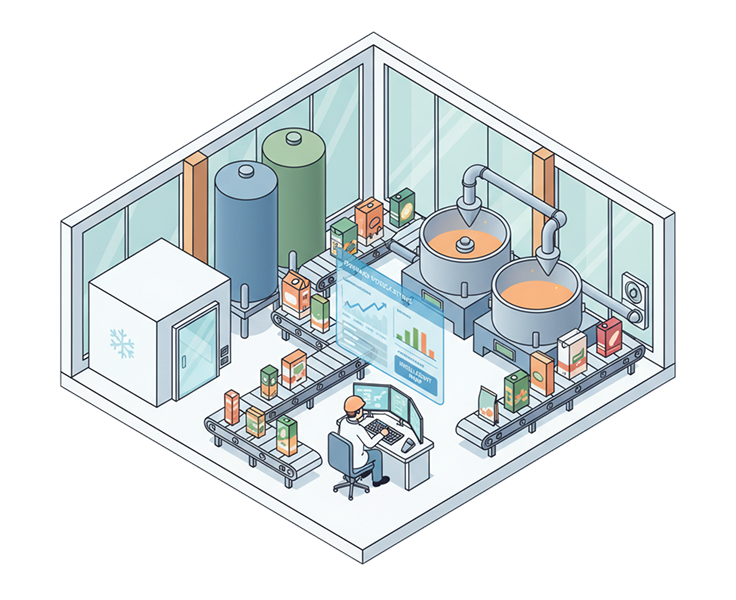
The Production Reality

Key Challenges in Food & Beverage Manufacturing

Fluctuating Demand and Production Requirements

Consumer demand can change based on seasons, promotions, market trends, and customer orders. Manufacturers need to adjust production plans quickly while avoiding unnecessary inventory and production capacity constraints.

Raw Material Availability

Production depends on the timely availability of ingredients, packaging materials, and other production inputs. Shortages or delays in critical materials can interrupt production and affect customer order fulfillment.

Material Shelf Life and Inventory Management

Many food and beverage materials have limited shelf lives and require careful inventory planning. Overstocking can increase waste, while insufficient inventory can create production interruptions and procurement pressure.

Complex Recipes and Product Structures

Food and beverage products may require multiple ingredients, packaging components, and production stages. Managing detailed product structures and accurately calculating material requirements can become challenging across a growing product portfolio.

Production Capacity Constraints

Production lines, processing equipment, workstations, and labor must be coordinated with planned production volumes. Capacity constraints can create bottlenecks and make it difficult to respond to changes in demand.

Production Waste and Material Variance

Ingredient usage, production losses, scrap, and material variances can affect manufacturing costs and profitability. Limited visibility into actual material consumption makes it harder to identify inefficiencies and control production costs.

The Automation Advantage

The Smarter Way to Manage Food & Beverage Manufacturing

Optimize Production Planning

Create production schedules based on customer demand, forecasts, production priorities, inventory availability, and manufacturing capacity. Our software helps manufacturers align planned production with changing market requirements.

Manage Recipes and Product Structures

Maintain detailed Bills of Materials and product structures covering ingredients, packaging materials, components, and finished products. Accurate product structures provide a reliable foundation for material and production planning.

Automate Material Requirements Planning

Automatically calculate ingredient and material requirements based on production schedules, product structures, inventory levels, safety stock, and open orders. Automated MRP helps manufacturers plan materials before production begins.

Improve Raw Material Availability

Monitor inventory, purchase orders, production orders, and material requirements from a centralized platform. Manufacturers can identify potential shortages early and coordinate purchasing with upcoming production requirements.

Plan Production Capacity

Compare planned production requirements with available machine, production line, workstation, and labor capacity. Capacity planning helps identify constraints and create more achievable production schedules.

Automate Procurement Planning

Generate purchase requisitions and purchase orders based on material requirements, inventory availability, and supplier lead times. Automated procurement planning helps ensure ingredients and packaging materials are available when production requires them.

Manage Production Orders and WIP

Create and release production orders while tracking work-in-progress, material consumption, labor, and machine activities. Real-time production visibility helps teams monitor progress and respond to production issues.

Improve Inventory and Material Utilization

Align material requirements with production schedules to reduce unnecessary purchasing and excess inventory. Better visibility into material consumption helps manufacturers improve inventory utilization and reduce avoidable waste.

Improve Production Efficiency

Analyze material usage, production activities, resource utilization, and manufacturing performance to identify inefficiencies. Manufacturers can use production insights to improve resource utilization, control costs, and maintain consistent production performance.

Explore smarter production planning, efficient material management, and optimized manufacturing operations.