Spend management is the process of tracking, controlling, and optimizing organizational purchasing from requisition through payment. For mid-market finance leaders, it delivers visibility into committed spend before it hits the general ledger, enforces budget controls at the point of request, and eliminates maverick purchases that surface as overruns at month-end.
The buy-side spend visibility provided by procurement platforms is distinct from expense management, which handles employee travel and entertainment reimbursement, and from AP automation, which processes vendor invoices. Spend management controls purchases at the point of requisition, before money is committed, rather than discovering overruns after invoices arrive. Mid-market companies typically implement spend-control software when manual processes break under growth, often triggered by a budget overrun, maverick-spend incident, or audit finding.
This blog explains how spend management works, why it matters for finance teams running mid-market organizations, and what to look for when evaluating a platform.
What Spend Management Controls
Many spend management platforms automate the full cycle from purchase request through invoice payment. Procure-to-pay automation spans requisition, approval, purchase order creation, goods receipt, invoice matching, and payment, with spend visibility starting at requisition.
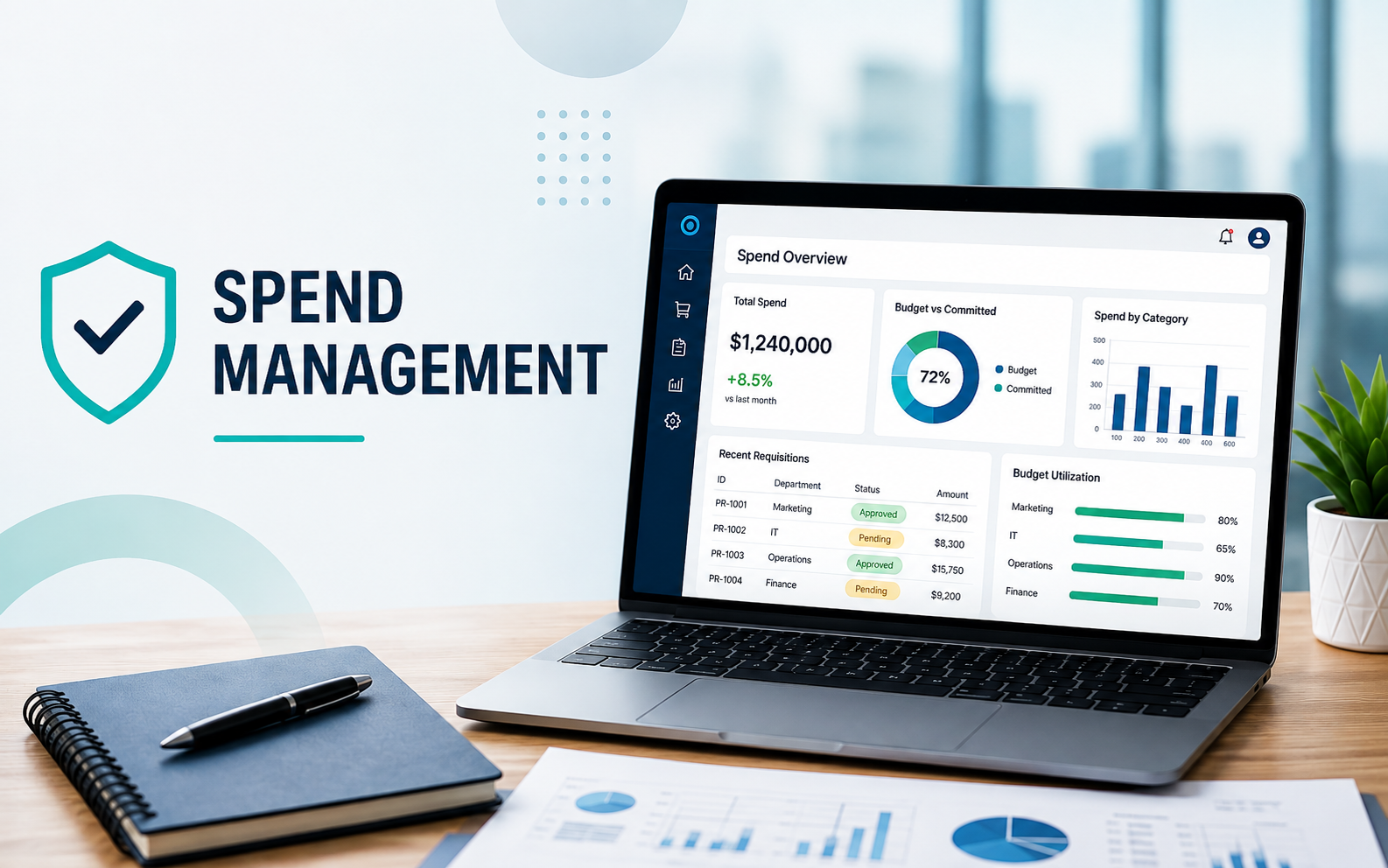
Real-time budget tracking at the requisition stage flags overruns while there is still time to act, rather than at month-end close. When a department head submits a purchase request, the platform checks it against the departmental budget and alerts the approver if the requisition will cause an overrun. The approver sees the budget impact on screen and can allow or reject the request before the commitment is made.
This early-stage control eliminates the reconciliation gap that manual processes create. When procurement data lives in spreadsheets or email threads and invoice data lives in the ERP, finance teams spend days at month-end reconciling what was ordered against what was paid. A connected procure-to-pay platform brings procurement and AP data together, reducing manual reconciliation and improving audit visibility. The approval trail can then run from request to payment with fewer manual handoffs between disconnected systems.
Who Owns Spend Management
Spend management is a finance-owned process, but the people who interact with it daily span multiple roles.
The CFO or VP Finance owns the spend-control mandate and signs off on the platform decision. They are accountable to the board for budget discipline across every department and need visibility into committed and actual spend without touching individual transactions. When preparing board materials, they want a current, accurate view of committed and actual spend by department, not a number reconstructed at month-end.
The Controller or Procurement Manager builds the business case and champions the evaluation. They manage the close cycle, field escalations from the AP team, and resolve exceptions when approvals stall or invoices do not match purchase orders. They are the ones who experience the operational cost of poor spend visibility every single day.
Department heads and budget owners submit purchase requests and need to know where their requests stand without emailing procurement to ask. They own a departmental budget but are not procurement specialists and do not want to become one.
All three personas appear in the evaluation. The CFO signs off. The Controller or Procurement Manager runs the demo and builds the internal ROI case. Department heads weigh in during pilot feedback sessions, and their adoption experience determines whether the rollout succeeds.
How Spend Management Prevents Overruns
Budget enforcement happens at the procurement side when a purchase is requested, not when the invoice arrives. By the time an invoice reaches AP, the money is already spent. The value of spend management is catching the overrun before the commitment is made.
Budgets are typically configured at the department, cost center, project, or vendor level. When a requester submits a purchase that will exceed the allocated budget, the system flags it to the approver. The approver sees the budget impact on the approval screen and decides whether to allow the exception or reject the request. The decision is documented in the approval trail, so there is a record of who authorized the overrun and why.
This control eliminates maverick spend, which is purchasing that happens outside approved channels or without a purchase order. Maverick spend creates budget surprises and audit findings that surface after the money is already committed. When purchases are consistently routed through requisition and approval workflows, organizations can significantly reduce maverick spend and make policy exceptions easier to identify and manage.
The result is spend discipline that does not depend on every department head remembering the policy. The rules are enforced by the system, not communicated in a PDF no one reads.
What to Look for in a Spend Management Platform
Not all spend management platforms are built the same. Mid-market finance teams need solutions that deliver control without requiring a dedicated implementation team or forcing the organization to change its approval workflows.
Look for a platform that enforces budgets at the requisition stage and gives approvers visibility into the impact before they sign off. Real-time budget tracking should flag overruns while there is still time to act, not at month-end when the only option is to explain the variance to the board.
Approval workflows should be configurable to your organization’s structure, not locked into a generic template. The platform should support routing by vendor, role, amount threshold, department, and cost center, in serial or parallel flows. If an approver is unavailable, the workflow should escalate automatically rather than stalling until someone manually chases it down.
Integration depth matters. The platform should connect to your ERP without middleware and share its data layer with AP automation, so the approval trail runs from requisition through payment without a reconciliation step. A connected procure-to-pay platform eliminates the manual handoff between procurement and AP that creates audit exposure and slows the close cycle.
Implementation timeline and total cost of ownership should be transparent. Some enterprise-scale platforms can require lengthy implementation cycles, extensive configuration, and dedicated internal resources. Mid-market teams need a solution that goes live in weeks, not quarters, without forcing the finance team to become a project management office.
Next Steps
If your organization processes more than 250 requisitions or invoices per month and budget overruns are discovered at month-end rather than prevented at the point of request, a spend management platform will close that gap.
Start by mapping your current approval workflows and identifying where requests stall or where budget exceptions surface too late. Document the time your Controller or Procurement Manager spends chasing approvals, reconciling procurement and AP data, and explaining variances that were visible weeks earlier but not flagged by any system.
Then evaluate platforms that enforce budgets at requisition, integrate with your ERP without middleware, and configure to your approval structure rather than forcing you to adapt to theirs. Request a demo that walks through your most complex approval scenarios, not a generic script. Ask how long implementation takes, what the total cost of ownership is, and whether the platform shares a data layer with AP automation, so your audit trail runs end to end.
Spend management is not a nice-to-have for mid-market finance teams. It is the structural control that prevents the overruns, maverick purchases, and audit findings that manual processes allow to happen by default.

Struggling to get visibility into committed spend?
See how SutiProcure helps automate spend controls and keep purchasing on track.
FAQs
Spend analysis can reveal unusual purchasing patterns, duplicate purchases, inactive suppliers, and spending outside preferred contracts or categories.
Finance and procurement teams should monitor spend continuously, with regular monthly or quarterly reviews to identify trends, exceptions, and opportunities for savings.
By capturing committed spend before invoices arrive, spend management gives finance teams a clearer view of upcoming obligations and helps improve cash flow and budget forecasting.
Organizations should evaluate integration capabilities, approval flexibility, budget controls, implementation requirements, user adoption, reporting, and total cost of ownership.
It enforces purchasing policies through predefined budgets, approval workflows, preferred suppliers, and purchasing channels, making exceptions easier to identify and manage.